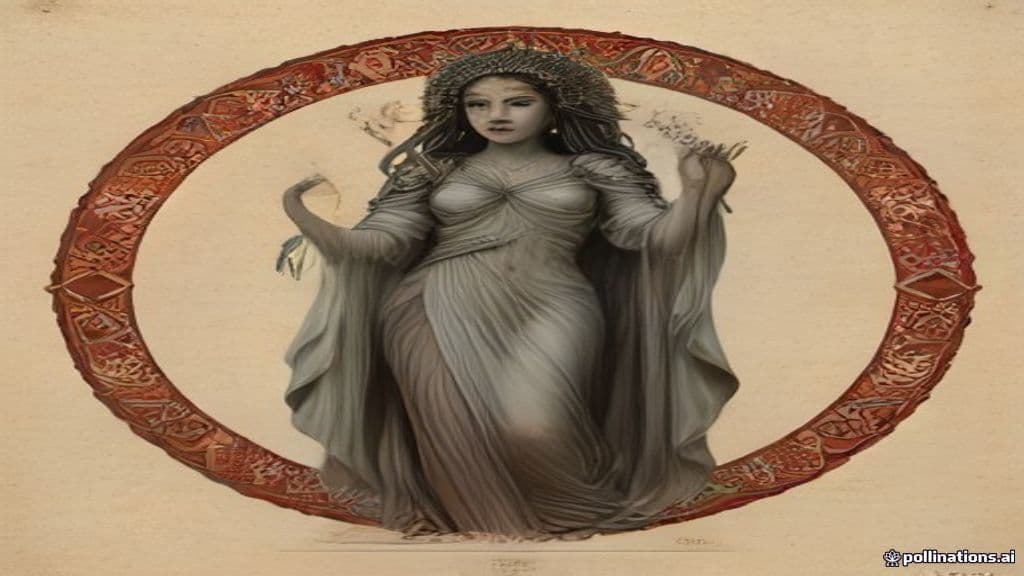
The supplied sources record three independent origins for the name Aedesia: (1) as an ancient Greek female personal name (Ancient Greek: Αἰδεσία) borne by a Neoplatonic philosopher of fifth‑century Alexandria; (2) as a Latinized botanical genus name, Aedesia O.Hoffm., published within modern taxonomic literature (accepted genus in Kew's Plants of the World Online); and (3) as a reused toponym/moon name in the Orion's Arm speculative encyclopedia (an image caption linking Hypatia and its moon Aedesia). The sources do not provide a mythic or legendary origin for the name and do not record any unifying etymology linking these uses.
Historical Aedesia: Biographical sources describe her as "celebrated for her beauty and her virtues," but do not supply detailed physical characteristics such as height, dress, or distinguishing marks. She is noted in narratives of the Neoplatonic circle as being received with distinction by contemporary philosophers (e.g., Proclus). Botanical Aedesia: The Plants of the World Online entry identifies the genus and its native range (W. Tropical Africa to Chad, including countries such as Benin, Burkina, Cameroon, Central African Republic, Chad) but the supplied excerpt does not include morphological descriptions (leaf form, flowers, habit). Fictional Aedesia: The Orion's Arm mention is an image caption naming a moon; no visual or physical description is provided in the excerpt.
Historical/social role: Sources attribute non‑supernatural social actions to Aedesia the woman — after her husband Hermias's death she devoted herself to relieving the wants of the distressed and to educating her children; she accompanied her son(s) to Athens so they could study with Proclus and was "received with great distinction" there. Botanical/fictional uses: The botanical entry gives only taxonomic and distributional information with no behavioral or ecological details in the supplied excerpt; the fictional use in Orion's Arm is a name reference only and supplies no powers or functions. No source attributes supernatural abilities or spirit behavior to any attested referent named Aedesia.
*Perkʷūnos
*Perkʷūnos is the reconstructed Proto-Indo-European thunder‑god hypothesized by comparative linguistics and mythology. Scholarly reconstructions portray him as a storm or thunder figure associated with fructifying rain and as the combatant who fights a multi‑headed water‑serpent to release life‑giving waters; no direct attestations from the Proto‑Indo‑European period survive and the figure is inferred from later Indo‑European traditions.
*Péh₂usōn (reconstructed)
Péh₂usōn is a hypothetical Proto‑Indo‑European pastoral guardian reconstructed by comparative scholars from parallels in Greek and Vedic traditions. Proposed as a Graeco‑Aryan ancestor‑figure, the reconstruction describes a protector of flocks, roads, and travellers rather than an attested historical cultic personality.
3-D Man
3-D Man is a Marvel Comics superhero identity associated with a 1950s-era origin in which the body of Chuck Chandler can materialize in three-dimensional existence when activated by his brother Hal via a pair of glasses. The mantle was later assumed by Delroy Garrett (formerly Triathlon) in modern continuity.
5 Ronin
5 Ronin is a 2011 Marvel Comics five-issue limited series that reimagines five Marvel superhero archetypes as rōnin (masterless samurai) in a fictionalized post‑Sekigahara feudal Japan. The work places Wolverine, Hulk, Punisher, Psylocke, and Deadpool analogues into period roles to explore displacement, revenge, and identity in an era of political upheaval.
57 Mnemosyne
57 Mnemosyne is a large main-belt asteroid (S-type) discovered in 1859 and named after the Greek Titaness Mnemosyne. It is a non-sentient astronomical body studied for its orbital and rotational properties and has been used in dynamical measurements related to Jupiter.
A Elbereth Gilthoniel
An Elvish hymn in Sindarin addressed to Elbereth (Varda) from J. R. R. Tolkien's legendarium. Presented in The Lord of the Rings and later musical and dramatic adaptations, the hymn functions as devotional poetic language that evokes Elvish reverence for the star-kindler rather than an independent supernatural agent.
A.R.G.U.S.
A.R.G.U.S. is a fictional clandestine United States government agency in the DC Comics universe that investigates, contains, and manages superhuman, meta-human, and supernatural incidents and assets. Introduced in The New 52 continuity, it functions as an institutional actor providing intelligence, logistical support, covert task forces (notably Task Force X / the Suicide Squad), and a dedicated magic division across comics and media adaptations.
Aamon
Aamon (also Amon) is a named spirit in early modern Western grimoire tradition (Pseudomonarchia Daemonum; the Ars Goetia / Lesser Key of Solomon). He is presented as a high-ranking infernal officer (Marquis/Prince) who governs forty legions and is credited with knowledge of past and future and with affecting human relationships (reconciling or procuring feuds and favor).
Abaddon
In Hebrew scripture Abaddon is primarily a noun meaning 'destruction' or a section/condition of the underworld paired with Sheol; in the New Testament Book of Revelation Abaddon is personified as an angelic figure (Greek Apollyon) described as the king of an army of locusts released from the abyss during the apocalypse.
Aban Yasht
The Aban Yasht is a hymn from the Persian tradition that praises Anahita, a goddess associated with water, fertility, and wisdom. It consists of 132 stanzas and is part of the 21 Yashts collection. (Note: - Power tier should be "Primordial" or possibly "Cosmic", given that it's a hymn of great spiritual significance and associated with a goddess. - The article incorrectly states that Anahita is associa)
Abath
No corroborated folkloric entity named "Abath" is documented in the provided sources. The string appears in the supplied material only as a surname/personal name in Aruban/Dutch-Caribbean archival records and as an unrelated taxonomic or encyclopedic hit; no mythic attributes, origin stories, rituals, or apotropaic practices for an entity called Abath are present in the documents reviewed.
Abatur
Abatur is an uthra (celestial emanation) in Mandaeism described as the 'father of the Uthras' and called the Ancient (ʿattīqā). He resides on the boundary between the World of Light and lower regions, functions as a judge who weighs souls (Abatur Muzania), and supplies instructions and materials to the demiurgic uthra Ptahil in accounts from the Diwan (Scroll) of Abatur.
Community Record
- [1]Aedesia — Wikipedia. Wikipedia contributors. "Aedesia." Wikipedia, The Free Encyclopedia.wiki
- [2]Ammonius (Stanford Encyclopedia of Philosophy). Stanford Encyclopedia of Philosophy. "Ammonius."academic
- [3]Ammonius (Stanford Encyclopedia of Philosophy — Plato entry). Stanford Encyclopedia of Philosophy / The Plato Project. "Ammonius."academic
- [4]Aedesia O.Hoffm. — Plants of the World Online (Kew). Kew Science. "Aedesia O.Hoffm." Plants of the World Online.academic
- [5]Rhakotis — Women of Antiquity (Rhakotis Magazine). Rhakotis. "Women of Antiquity / IWD2020."other
- [6]Orion's Arm — Encyclopedia Galactica: Hypatia. Orion's Arm. "Hypatia." (image caption references Aedesia)literary