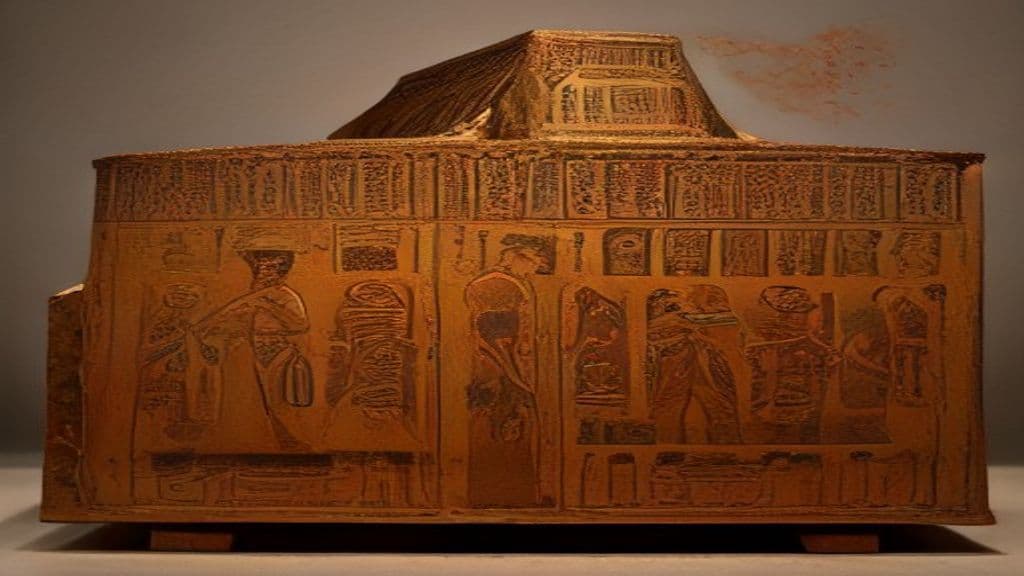
Historically Amenhotep I was the second pharaoh of Egypt's Eighteenth Dynasty, son of Ahmose I and Queen Ahmose-Nefertari, who ruled in the late 16th–early 15th century BCE according to competing chronologies (commonly cited ranges c. 1546–1526 BC or c. 1526–1506 BC). After his death he was absorbed into local Theban mortuary religion: over subsequent centuries his memory and portraiture were maintained and he was honored as a deified royal ancestor and patron of the workforce and community tied to royal tomb production at Deir el-Medina. This transition—from living sovereign with military campaigns and building activity to a localized funerary patron invoked in burial contexts—is attested in modern summaries and in archaeological objects that place his image among deified 18th‑Dynasty kings used for protection in the necropolis.
The supplied sources do not record a unique biographical portrait in prose; instead archaeological and coffin decoration show Amenhotep I rendered in standard royal funerary modes. For example, the Coffin of Bakenmut depicts back-to-back seated images of Amenhotep I grouped with other deified 18th‑Dynasty rulers. From that material context he is represented as a formal, seated royal figure within funerary iconography — the conventional pharaonic/mummiform imagery used in tombs and coffins — rather than as an individualized folkloric apparition. The sources provide no detailed facial description or distinctive costume elements unique to his cult beyond typical royal/funerary representation.
The sources do not attribute combative or occult powers to Amenhotep I in the manner of malicious spirits; rather they show a cultic, protective function. Modern summaries state that "after his death, he was deified as a patron god of Deir el-Medina," and the Coffin of Bakenmut places his images among funerary gods and protective spells. This indicates that in local Theban practice his presence was invoked as part of the protective and devotional program surrounding burial and the safety of tomb workers — effectively a patronal/protective role in mortuary contexts — but the sources do not record explicit supernatural abilities, miracle narratives, or spells uniquely ascribed to him.
Weaknesses
- otherNo specific weaknesses recorded in the provided sources; Amenhotep I is presented as a cultic/patron figure rather than a hostile spirit requiring countermeasures.
Wards
- symbolProtective spells and magical symbols on coffins
- otherDepiction or invocation of deified 18th‑Dynasty kings (including Amenhotep I) on funerary objects as part of the protective program
*Perkʷūnos
*Perkʷūnos is the reconstructed Proto-Indo-European thunder‑god hypothesized by comparative linguistics and mythology. Scholarly reconstructions portray him as a storm or thunder figure associated with fructifying rain and as the combatant who fights a multi‑headed water‑serpent to release life‑giving waters; no direct attestations from the Proto‑Indo‑European period survive and the figure is inferred from later Indo‑European traditions.
*Péh₂usōn (reconstructed)
Péh₂usōn is a hypothetical Proto‑Indo‑European pastoral guardian reconstructed by comparative scholars from parallels in Greek and Vedic traditions. Proposed as a Graeco‑Aryan ancestor‑figure, the reconstruction describes a protector of flocks, roads, and travellers rather than an attested historical cultic personality.
57 Mnemosyne
57 Mnemosyne is a large main-belt asteroid (S-type) discovered in 1859 and named after the Greek Titaness Mnemosyne. It is a non-sentient astronomical body studied for its orbital and rotational properties and has been used in dynamical measurements related to Jupiter.
Aani
Aani (ancient Egyptian jꜥnr) is the lexical term for the baboon in ancient Egyptian language and functions in religious contexts as an animal icon and theophoric epithet. Attested repeatedly in Egyptian texts and images, the baboon image is used to represent or denote aspects of gods such as Thoth, Hapy, Khonsu, and Osiris rather than implying the animal itself is an independent deity.
Aati
Aati (also rendered Ati) is one of the 42 judges of the dead in ancient Egyptian funerary literature, attested in the Book of the Dead tradition (notably the Papyrus of Nebsemy). Described as originating 'from Heliopolis', Aati's documented function is to question the deceased about a specific moral accusation during the Duat judgment; the funerary texts supply a formulaic denial the soul must recite.
Abaddon
In Hebrew scripture Abaddon is primarily a noun meaning 'destruction' or a section/condition of the underworld paired with Sheol; in the New Testament Book of Revelation Abaddon is personified as an angelic figure (Greek Apollyon) described as the king of an army of locusts released from the abyss during the apocalypse.
Abadiu of Antinoe
Abadiu of Antinoe was a fourth‑century bishop of Antinoe (Antinoopolis, in Roman Egypt) commemorated as a martyr and saint in the Coptic Orthodox Church, with a feast day on 26 December. Sources record that he was killed during a theological dispute with Arian opponents and reference him in collections of Egyptian martyrs.
Aban Yasht
The Aban Yasht is a hymn from the Persian tradition that praises Anahita, a goddess associated with water, fertility, and wisdom. It consists of 132 stanzas and is part of the 21 Yashts collection. (Note: - Power tier should be "Primordial" or possibly "Cosmic", given that it's a hymn of great spiritual significance and associated with a goddess. - The article incorrectly states that Anahita is associa)
Abaset
Abaset is a localized ancient Egyptian goddess attested in tomb decoration at El‑Bawiti in the Bahariya Oasis during the 26th Dynasty. She is depicted anthropomorphically with a hedgehog motif incorporated into her headdress and appears on the walls of Qarat Qasr Salim, including twice in the Tomb of Bannentiu. No cult texts, myth narratives, or ritual prescriptions for her are recorded in the cited corpus.
Abath
No corroborated folkloric entity named "Abath" is documented in the provided sources. The string appears in the supplied material only as a surname/personal name in Aruban/Dutch-Caribbean archival records and as an unrelated taxonomic or encyclopedic hit; no mythic attributes, origin stories, rituals, or apotropaic practices for an entity called Abath are present in the documents reviewed.
Abatur
Abatur is an uthra (celestial emanation) in Mandaeism described as the 'father of the Uthras' and called the Ancient (ʿattīqā). He resides on the boundary between the World of Light and lower regions, functions as a judge who weighs souls (Abatur Muzania), and supplies instructions and materials to the demiurgic uthra Ptahil in accounts from the Diwan (Scroll) of Abatur.
Abatwa (Twa / Batwa)
Abatwa (also recorded as Twa, Batwa, Mutwa; singular forms Barhwa or Murhwa in some transcriptions) are indigenous hunter‑gatherer peoples of the Great Lakes region of Central Africa, historically identified as some of the earliest inhabitants of the area. The available sources treat them as human ethnic groups whose livelihoods, lands, and populations have been severely affected by conservation policies and modern violence.
Community Record
- [1]Amenhotep I — Wikipedia. Wikipedia entry 'Amenhotep I' — summary of historical reign and posthumous deification as patron of Deir el-Medinawiki
- [2]Wikidata: Q157966 (Amenhotep I). Wikidata item for Amenhotep I — structured data on historical identity and identifiersother
- [3]Coffin of Bakenmut (Cleveland Museum description). Description of the Coffin of Bakenmut showing back-to-back seated images of Amenhotep I among deified 18th‑Dynasty kings and noting the crowded funerary scenes, protective spells, and magical symbols.academic
- [4]FIFAO 11: Le Temple Du Scribe Royal Amenhotep, Fils De Hapou (Robichon & Varille). Archive entry for FIFAO 11; cited in research notes though specific ritual contents for Amenhotep I are not quoted in the provided excerpts.academic
- [5]Amenhotep, l'élu des dieux (novel). Modern fictional treatment listed in archive results; not used for factual ritual claims in the provided notes.literary