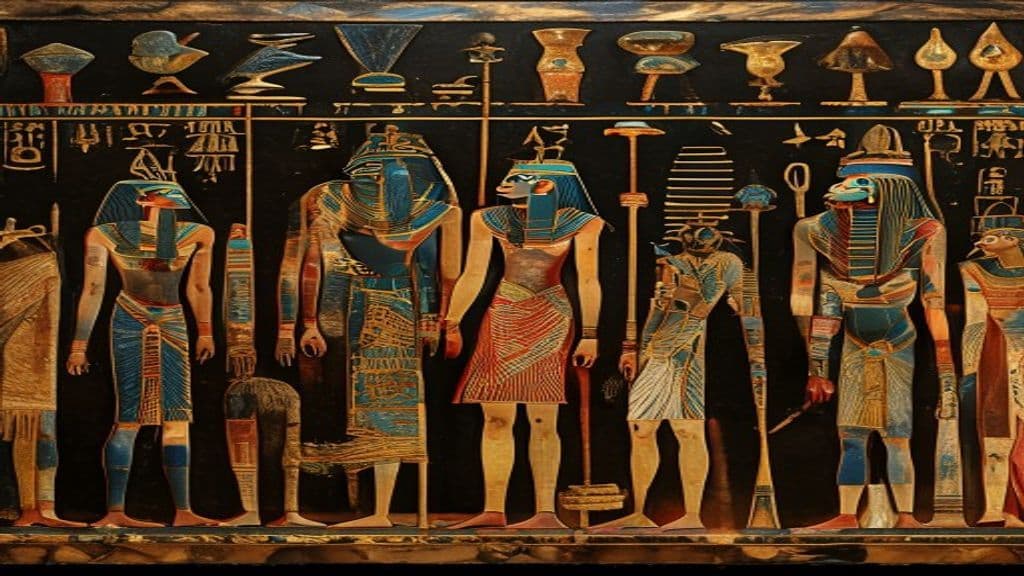
The category nṯr/nṯrt emerges in Predynastic and Early Dynastic Egypt and is attested in early written and ritual materials associated with the formation of pharaonic religion (early Dynastic and Old Kingdom corpus). Scholarly work frames deityhood functionally: a being qualifies as a deity when it has an ongoing cult, participates in aspects of the universe, and is described in myth or written tradition (Jan Assmann's working definition as summarized in the sources). Over historical periods particular deities rose or declined in prominence (for example Ra and Amun as state gods and the Aten in the 14th century BCE).
Egyptian deities are represented with diverse, symbolic iconography: as humans, animals, hybrids (human bodies with animal heads), objects and personified concepts. Hieroglyphic determinatives used to write nṯr/nṯrt — most commonly a flag on a pole, and alternately a falcon, a seated deity sign, an egg (for some feminine forms), or a cobra — reflect and inform visual and symbolic identifications in art and temple display. Distinctive headdresses and animal emblems (e.g., falcon imagery for Horus, jackal associations for Anubis, the Set animal for Set) serve as identifying markers of function and affiliation.
Deities embody and influence natural forces and phenomena and act in cosmological roles such as creation, the solar cycle, kingship legitimization, and afterlife processes (for example solar deities like Ra and creator/kingly roles attributed to Amun; funerary deities associated with resurrection motifs like Osiris in broader literature). Their influence is mediated by ritual: Egyptians petitioned, compelled, and maintained gods' actions through prayers, offerings, and temple rites. Mythic narratives describe family ties, hierarchies, and syncretisms that shape specific deity behaviors and powers; functions vary by deity and historical context.
Weaknesses
- conditionDependence on cult and ritual upkeep
- otherInfluence mediated and constrained by maat and institutional roles (pharaoh/temple)
Wards
- ritualRegular temple cult and offerings
- ritualFunerary rites and funerary literature (Pyramid Texts, Coffin Texts, Book of the Dead) as procedures for transforming deceased into divine-like status and securing afterlife protections
Anansi
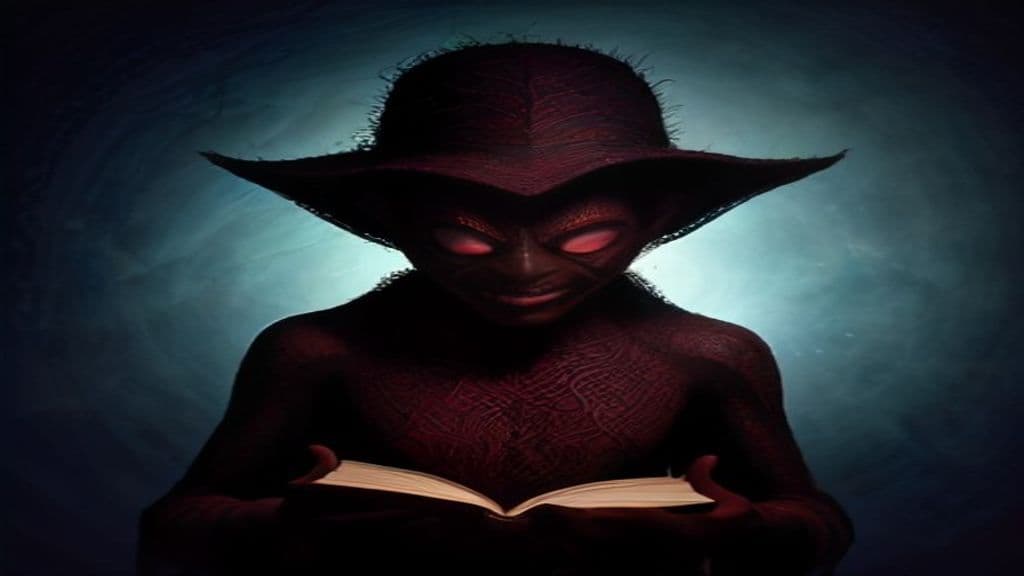
The spider trickster god of Akan folklore — cunning, mischievous, and wise. Keeper of stories and teacher of human beings, brought through the slave trade into Caribbean and African-American tradition.
Anansi
The spider trickster god of Akan folklore — cunning, mischievous, and wise. Keeper of stories and teacher of human beings, brought through the slave trade into Caribbean and African-American tradition.
*Perkʷūnos
*Perkʷūnos is the reconstructed Proto-Indo-European thunder‑god hypothesized by comparative linguistics and mythology. Scholarly reconstructions portray him as a storm or thunder figure associated with fructifying rain and as the combatant who fights a multi‑headed water‑serpent to release life‑giving waters; no direct attestations from the Proto‑Indo‑European period survive and the figure is inferred from later Indo‑European traditions.
*Péh₂usōn (reconstructed)
Péh₂usōn is a hypothetical Proto‑Indo‑European pastoral guardian reconstructed by comparative scholars from parallels in Greek and Vedic traditions. Proposed as a Graeco‑Aryan ancestor‑figure, the reconstruction describes a protector of flocks, roads, and travellers rather than an attested historical cultic personality.
57 Mnemosyne
57 Mnemosyne is a large main-belt asteroid (S-type) discovered in 1859 and named after the Greek Titaness Mnemosyne. It is a non-sentient astronomical body studied for its orbital and rotational properties and has been used in dynamical measurements related to Jupiter.
Aani
Aani (ancient Egyptian jꜥnr) is the lexical term for the baboon in ancient Egyptian language and functions in religious contexts as an animal icon and theophoric epithet. Attested repeatedly in Egyptian texts and images, the baboon image is used to represent or denote aspects of gods such as Thoth, Hapy, Khonsu, and Osiris rather than implying the animal itself is an independent deity.
Aati
Aati (also rendered Ati) is one of the 42 judges of the dead in ancient Egyptian funerary literature, attested in the Book of the Dead tradition (notably the Papyrus of Nebsemy). Described as originating 'from Heliopolis', Aati's documented function is to question the deceased about a specific moral accusation during the Duat judgment; the funerary texts supply a formulaic denial the soul must recite.
Abaddon
In Hebrew scripture Abaddon is primarily a noun meaning 'destruction' or a section/condition of the underworld paired with Sheol; in the New Testament Book of Revelation Abaddon is personified as an angelic figure (Greek Apollyon) described as the king of an army of locusts released from the abyss during the apocalypse.
Abadiu of Antinoe
Abadiu of Antinoe was a fourth‑century bishop of Antinoe (Antinoopolis, in Roman Egypt) commemorated as a martyr and saint in the Coptic Orthodox Church, with a feast day on 26 December. Sources record that he was killed during a theological dispute with Arian opponents and reference him in collections of Egyptian martyrs.
Aban Yasht
The Aban Yasht is a hymn from the Persian tradition that praises Anahita, a goddess associated with water, fertility, and wisdom. It consists of 132 stanzas and is part of the 21 Yashts collection. (Note: - Power tier should be "Primordial" or possibly "Cosmic", given that it's a hymn of great spiritual significance and associated with a goddess. - The article incorrectly states that Anahita is associa)
Abaset
Abaset is a localized ancient Egyptian goddess attested in tomb decoration at El‑Bawiti in the Bahariya Oasis during the 26th Dynasty. She is depicted anthropomorphically with a hedgehog motif incorporated into her headdress and appears on the walls of Qarat Qasr Salim, including twice in the Tomb of Bannentiu. No cult texts, myth narratives, or ritual prescriptions for her are recorded in the cited corpus.
Abath
No corroborated folkloric entity named "Abath" is documented in the provided sources. The string appears in the supplied material only as a surname/personal name in Aruban/Dutch-Caribbean archival records and as an unrelated taxonomic or encyclopedic hit; no mythic attributes, origin stories, rituals, or apotropaic practices for an entity called Abath are present in the documents reviewed.
Abatur
Abatur is an uthra (celestial emanation) in Mandaeism described as the 'father of the Uthras' and called the Ancient (ʿattīqā). He resides on the boundary between the World of Light and lower regions, functions as a judge who weighs souls (Abatur Muzania), and supplies instructions and materials to the demiurgic uthra Ptahil in accounts from the Diwan (Scroll) of Abatur.
Abatwa (Twa / Batwa)
Abatwa (also recorded as Twa, Batwa, Mutwa; singular forms Barhwa or Murhwa in some transcriptions) are indigenous hunter‑gatherer peoples of the Great Lakes region of Central Africa, historically identified as some of the earliest inhabitants of the area. The available sources treat them as human ethnic groups whose livelihoods, lands, and populations have been severely affected by conservation policies and modern violence.
Community Record
- [1]Ancient Egyptian deities - Wikipedia. Wikipedia contributors, 'Ancient Egyptian deities', Wikipedia, The Free Encyclopediawiki
- [2]Ancient Egyptian deity - Wikidata. Wikidata entry Q146083, 'Ancient Egyptian deity'wiki
- [3]The God Log: Egyptian Gods. The God Log (podcast episode), Archive.orgother
- [4]Headdresses of the Ancient Egyptian Deities. Headdresses overview (iconography notes), online resourceother
- [5]Gods and Monkeys (ep. 181) — Archive. Archive podcast episode referenced for comparative motifsother
- [6]The Werewolf: Lycanthropy and Cynocephaly — Archive. Archive episode on cynocephaly referenced for dog-headed deity comparisonsother