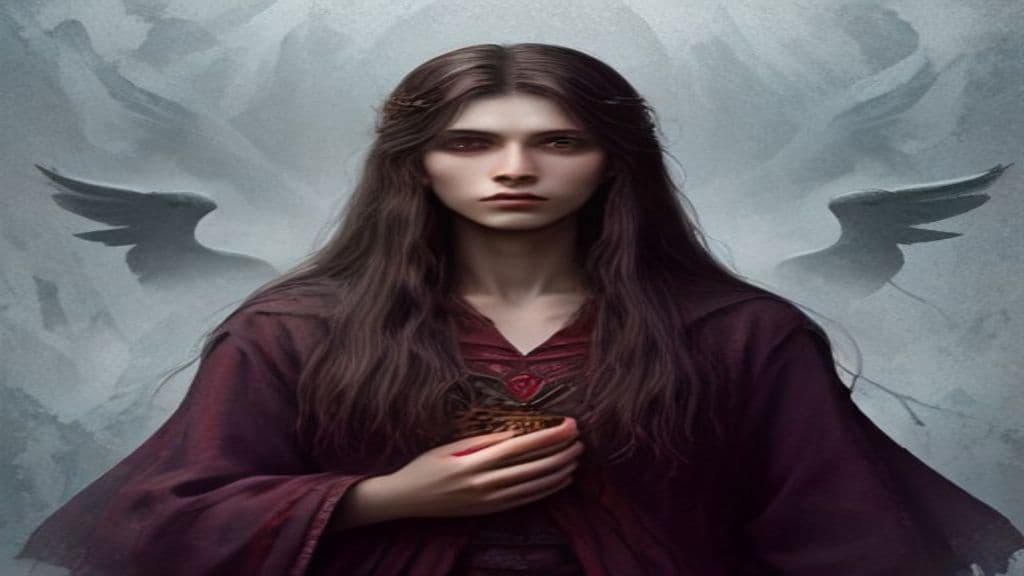
Auseklis does not have a single coherent origin narrative in the surviving material; his identity is reconstructed from recurring motifs in Latvian dainas and later scholarly synthesis. From those motifs he emerges as a named youthful member of the heavenly household—one of the Dieva dēli—linked etymologically to the dawn (root aus- + suffix -eklis) and situated in comparative Indo‑European frameworks of dawn/stellar personifications.
Surviving sources characterize Auseklis primarily by age and emblematic representation rather than detailed anthropomorphic features: he is described as 'very young' in the daina-derived tradition and in scholarly summaries. Iconographically his name is attached to an eight-pointed isogonal star (octagram) that functions as his visual emblem. Narrative motifs also associate him with a horse, described in some accounts as bought by him or given to him by the Sun, indicating a companion animal in story contexts.
Dainas and scholarly summaries attribute to Auseklis social and ritualized functions among sky beings rather than overtly hostile supernatural powers. He acts as an attendant to the Sun deity (Saule), helper in the so-called 'heavenly bath house', and a suitor/participant in the 'celestial wedding' drama—sometimes competing with Mēness (the Moon) over the Sun's daughter. Sources do not ascribe to him traditions of possession, explicit harmful magic, shapeshifting, or direct attacks on humans; the emphasis is on familial, courtship, and household roles within the mythic sky.
Weaknesses
- otherNo specific weaknesses recorded in available sources
Wards
- symbolEight-pointed star (Auseklis octagram) — emblem associated with Auseklis; documented usage as one of the protective 'crosses' drawn against the malevolent spirit Lietuvēns (drawn without lifting the hand).
- symbolPentagram — recorded alongside the Auseklis octagram as another protective sign used against Lietuvēns (also to be drawn without lifting the hand).
Aitvaras
Aitvaras is a Baltic (primarily Lithuanian) household/nature spirit that, according to available summaries, lodges in homes and provides its household with material goods—often described as stolen gold and grain—while also bringing misfortune or trouble. It is variously described as a rooster- or chicken-like bird indoors and as a dragon-like or serpentine bird outdoors, often with fiery/meteor imagery.
Alatyr
A sacred world-stone in East Slavic and wider Slavic folklore, described as the "father to all stones" and the "navel of the earth." Located at the world's center (often on Buyan island), it is associated with a miraculous spring, sacred letters, healing properties, and liminality between the human world and other realms.
Alka
Alka (plural alkas) is a class of sacred natural places in pre-Christian Baltic religion—Latvian and Lithuanian—functioning as set-apart cult sites where offerings and sacrifices were made. Treated as holy ground rather than a single anthropomorphic spirit, alkas served as loci connecting communities with ancestors and otherworldly realms and frequently appear in toponyms across the Baltic landscape.
Aušrinė
Aušrinė is the Lithuanian personification and deity of the morning star (planet Venus) in traditional Baltic cosmology. She is a feminine liminal figure associated with dawn, beauty, youth, love, health and renewal who appears each morning to prepare the way for Saulė (the Sun).
Ašvieniai
Ašvieniai are the paired divine twins of Baltic (particularly Lithuanian) tradition, horse-associated celestial beings who pull the chariot of Saulė (the Sun) across the sky and appear as protective little horses used as apotropaic motifs in vernacular architecture and household objects.
Bangpūtys
Bangpūtys is a reconstructed masculine sea-and-storm deity from Lithuanian mythology. Known from very scanty sources, modern mythologists portray him as an austere, vindictive master of winds and the sea and as the reconstructed father-figure of the cardinal wind-gods.
Black cat
A domestic cat with black fur that functions both as an ordinary companion animal and as a versatile folkloric symbol. In many traditions it is an omen of good or bad fortune, is associated with witches and seafaring luck, and has been repurposed in modern political and cultural symbolism.
Dievas
Dievas (Lithuanian; Dievs in Latvian; Diews in Old Prussian) is the primordial supreme sky deity in Baltic religion, understood as the luminous sky-dome, a creator and ruler of gods, and a god of light, prosperity and time. The lexeme is a Baltic reflex of Proto-Indo-European *Dyēus and, following Christianization, the same word came to denote the Christian God.
Dievs (Dievas)
Dievs (Latvian Dievs; Lithuanian Dievas) is the primordial sky‑father of the Baltic traditional pantheon, presented in sources as a supreme luminous sky power, creator and ruler of the gods, and associated with light, prosperity, and cosmic order. The theonym survives in modern Latvian language and civic/religious usage but the supplied corpus gives little on specific myths, iconography, or ritual praxis tied to the pre‑Christian figure.
Eglė the Queen of Serpents (Žilvinas)
A central figure of a Lithuanian folktale in which a speaking serpentine ruler—called the grass-snake/serpent prince Žilvinas—marries the human maiden Eglė, keeps an underwater palace and household, can be summoned by a secret chant, and whose story culminates in human→tree metamorphoses after betrayal.
Gabija
Gabija is the Lithuanian household fire spirit and protector of the hearth and family. Treated as a living presence in the home, she is cared for through routine domestic practices (feeding, covering embers, providing water) and is held responsible in folklore for wandering or destructive fires when offended or neglected.
Jumala
Jumala is a divine name and concept in Finnic and some Volga‑Finnic language communities, referring both to pre‑Christian sky‑deity figures (often associated with sky, thunder, storms and fertility) and, after Christianization, to the Christian God as the ordinary word for 'God'. It functions variably as a proper name, a generic term for deity, or the designation of local sky gods in regional traditions.
Community Record
- [1]Auseklis (Wikipedia). Wikipedia contributors. 'Auseklis.' Wikipedia, The Free Encyclopedia.wiki
- [2]SOVIET MERCHANT SHIPS (SANITIZED): CIA reading room document (mentions ship named AUSEKLIS). Central Intelligence Agency (declassified list), archive entry noting a merchant ship named AUSEKLIS (1954).other
- [3]Lastångfartyget AUSEKLIS av Riga liggande i Limhamn i aug. 1951 (archive photo listing). Archive photographic listing for a ship named AUSEKLIS (1951).other
- [4]Latvian Folk Symbols Cookie-Cutters (Thingiverse/Archive note). Archive entry referencing Latvian folk symbols including the octagram associated with Auseklis.other