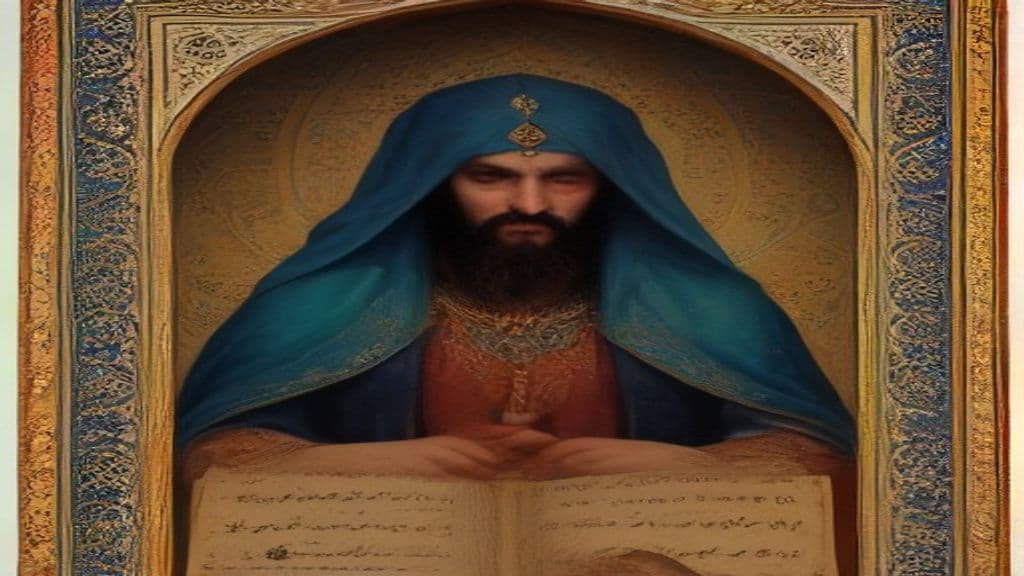
Sources present Bozorgmehr as a member of the noble House of Karen (a Parthian/Arsacid noble lineage) and style him with the patronymic -i Bōkhtagān ('son of Bokhtagan') in Middle Persian. The name has theophoric readings in some epigraphic material (e.g., Dadburzmihr, 'given by the high Mihr'), which scholars cite as evidence of onomastic links to Mihr/Mithra devotion in his clan; however, sources treat him as a historical courtier and do not offer a mythic cosmogonic origin.
The provided sources do not supply a physical or supernatural portrait of Bozorgmehr. He is attested in textual sources (Aydāgār ī Wuzurgmihr and later Persian and Arabic works) and on seals where administrative and military titulature appears; one seal-style attestation records him styling himself with Parthian/aspbed terminology (linked to the office of spahbed). Beyond such documentary styling, no consistent iconographic description or supernatural appearance is given in the cited materials.
Cited sources attribute to Bozorgmehr the offices and functions of a high Sasanian dignitary: wuzurg framadār (grand minister) under Kavad I and Khosrow I; spahbed (military commander) of the kust of Khwarasan under Khosrow I and continued service under Hormizd IV in some accounts. He is credited with political counsel (for example, persuading Kavad to abolish certain taxes on fruit and grain in one report) and with authoring several Middle Persian treatises, most notably the Wizārišn ī čatrang ('Treatise on Chess' / Chatrang Nama) and other works cited in medieval sources and tradition. Later literary traditions preserve divergent narrative episodes about his relations with kings (pardon, execution), but these are presented as literary variations rather than uniform historical fact.
A'ra
No reliable sources in the supplied material establish A'ra as a distinct supernatural entity. The token "A'ra" appears in the dataset as (a) part of general references to pre-Islamic Arabian deities, (b) a modern Korean female given name (A-ra/아라), and (c) an Arabic toponym (A'ra, one village merged into Ar'ara).
Ab-Zohr
Ab-Zohr is the culminating rite of the Zoroastrian Yasna service: a formal offering to the waters (Aban/Apas) that creates the consecrated liquid parahaoma and functions to purify, strengthen, and atone for damage done to waters. It is a ritual action rather than an independent supernatural being.
Aban (Āb/Ābān)
Aban (Avestan apas; Middle Persian āb/ābān) is the collective, sacred principle of the waters in Zoroastrian cosmology — both the element water and its personified hypostases (the Apas/Ahuranis). Aban functions as a primordial, life-giving creation, a calendrical and liturgical focus (day-name, month-name, Abanagan feast), and a ritual object of veneration (ape zaothra, Aban Yasht) rather than a malign force to be expelled.
Aban Yasht
The Aban Yasht is a hymn from the Persian tradition that praises Anahita, a goddess associated with water, fertility, and wisdom. It consists of 132 stanzas and is part of the 21 Yashts collection. (Note: - Power tier should be "Primordial" or possibly "Cosmic", given that it's a hymn of great spiritual significance and associated with a goddess. - The article incorrectly states that Anahita is associa)
Abgal
Abgal (Arabic: أبغال) is a pre‑Islamic local tutelary figure attested in the Palmyrene cultural sphere (c. 154–270 AD), primarily venerated by nomadic Arab groups in the Syrian desert. He appears in inscriptions and reliefs as one of a constellation of armed, mounted protective deities associated with caravan and nomadic protection, though no ritual texts survive in the cited sources.
Abtin
Abtin (Persian: آبتین), attested also as Athwya, is a mythic ancestral figure in Iranian tradition described in Avestan and later epic literature as one of a small set of formative human-like figures involved in preparing the corporeal world and as the father of the epic hero-king Fereydun in the Shahnama.
Adur Burzen-Mihr
Adur Burzen-Mihr is a consecrated Atash Behram — one of the three Great Fires of late antique Sasanian Zoroastrianism — historically associated with the farmer social estate and with a cultic location in northeastern Iran. Medieval texts (e.g., the Bundahishn) and later summaries record it as a major pilgrimage fire with legendary associations of protection and miraculous efficacy; its documentary history after the early Islamic period is unclear.
Adur Farnbag
Adur Farnbag is one of the three Great or Royal fires in the Zoroastrian ritual/topographical system of pre‑Islamic Iran. Presented in the sources as a continuously tended sacred fire housed in a temple, it is attested in secondary accounts as a focus of cultic activity, miracle stories, and association with elite ritual geography in the Parthian–Sasanian eras.
Adur Gushnasp
Adur Gushnasp (Middle Persian: Ādur ī Gušnasp; New Persian: Āzargušnasp) is a pre-Islamic Zoroastrian Great Fire — one of the three highest grade sacred temple fires (Atash Behram) of Sasanian-era Iran. Housed at the temple-site historically called Shiz (modern Takht-e Soleymān, Adurbadagan), it functioned as a continuously tended cultic fire, a pilgrimage destination, and a focal point of royal patronage and warrior-class identity.
Aeshma
Aeshma is the Zoroastrian hypostasis of wrath — a fiendish being who personifies rage and functions as an ontological opponent to Ahuric principles and ritual discipline. In scripture and later tradition he distracts worship, foments violence and drunkenness, can be driven off by prayer or by divine agents such as Sraosha and Mithra, and will be overthrown or flee at the final renovation.
Afrasiab
Afrasiab is the legendary king and arch-enemy of Iran in Iranian epic and Zoroastrian-influenced tradition. Attested from the Avestan Fraŋrasyan through Middle Persian and the Shahnameh, he functions as a powerful Turanian ruler associated with sorcery, subterranean dwellings, and opposition to Iranian heroes and divine agencies.
Aghrirat
Aghrirat is a named Turanian noble and peacemaker in the Shahnameh and Iranian mythic tradition, presented as a son of Pashang and brother of Afrasiab and Garsivaz. He is notable for his kind and gentle character and for attempting, largely unsuccessfully, to end the hostilities between Iran and Turan.
Community Record
- [1]Bozorgmehr. Wikipedia: Bozorgmehr (summary of historical and literary attestations, name forms, offices, and attributed works)wiki
- [2]Wikidata entry for Bozorgmehr. Wikidata: Q3780281 (identifier and linked attestations)other
- [3]Aydāgār ī Wuzurgmihr and later Persian/Arabic references. Summary noting early reference in the Aydāgār ī Wuzurgmihr and later mentions in the Shahnameh, al-Tha'alibi, and al-Masudiliterary