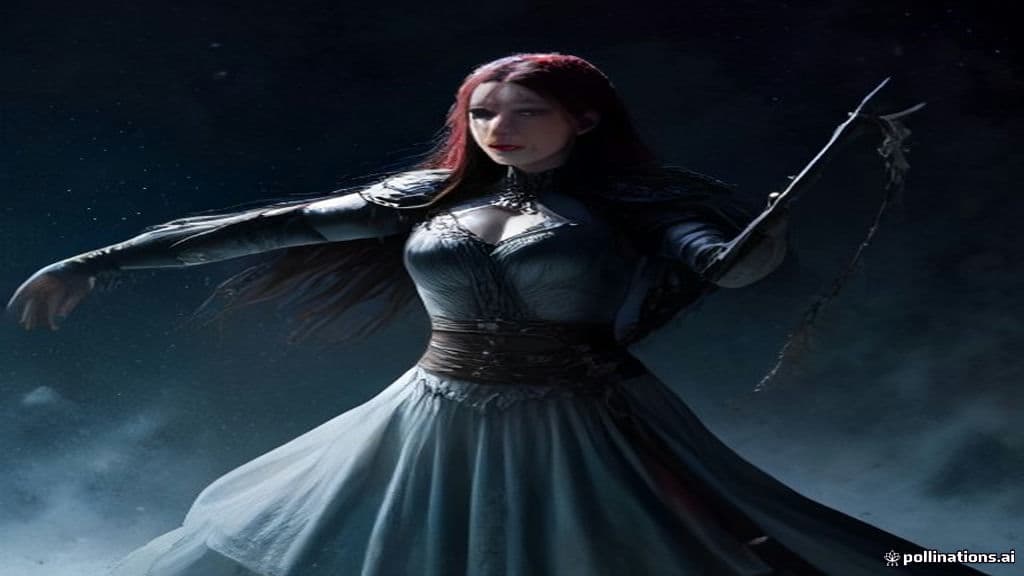
Brünnhilde is a legendary hero in Germanic folklore, from Germanic Europe. Brünnhilde (also Brunhild, Brunhilda, Brynhild) is a central female figure of Germanic heroic legend who was later adapted as a principal dramatic character in Richard Wagner’s operatic Ring cycle. Sources supplied treat her as an individual legendary/heroic heroine rather than as a regularly classified supernatural species; one scholarly note links her possible origin to the historical Visigothic queen Brunhilda of Austrasia.
Within the supplied materials Brünnhilde appears as a female character of Germanic heroic legend; the brief encyclopedic note provided explicitly states she 'may have her origins in the Visigothic princess and queen Brunhilda of Austrasia.' The available sources do not offer a single canonical prehistoric cosmogony or a full philological derivation; instead they record a figure transmitted through legendary narrative and later reshaped and popularized by 19th–20th century artistic adaptation, most notably Richard Wagner’s Der Ring des Nibelungen as preserved in mid-20th-century performance recordings.
The provided sources do not supply a consistent primary-text physical description from the legendary corpus. Modern visual portrayals of Brünnhilde are chiefly known through stage practice and recordings: the supplied archival cast lists and recordings identify performers (for example Martha Mödl as Brünnhilde in a 1953 EMI live broadcast conducted by Wilhelm Furtwängler, and Max Lorenz in recorded excerpts), indicating varied theatrical depictions across productions rather than a single canonical appearance in the documentary set.
The documents available for this entry do not enumerate specific supernatural powers or routine magical behaviors for Brünnhilde. They present her as a named central character in Germanic legend and as a dramatic protagonist in Wagner’s operas; beyond her narrative importance, no consistent list of abilities, magic, or cosmological role is provided in the supplied materials.
3-D Man
3-D Man is a Marvel Comics superhero identity associated with a 1950s-era origin in which the body of Chuck Chandler can materialize in three-dimensional existence when activated by his brother Hal via a pair of glasses. The mantle was later assumed by Delroy Garrett (formerly Triathlon) in modern continuity.
5 Ronin
5 Ronin is a 2011 Marvel Comics five-issue limited series that reimagines five Marvel superhero archetypes as rōnin (masterless samurai) in a fictionalized post‑Sekigahara feudal Japan. The work places Wolverine, Hulk, Punisher, Psylocke, and Deadpool analogues into period roles to explore displacement, revenge, and identity in an era of political upheaval.
A Elbereth Gilthoniel
An Elvish hymn in Sindarin addressed to Elbereth (Varda) from J. R. R. Tolkien's legendarium. Presented in The Lord of the Rings and later musical and dramatic adaptations, the hymn functions as devotional poetic language that evokes Elvish reverence for the star-kindler rather than an independent supernatural agent.
A.R.G.U.S.
A.R.G.U.S. is a fictional clandestine United States government agency in the DC Comics universe that investigates, contains, and manages superhuman, meta-human, and supernatural incidents and assets. Introduced in The New 52 continuity, it functions as an institutional actor providing intelligence, logistical support, covert task forces (notably Task Force X / the Suicide Squad), and a dedicated magic division across comics and media adaptations.
Abin Sur
Abin Sur is a fictional extraterrestrial Green Lantern from the planet Ungara in DC Comics. A former history professor turned Green Lantern of Space Sector 2814, he discovered and investigated a prophecy tied to the "Blackest Night," died wounded on Earth and chose Hal Jordan as his ring-successor, and was later reanimated as a Black Lantern in the Blackest Night storyline.
Abraun
Abraun is an attested name in German-language plant-legend scholarship (Der abraun, ein beitrag zur pflanzensagenkunde, 1916) and a short database entry (Wikidata) labels it as a spirit from German mythology. Surviving accessible documentation is extremely limited: the principal academic treatment is a 1916 contribution to pflanzensagenkunde (plant-saga studies), but the excerpts available here contain only bibliographic metadata and do not record tales, descriptions, or rituals.
Absolute Green Lantern (tradition)
A modern comic-book reinterpretation in DC's Absolute Universe in which a giant green lantern-shaped vessel appears above Evergreen, Nevada, generates an impenetrable green dome, judges townspeople and sends the judged into the Lantern to await further adjudication in OA (Omega‑Alpha). The story reframes Green Lantern mythos as cosmic/religious horror with an "Enlightenment Spectrum" of flames (Qard, Rao, Sur, Aur) stewarded by Oans such as Abin Sur.
Absorbing Man
A fictional Marvel Comics character (Carl "Crusher" Creel) whose body acquires the physical properties of materials or energies he touches. Debuting in Journey into Mystery #114 (March 1965), created by Stan Lee and Jack Kirby, he is presented as a mortal supervillain/occasional antihero who challenges heroes such as Thor, Hulk, Spider-Man, and the Avengers.
Ace West
Ace West (Wallace Daniel "Ace" West) is a contemporary American comic-book character in DC Comics continuity, a young speedster who channels the metaphysical Speed Force and occupies legacy-hero roles such as Kid Flash and Ace. Introduced in New 52-era stories as a biracial reinterpretation of Wally West and later retconned in DC Rebirth as a distinct Wallace West, son of Daniel West (Reverse-Flash), he appears across present-day and alternate/future timelines and participates in team and sacrifice narratives tied to the Speed Force.
Acheron
Acheron is a mythological river of the Ancient Greek Underworld, portrayed in classical literature as a boundary or entrance to Hades across which the dead are conveyed. It is also a real river in Epirus whose landscape and nearby cult sites (notably a Necromanteion) were mapped onto the literary river; later Western authors use Acheron metonymically for Hell or the infernal realm.
Achilles and Patroclus
A central heroic dyad in the Homeric Trojan War tradition: two mortal Greek warriors whose close bond—portrayed as deep companionship in the Iliad—drives key events of the epic when Patroclus' death provokes Achilles' rage, return to battle, and the slaying of Hector.
Acoetes
Acoetes is a proper name applied to multiple mortal figures in classical Greco‑Roman mythic narratives. Most famously, an Acoetes is a fisherman who recognizes and testifies to the divinity of Bacchus/Dionysus and recounts how blasphemous sailors were transformed into dolphins; other bearers of the name appear as a Trojan genealogical figure (father of Laocoön), an aged former squire of Evander, and a frightened soldier in Statius' Thebaid.
Community Record
- [1]Brunhild (Wikipedia). Wikipedia: 'Brunhild, also known as Brunhilda or Brynhild, is a female character from Germanic heroic legend. She may have her origins in the Visigothic princess and queen Brunhilda of Austrasia.'wiki
- [2]Wikidata entry Q131468628. Wikidata label entry (noted in research notes as incongruent: 'famous cat').other
- [3]Götterdämmerung: Prologue-Act I (archive recording track listing). Archive track listing: includes 'Gotterdammerung "Brunnhilde, heilige Braut!' (Max Lorenz)'.other
- [4]Götterdämmerung live broadcast recording (EMI, Nov. 20, 1953). Recording credits listing Martha Mödl as Brünnhilde; Ludwig Suthaus (Siegfried); Alfred Poell (Gunther); Josef Greindl (Hagen); Sena Jurinac (Gutrune); RAI Rome Symphony Orchestra; Wilhelm Furtwängler, cond. EMI, live broadcast recording, Nov. 20, 1953.other
- [5]Vocal Archives: Max Lorenz 1942-1944. Archive set including recordings where Brünnhilde excerpts are documented (noting performers and production contexts).other