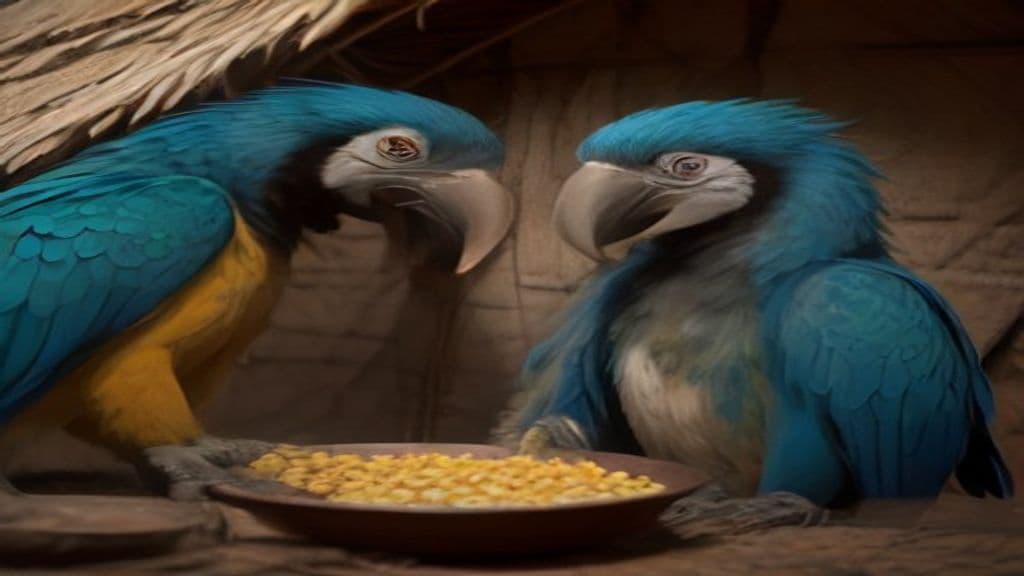
The ethnonym Cañari (Kichwa: Kañari) is reported in available sources to derive from kan (“snake”) and ara (“macaw”), explanations that either read the name literally as indicating ancestral identity with those animals or indicate that snakes and macaws were considered sacred and emblematic in Cañari material culture and stories. Separately, Cañari oral tradition as recorded in secondary summaries contains a flood myth: after a great deluge two brothers survived on a high mountain; later their repaired hut was found provisioned each day by two female beings with macaw faces, and one brother married the younger of these macaw‑faced women, whose offspring repopulated the world. The sources treat the macaw‑faced women as figures within Cañari myth rather than equating the ethnonym itself with a single named spirit (Wikipedia: "Cañari"; Cañari language entry).
The only explicit mythic appearance attested in the provided sources is that of two female beings described as having macaw faces while otherwise acting in human‑like ways (preparing food, repairing a hut, entering into marriage with a human). Beyond this episode, the corpus contains no consistent iconography or morphological description of a singular supernatural being called "Cañari," and no other consistent physical traits are recorded in the supplied materials (Wikipedia: "Cañari").
Within the flood myth episode preserved in secondary summaries, the macaw‑faced female beings repaired the brothers' hut and stocked it with prepared food each day, enabling survival; one such being married a human survivor, and their progeny repopulated the world. No wider catalogue of powers, recurring behaviors, magical capacities, or standardized interactions for an entity named "Cañari" is attested in the provided sources.
Aguano
Aguano is an ethnonym for an indigenous people of Peru (also recorded as Awano, Ahuano, Hilaca, Uguano, Aguanu, Santacrucino, Tibilo). Sources identify them as inhabitants of riverine areas of the Huallaga, Samiria and Marañón and note demographic collapse after European contact; the provided materials do not document Aguano as a supernatural being.
Aiapæc (Ai Apaec)
Aiapæc (Colonial Mochica: aiapæc, aiapäk) is a prominent mythological figure identified in Moche (Mochica) iconography. Scholarly reconstructions present Aiapæc as a powerful provider and protector associated with mountains, water, food and military success, and also as a feared punitive recipient of offerings including human heads; the exact rank and identity of the figure within pre‑Hispanic Moche religion is debated in the secondary literature.
Amaru (Inca mythology)
In Inca tradition, Amaru is a double-headed serpent representing infinity, knowledge, and cosmic renewal, with the ability to traverse worlds. (Note: - Power tier should be Ancient (Amaru's abilities suggest a deity-level power) - Origin story is missing - Wards and weaknesses are not mentioned in the source material, so they should be removed or r)
Apu
In Andean (Inca-era and continuing) belief, an apu is the spirit of a mountain or a solitary rock, conceived as a localized, often anthropomorphic guardian presence associated with a particular peak or notable stone in Peru, Ecuador, and Bolivia.
Apu Illapu
Apu Illapu (also Illapa, Ilyapa, Ilyap'a, Iyapa) is a major Inca deity associated with thunder, lightning, rain and other atmospheric phenomena. He was invoked in agricultural contexts and during drought; temples, pilgrimages, prayers and sacrifices were offered to secure his favor or to halt destructive storms.
Atoq (Andean fox spirit) — Untested attestation
Atoq is presented in some modern summaries as an 'Andean fox spirit' associated with Inca-related material, but the single provided source (a general overview of Inca mythology) does not itself attest specific information about Atoq. This entry therefore limits claims to what the supplied source supports and notes absent evidence where appropriate.
Ayar Anca (unconfirmed)
Ayar Anca is a queried name for which no direct attestation appears in the supplied source corpus. The materials provided document Inca creation and founding figures (e.g., Viracocha, Manco Cápac, Mama Ocllo) and note variant traditions; within that context the name Ayar Anca is not found and must be treated as unconfirmed pending primary-source evidence.
Ayar Auca
Ayar Auca is named in modern accounts as one of the Ayar siblings in the Inca origin cycle who emerge from the cave at Paqariq Tampu; in the provided sources he appears as a member of the founding-ancestor group rather than as a separately detailed supernatural class.
Ayar Cachi
In Inca mythology, Ayar Cachi is one of the brothers of Manco Cápac and a significant figure in the origin myth of the Incas. (Note: 1. Power tier: Lower to Ancient (deity-level) since Ayar Cachi is described as one of Manco Cápac's brothers and shares an origin myth, but does not appear to possess cosmic powers. 2. Abilities: The )
Ayar Uchu
Ayar Uchu is a name that appears in at least one modern web listing as an 'Inca God of Mystery' but lacks corroboration in the supplied primary and reference sources. There is no reliable ethnographic or classical mythic documentation for an entity by this exact name in the provided materials.
Aymara people (tradition)
Aymara cultural and ritual traditions of the high Andean Altiplano centering on long-term place-based continuity (Lake Titicaca, Tiwanaku), ancestor mortuary practices (chullpas), oral and musical repertoires, and distinctive linguistic cosmologies that shape how the community apprehends time, space, and relations with powerful places. The supplied sources do not record a single named supernatural entity; this entry documents the ethnographic and cosmological context relevant to Aymara beliefs about ancestors, sacred places, and ritual practice.
Bolas
Bolas are a physical throwing weapon consisting of weights connected by cords, used historically and traditionally to entangle the legs of animals (and occasionally humans) at a distance. They appear in multiple regional traditions—notably in southern South America among Tehuelche and gauchos, in Mapuche and Inca military contexts, and in Inuit bird-hunting practice—under a variety of local names and constructions.
Community Record
- [1]Cañari (Wikipedia). Wikipedia contributors, "Cañari," Wikipedia, The Free Encyclopedia, https://en.wikipedia.org/wiki/Ca%C3%B1ariwiki
- [2]Cañari language (Wikipedia). Wikipedia contributors, "Cañari language," Wikipedia, The Free Encyclopedia, https://en.wikipedia.org/wiki/Ca%C3%B1ari_languagewiki
- [3]Wikidata: Canari (commune — name match). Wikidata entry Q765745, http://www.wikidata.org/entity/Q765745other