
The cadejo is presented in the literature as a survival of older Mesoamerican beliefs in animal companions, nagualism, and dogs as psychopomps that accompany the dead to the afterlife. Modern Spanish usage applies the name 'cadejo' to this spirit; sources characterise the motif as rooted primarily in Maya mythology and Nahua shamanistic traditions, later syncretized with Christian elements in popular narratives.
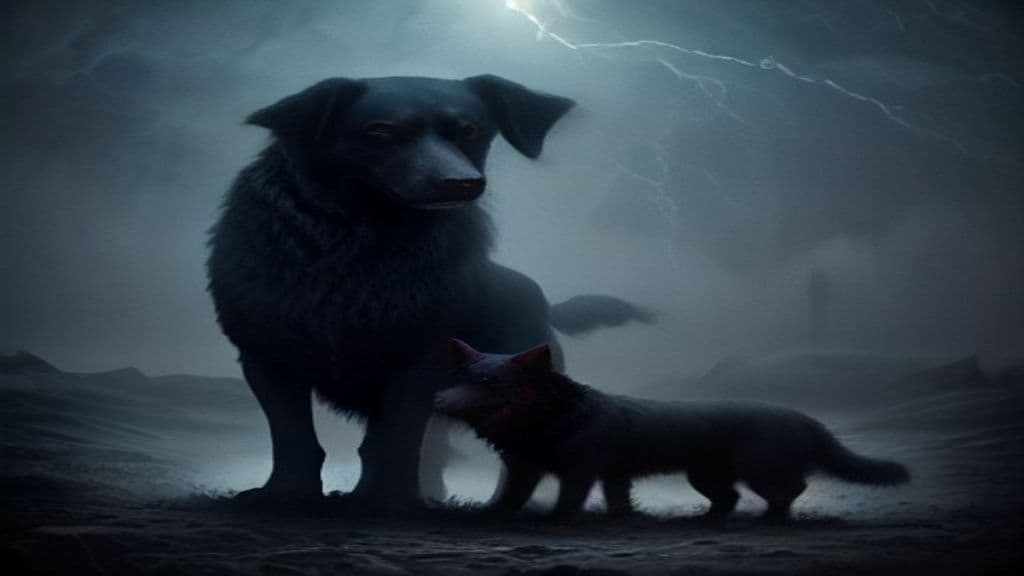
Typical accounts depict the cadejo as a large, shaggy, dog‑shaped creature encountered at night. Many descriptions emphasize luminous eyes that are blue when the creature is calm and red when attacking. A common regional distinction presents a large black cadejo with ember‑like red eyes and often dragging heavy chains, and a white cadejo that functions as a protective spirit. Local and literary variants add differing details—goat hooves, jaguar teeth, rabbit ears, bat‑like features, wholly brown coats in some Costa Rican tellings, or a half‑dog half‑man form in Yucatán—indicating significant regional morphological variation in the lore.
Folklore attributes both protective and harmful roles to the cadejo. The white cadejo is said to guard travelers (in some areas specifically protecting drunk people from robbery or harm), while the black cadejo may attack or try to kill nocturnal wayfarers. Narratives claim that turning one’s back on or speaking to a cadejo can induce insanity; attempts to kill a cadejo are said in tradition to fail and to lead to the death of the would‑be slayer, and if a cadejo's corpse is reported it allegedly smells terrible for days before disappearing. Other behaviors include dragging chains, bone‑rattling footsteps, and in some Honduran accounts scavenging on putrefying corpses.
Weaknesses
- mantraAvoid speaking to it or turning one's back (behavioral prescription said to prevent induced insanity)
Wards
- mantraHonduran recited phrases: 'it smells of holiness', 'it smells of incense', or 'excuse me, compadre Alejo' (used to repel the black cadejo)
- symbolThe Christian Cross (anecdotal/literary account of a cadejo driven off by exposing a cross)
Black Shuck
A spectral black dog of East Anglian legend, with glowing red or green eyes. Its appearance is an omen of death. Its howl has been heard on clifftops during storms for centuries.

Hellhound
A class of mythic canine beings associated across many cultures with the boundary between the human world and the underworld or otherworld. Depending on tradition they function as guardians or attendants of the realm of the dead, members of spectral hunts, omens of death, or emissaries of diabolic forces.

La Llorona
The Weeping Woman of Mexican folklore — the ghost of a mother who drowned her children and now wanders rivers and lakes, weeping for them and taking other children she finds at night.
Acolnahuacatl
Acolnahuacatl is a name attested in central Mexican sources both as a historical Tepanec ruler of Azcapotzalco and, in several modern compilations and trivia lists, as a minor chthonic or underworld-associated figure (often given the variant Acolmiztli). The evidence in the provided material is divided: the historical/genealogical reading is supported by standard reference entries, while the deity reading appears mainly in secondary online god-lists and quizzes and is not substantiated by detailed primary ritual or mythic texts in the supplied set.
Ahuiateteo
Ahuiateteo (Āhuiatēteoh; also rendered Mācuīltōnalequeh) are a quintet of Aztec deities associated with excess, pleasure, and the dangers that accompany over‑indulgence. They appear in calendrical and codical contexts, are invoked in divinatory practice, and are thematically linked to pleasures (feasting, drinking, gambling, sex, music) and the misfortunes that follow excess.
Ahuitzotl
Ahuitzotl is both the personal name of the eighth tlatoani (ruler) of Tenochtitlan (reigned ca. 1486–1502) known for military expansion and monumental rebuilding, and an onomastic term in Nahuatl for an aquatic animal/legendary creature (commonly glossed 'water thorny' and often associated with an otter or water opossum). The sources treat these registers—historical ruler and animal-name—as related but distinct uses of the same Nahuatl lexeme.
Akateko
Akateko (赤手児, lit. 'red child's hand') is a yōkai from Japanese folklore commonly told as a small, red, disembodied child's hand that appears from trees—especially the Japanese honey locust—and startles travelers; in some regional variants it is accompanied by a specter of a young woman or manifests as paired foot- or leg-like apparitions. Accounts vary between mostly harmless trickster apparition and a violent variant that attacks humans.
Alicante
Alicante is attested in available reference sources as the proper name of a mythological snake identified with Mexico. The surviving entries provide only the name and a categorical label (mythological snake) without accompanying narrative, attributes, or ritual context.
Alicanto
A nocturnal, flightless bird-like being from Chilean Atacama desert folklore whose glowing wings indicate the presence of underground ores; it can guide a stealthy prospector to a mother lode or, if offended or detected, extinguish its light and mislead or endanger the seeker.
Aloja
Aloja is listed in available sources as a named figure in Catalan legend; beyond a brief disambiguation listing, traditional folkloric details are absent in the consulted material. A contemporary commercial design note reinterprets Aloja as a Mediterranean/sea goddess with energetic yet tender character, but this is explicitly a modern creative description rather than documented folk belief.
Ascalapha odorata (Hawaiian)
A nocturnal moth associated with death or misfortune in Hawaiian tradition, possibly tied to Central and South American folklore. (Note: - Summary should note that Ascalapha odorata's association with death/misfortune is found in Central and South American folklore, not explicitly mentioned in Hawaiian tradition. - Power tier: Primordi)
Atabey
Atabey is a principal Taíno ancestral mother-spirit (a zemi) associated with fresh water, fertility, and prime matter; she appears in early ethnohistorical transmissions with multiple names and manifestations ranging from nurturing mother to violent storm-mother.
Atlacoya
Atlacoya is named in modern compilations as a figure from Aztec tradition associated with drought; some modern databases alternately classify the name under water-deity categories. The supplied sources do not provide primary-codex citations, iconography, etymology, or detailed ritual texts.
Atlahua
Atlahua is an Aztec water-associated deity attested in colonial and modern summaries as a water god described as a fisherman and archer, identified in sources as a blue/aspectual form of Tlaloc and invoked in contexts of deaths in water.
Ayizan
Ayizan is a racine (root loa) in Haitian Vodou and related West African-derived Vodoun traditions, functioning as the archetypal mambo (priestess) and a guardian of ritual order, initiation (kanzo), and the transmission of sacerdotal implements such as the asson. She is also associated with the marketplace and commerce and is syncretized with the Catholic Saint Clare.
Community Record
- [1]Cadejo (Wikipedia). Wikipedia contributors. 'Cadejo.' Wikipedia, The Free Encyclopedia. https://en.wikipedia.org/wiki/Cadejowiki
- [2]Wikidata: Cadejo (Q5016347). Wikidata entry Q5016347 (Cadejo). http://www.wikidata.org/entity/Q5016347other
- [3]Archive listing: Eventos paranormales... (conference audio listing). Archive.org. 'Eventos paranormales, parálisis del sueño, desdoblamiento astral interno, exorcismos, obsesión psíquica...' (conference listing). https://archive.org/details/julio-10-eventos-paranormalesother
- [4]Archive listing: Turn around (conference audio listing). Archive.org. 'Turn around' (conference listing including 'seres paranormales'). https://archive.org/details/acidplanet-audio-01430052other