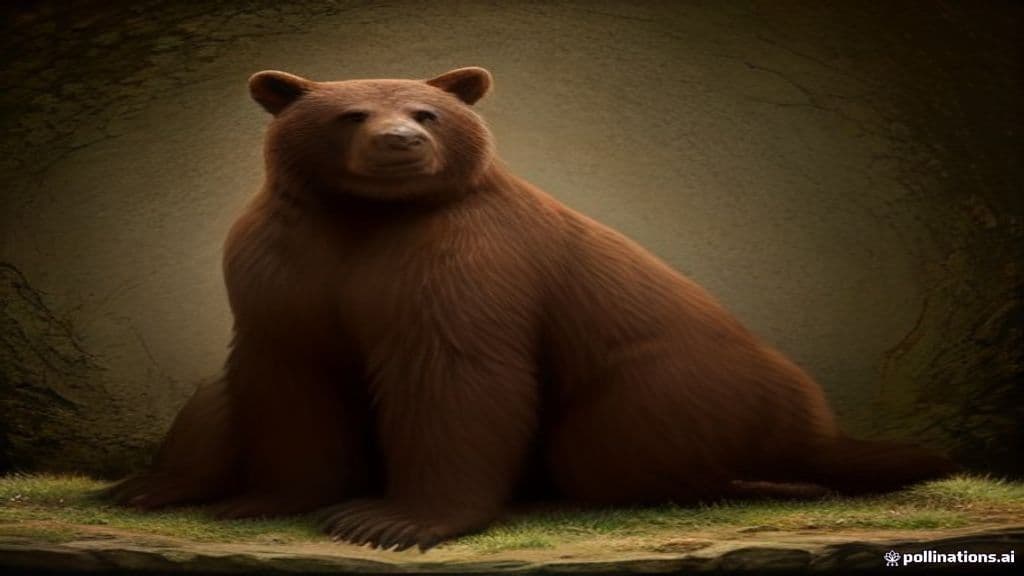
The Cantabrian brown bear is not presented in the available sources as a mythic or supernatural origin tale but as a biogeographical remnant: historically brown bears ranged across much of the Iberian Peninsula but populations contracted sharply during the 19th and 20th centuries because of direct human persecution (hunting) and habitat loss from agriculture and construction. Over time this contraction left two isolated enclaves in the Cantabrian Mountains (a larger western enclave and a smaller eastern enclave). Genetic and demographic research has documented the consequences of isolation — inbreeding and skewed sex ratios in the smaller population — and, more recently, limited interbreeding evidence between enclaves (e.g., 2008 evidence from Redes Natural Park). Reintroduction efforts elsewhere in Spain (for example, Pyrenean reintroductions from Slovenia) and occasional range extensions (footprints near the Portuguese border in 2005 and a confirmed roaming individual in Portugal in 2019) form part of the contemporary history documented by conservation sources.
The Cantabrian brown bear is a large ursid with an overall brown coat; historical descriptions highlighted a yellowish tint to the tips of hairs and dark (black) paws in some early taxonomic characterizations. Adults measure between about 1.6 and 2.0 metres in body length and stand roughly 0.90 to 1.0 metre at the shoulder. Females average about 85 kg but can reach up to 150 kg, while males average about 115 kg and can weigh as much as 200 kg. Lifespan in the wild is approximately 25–30 years. Field accounts and conservation literature emphasize that the animal is timid toward humans and typically tries to avoid contact.
Described in ecological terms rather than supernatural powers, the Cantabrian brown bear exhibits typical brown bear behavior: largely omnivorous with a strong leaning toward vegetable matter, supplemented by carrion which is particularly important for building fat reserves before winter and as a spring food source after hibernation. Bears in this population hibernate seasonally, although recent observations indicate some winter activity possibly linked to milder winters. Females show pronounced philopatry, remaining near natal areas, which slows female-mediated dispersal and affects recolonisation dynamics. Small, isolated population structure has produced measurable genetic consequences such as inbreeding-related complications and altered sex ratios in the eastern enclave.
Weaknesses
- conditionhabitat fragmentation and small population size
- conditionhistorical human persecution (hunting) and ongoing human land use pressures
- conditiongenetic endogamy in isolated eastern enclave leading to birth defects and skewed sex ratios
- conditionclimate impacts on hibernation patterns (mild winters altering seasonal behaviour)
Wards
- otherlegal protection and conservation measures (ban on hunting since 1973; fines up to €300,000 for killing a bear)
- otheravoidance and non-confrontation by people (behavioral mitigation implied by bear timidity)
*Perkʷūnos
*Perkʷūnos is the reconstructed Proto-Indo-European thunder‑god hypothesized by comparative linguistics and mythology. Scholarly reconstructions portray him as a storm or thunder figure associated with fructifying rain and as the combatant who fights a multi‑headed water‑serpent to release life‑giving waters; no direct attestations from the Proto‑Indo‑European period survive and the figure is inferred from later Indo‑European traditions.
*Péh₂usōn (reconstructed)
Péh₂usōn is a hypothetical Proto‑Indo‑European pastoral guardian reconstructed by comparative scholars from parallels in Greek and Vedic traditions. Proposed as a Graeco‑Aryan ancestor‑figure, the reconstruction describes a protector of flocks, roads, and travellers rather than an attested historical cultic personality.
3-D Man
3-D Man is a Marvel Comics superhero identity associated with a 1950s-era origin in which the body of Chuck Chandler can materialize in three-dimensional existence when activated by his brother Hal via a pair of glasses. The mantle was later assumed by Delroy Garrett (formerly Triathlon) in modern continuity.
5 Ronin
5 Ronin is a 2011 Marvel Comics five-issue limited series that reimagines five Marvel superhero archetypes as rōnin (masterless samurai) in a fictionalized post‑Sekigahara feudal Japan. The work places Wolverine, Hulk, Punisher, Psylocke, and Deadpool analogues into period roles to explore displacement, revenge, and identity in an era of political upheaval.
57 Mnemosyne
57 Mnemosyne is a large main-belt asteroid (S-type) discovered in 1859 and named after the Greek Titaness Mnemosyne. It is a non-sentient astronomical body studied for its orbital and rotational properties and has been used in dynamical measurements related to Jupiter.
58 Concordia
58 Concordia is a fairly large main-belt asteroid orbiting the Sun, discovered in 1860 and named after the Roman goddess Concordia. Astronomical sources classify it as a C-type (carbonaceous) body with a multi-year orbital period and measurable rotation and pole orientations.
9MOTHER9HORSE9EYES9
An anonymous Reddit screen name and online persona used by the author of the Interface series, a multipart speculative-horror narrative posted in short installments across Reddit in 2016. The name functions as the signature of an authorial identity and as a focal label for a fandom that created archives, a subreddit, and a wiki documenting the story and its fictional phenomena (notably entities called "flesh interfaces").
A.R.G.U.S.
A.R.G.U.S. is a fictional clandestine United States government agency in the DC Comics universe that investigates, contains, and manages superhuman, meta-human, and supernatural incidents and assets. Introduced in The New 52 continuity, it functions as an institutional actor providing intelligence, logistical support, covert task forces (notably Task Force X / the Suicide Squad), and a dedicated magic division across comics and media adaptations.
Abaddon
In Hebrew scripture Abaddon is primarily a noun meaning 'destruction' or a section/condition of the underworld paired with Sheol; in the New Testament Book of Revelation Abaddon is personified as an angelic figure (Greek Apollyon) described as the king of an army of locusts released from the abyss during the apocalypse.
Aban Yasht
The Aban Yasht is a hymn from the Persian tradition that praises Anahita, a goddess associated with water, fertility, and wisdom. It consists of 132 stanzas and is part of the 21 Yashts collection. (Note: - Power tier should be "Primordial" or possibly "Cosmic", given that it's a hymn of great spiritual significance and associated with a goddess. - The article incorrectly states that Anahita is associa)
Abath
No corroborated folkloric entity named "Abath" is documented in the provided sources. The string appears in the supplied material only as a surname/personal name in Aruban/Dutch-Caribbean archival records and as an unrelated taxonomic or encyclopedic hit; no mythic attributes, origin stories, rituals, or apotropaic practices for an entity called Abath are present in the documents reviewed.
Abatur
Abatur is an uthra (celestial emanation) in Mandaeism described as the 'father of the Uthras' and called the Ancient (ʿattīqā). He resides on the boundary between the World of Light and lower regions, functions as a judge who weighs souls (Abatur Muzania), and supplies instructions and materials to the demiurgic uthra Ptahil in accounts from the Diwan (Scroll) of Abatur.
Community Record
- [1]Cantabrian brown bear — Wikipedia. Wikipedia contributors. "Cantabrian brown bear." Wikipedia, The Free Encyclopedia.wiki
- [2]Q5033519 — Cantabrian brown bear (Wikidata). Wikidata entry Q5033519, Cantabrian brown bear.other