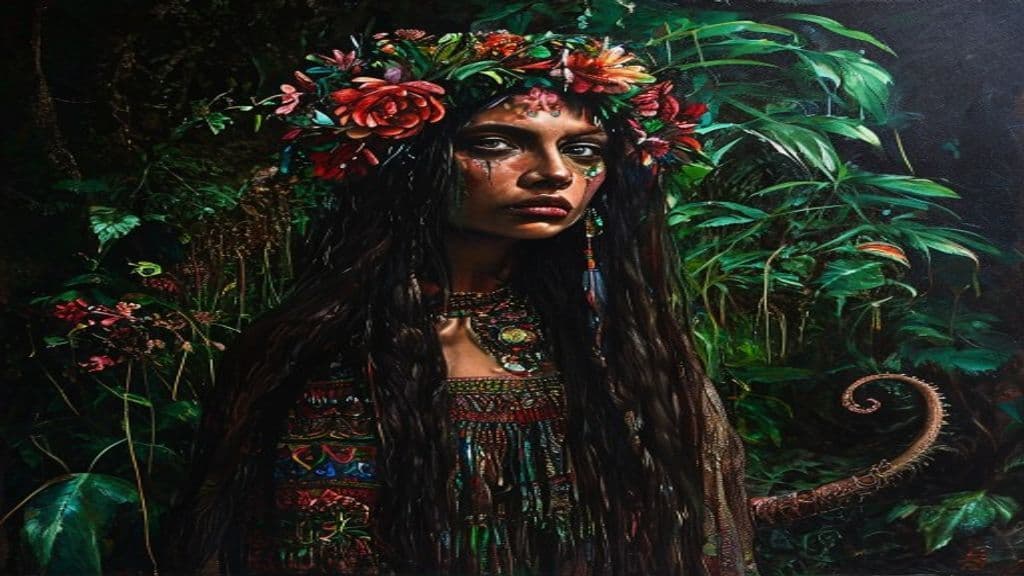
La Cegua is attested in regional oral tradition rather than a single codified origin myth. Sources present her as part of a family of Mesoamerican cautionary female apparitions (variants named Sihuanaba/Siguanaba/Sihuehuet and related figures like Xtabay) that recur across countries such as Nicaragua, El Salvador, Guatemala and Mexico. The collected materials emphasize the tale form and social function—stories passed in communities to deter risky male behavior—rather than a singular creation narrative or a fixed cosmological genealogy. Specific localized versions vary, and the assembled sources do not provide a consistent origin account beyond her embeddedness in oral moral instruction across the region.
In the consistent motif reported across sources, La Cegua initially appears to a passerby as an alluring, long-haired woman—often described as very beautiful and commonly noticed from behind. When a victim approaches or follows, her true visage is revealed: accounts variously describe the face as that of a horse (sometimes specifically a horse skull) or alternately as a human skull. Modern retellings and contemporary cultural references sometimes emphasize the 'horse skull' image, but both horse-head and skeletal variants are recorded in the folkloric record. The dramatic transformation from feminine beauty (especially seen from behind) to a non-human or dead visage is the central visual hallmark.
Sources describe La Cegua primarily as a shapeshifting apparition whose salient behaviors are luring and exposing. She attracts certain men—notably those who are drunk or habitually womanizing—by appearing beautiful or by seeking their help, guides them along lonely roads at night, and then reveals her true face (horse head or skull). After the revelation the tale typically implies danger, harm, or death for the victim; the sources record the punitive, cautionary function more than detailed mechanics of assault or killing. The figure's power set in the cited materials is therefore limited to deceptive appearance, targeted luring, and the narrative consequence of dire outcomes for transgressing men.
Weaknesses
- conditionAvoidance by not walking alone at night
- conditionAvoidance by not being intoxicated (not walking drunk)
- conditionAvoidance by abstaining from mujeriego (womanizing) behavior
Wards
- conditionSocial/practical precautions (do not walk alone at night; avoid intoxication)

Xtabay
A supernatural being in Maya tradition, described as a 'demonic femme fatale' who preys upon men in the Yucatán Peninsula. (Note: 1. Power tier should be Primordial, as Xtabay's described abilities have no clear limits in the region and imply an otherworldly power. 2. Origin story: add that it is inferred from the context of May)

Sihuanaba
A Central American shapeshifting female spirit from regional oral tradition that lures solitary travelers—often portrayed as beautiful and long‑haired—into isolated or hazardous places before revealing a grotesque true form; the motif functions as a cautionary legend enforcing social norms.
Acolnahuacatl
Acolnahuacatl is a name attested in central Mexican sources both as a historical Tepanec ruler of Azcapotzalco and, in several modern compilations and trivia lists, as a minor chthonic or underworld-associated figure (often given the variant Acolmiztli). The evidence in the provided material is divided: the historical/genealogical reading is supported by standard reference entries, while the deity reading appears mainly in secondary online god-lists and quizzes and is not substantiated by detailed primary ritual or mythic texts in the supplied set.
Ahuiateteo
Ahuiateteo (Āhuiatēteoh; also rendered Mācuīltōnalequeh) are a quintet of Aztec deities associated with excess, pleasure, and the dangers that accompany over‑indulgence. They appear in calendrical and codical contexts, are invoked in divinatory practice, and are thematically linked to pleasures (feasting, drinking, gambling, sex, music) and the misfortunes that follow excess.
Ahuitzotl
Ahuitzotl is both the personal name of the eighth tlatoani (ruler) of Tenochtitlan (reigned ca. 1486–1502) known for military expansion and monumental rebuilding, and an onomastic term in Nahuatl for an aquatic animal/legendary creature (commonly glossed 'water thorny' and often associated with an otter or water opossum). The sources treat these registers—historical ruler and animal-name—as related but distinct uses of the same Nahuatl lexeme.
Akateko
Akateko (赤手児, lit. 'red child's hand') is a yōkai from Japanese folklore commonly told as a small, red, disembodied child's hand that appears from trees—especially the Japanese honey locust—and startles travelers; in some regional variants it is accompanied by a specter of a young woman or manifests as paired foot- or leg-like apparitions. Accounts vary between mostly harmless trickster apparition and a violent variant that attacks humans.
Alicante
Alicante is attested in available reference sources as the proper name of a mythological snake identified with Mexico. The surviving entries provide only the name and a categorical label (mythological snake) without accompanying narrative, attributes, or ritual context.
Alicanto
A nocturnal, flightless bird-like being from Chilean Atacama desert folklore whose glowing wings indicate the presence of underground ores; it can guide a stealthy prospector to a mother lode or, if offended or detected, extinguish its light and mislead or endanger the seeker.
Aloja
Aloja is listed in available sources as a named figure in Catalan legend; beyond a brief disambiguation listing, traditional folkloric details are absent in the consulted material. A contemporary commercial design note reinterprets Aloja as a Mediterranean/sea goddess with energetic yet tender character, but this is explicitly a modern creative description rather than documented folk belief.
Ascalapha odorata (Hawaiian)
A nocturnal moth associated with death or misfortune in Hawaiian tradition, possibly tied to Central and South American folklore. (Note: - Summary should note that Ascalapha odorata's association with death/misfortune is found in Central and South American folklore, not explicitly mentioned in Hawaiian tradition. - Power tier: Primordi)
Atabey
Atabey is a principal Taíno ancestral mother-spirit (a zemi) associated with fresh water, fertility, and prime matter; she appears in early ethnohistorical transmissions with multiple names and manifestations ranging from nurturing mother to violent storm-mother.
Atlacoya
Atlacoya is named in modern compilations as a figure from Aztec tradition associated with drought; some modern databases alternately classify the name under water-deity categories. The supplied sources do not provide primary-codex citations, iconography, etymology, or detailed ritual texts.
Atlahua
Atlahua is an Aztec water-associated deity attested in colonial and modern summaries as a water god described as a fisherman and archer, identified in sources as a blue/aspectual form of Tlaloc and invoked in contexts of deaths in water.
Ayizan
Ayizan is a racine (root loa) in Haitian Vodou and related West African-derived Vodoun traditions, functioning as the archetypal mambo (priestess) and a guardian of ritual order, initiation (kanzo), and the transmission of sacerdotal implements such as the asson. She is also associated with the marketplace and commerce and is syncretized with the Catholic Saint Clare.
Community Record
- [1]Sihuanaba (Wikipedia: Cegua/Sihuanaba article). Wikipedia, 'Sihuanaba' / 'Cegua' entry — summary of shapeshifting woman who reveals horse or skull facewiki
- [2]La Cegua | USC Digital Folklore Archives. USC Digital Folklore Archives informant summary (La Cegua / Sophia Guzman) — notes appearance to drunk men and mujeriegos, night roads, moral functionfolk
- [3]The Enchanted Orchard, and Other Folktales of Central America. Folktale anthology listing 'The Cegua' and other Central American tales, providing regional tale contextfolk
- [4]Wikidata: Xtabay. Wikidata entry for 'Xtabay' — related Mesoamerican figure described as a beautiful woman who reveals true appearance and kills men (used for comparative context)wiki
- [5]La Cegua | Villains Wiki (Fandom). Villains Wiki (Fandom) entry synthesizing motif details (used cautiously alongside archival sources)other
- [6]These Vengeful Wishes (contemporary cultural reference mentioning horse skull motif). Publisher and event materials referencing 'La Cegua, a vengeful female spirit with the face of a horse skull' — evidence of motif persistence in modern retellingsliterary
- [7]Culture of Nicaragua (contextual background). Wikipedia: Culture of Nicaragua — background on blended cultural influences in regional folklorewiki