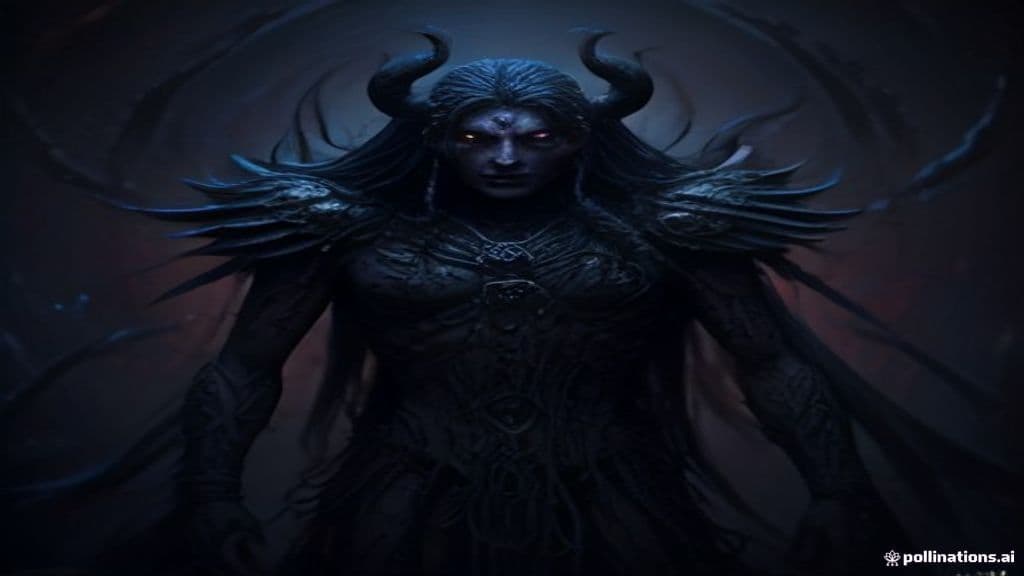
In classical and comparative mythological treatments the category comprises figures that function as personifications of primordial chaos — cosmological forces present at or before creation and invoked in cosmogonies to explain disorder and the origins of the world (supported by encyclopedic listings). Separately, in modern fictional-franchise treatments discussed in fandom sources (chiefly Warhammer 40,000 community discussion), 'chaos gods' are described as arising within a parallel immaterial realm (the Warp/Immaterium) when concentrated negative emotions or psychic energy coalesce into sentient, godlike intelligences.
Traditional mythological sources catalog chaos-deity figures primarily as conceptual or symbolic actors in cosmogony rather than fixed visual types; cross-cultural lists emphasize variability rather than a single morphology. Modern fictional portrayals (fandom discussions of Warhammer 40K) characterize chaos gods as metaphysical powers capable of producing mutable daemonic manifestations, but the provided sources do not give a single canonical visual description.
As a category in myth, chaos deities represent disruptive, disordering, or formative primordial forces in cosmology. In the modern fictional framing found in fandom sources, they are described as emerging from aggregated emotional/psychic energy, producing subordinate beings (daemons), and engaging in persistent rivalry and conflict with other gods — behaviours framed as intrinsic to their nature in those fictional settings. The degree and particulars of such powers vary by source and setting; the provided notes separate the mythological personification use from the franchise-specific mechanics.
*Perkʷūnos
*Perkʷūnos is the reconstructed Proto-Indo-European thunder‑god hypothesized by comparative linguistics and mythology. Scholarly reconstructions portray him as a storm or thunder figure associated with fructifying rain and as the combatant who fights a multi‑headed water‑serpent to release life‑giving waters; no direct attestations from the Proto‑Indo‑European period survive and the figure is inferred from later Indo‑European traditions.
*Péh₂usōn (reconstructed)
Péh₂usōn is a hypothetical Proto‑Indo‑European pastoral guardian reconstructed by comparative scholars from parallels in Greek and Vedic traditions. Proposed as a Graeco‑Aryan ancestor‑figure, the reconstruction describes a protector of flocks, roads, and travellers rather than an attested historical cultic personality.
3-D Man
3-D Man is a Marvel Comics superhero identity associated with a 1950s-era origin in which the body of Chuck Chandler can materialize in three-dimensional existence when activated by his brother Hal via a pair of glasses. The mantle was later assumed by Delroy Garrett (formerly Triathlon) in modern continuity.
5 Ronin
5 Ronin is a 2011 Marvel Comics five-issue limited series that reimagines five Marvel superhero archetypes as rōnin (masterless samurai) in a fictionalized post‑Sekigahara feudal Japan. The work places Wolverine, Hulk, Punisher, Psylocke, and Deadpool analogues into period roles to explore displacement, revenge, and identity in an era of political upheaval.
57 Mnemosyne
57 Mnemosyne is a large main-belt asteroid (S-type) discovered in 1859 and named after the Greek Titaness Mnemosyne. It is a non-sentient astronomical body studied for its orbital and rotational properties and has been used in dynamical measurements related to Jupiter.
58 Concordia
58 Concordia is a fairly large main-belt asteroid orbiting the Sun, discovered in 1860 and named after the Roman goddess Concordia. Astronomical sources classify it as a C-type (carbonaceous) body with a multi-year orbital period and measurable rotation and pole orientations.
9MOTHER9HORSE9EYES9
An anonymous Reddit screen name and online persona used by the author of the Interface series, a multipart speculative-horror narrative posted in short installments across Reddit in 2016. The name functions as the signature of an authorial identity and as a focal label for a fandom that created archives, a subreddit, and a wiki documenting the story and its fictional phenomena (notably entities called "flesh interfaces").
A.R.G.U.S.
A.R.G.U.S. is a fictional clandestine United States government agency in the DC Comics universe that investigates, contains, and manages superhuman, meta-human, and supernatural incidents and assets. Introduced in The New 52 continuity, it functions as an institutional actor providing intelligence, logistical support, covert task forces (notably Task Force X / the Suicide Squad), and a dedicated magic division across comics and media adaptations.
Abaddon
In Hebrew scripture Abaddon is primarily a noun meaning 'destruction' or a section/condition of the underworld paired with Sheol; in the New Testament Book of Revelation Abaddon is personified as an angelic figure (Greek Apollyon) described as the king of an army of locusts released from the abyss during the apocalypse.
Aban Yasht
The Aban Yasht is a hymn from the Persian tradition that praises Anahita, a goddess associated with water, fertility, and wisdom. It consists of 132 stanzas and is part of the 21 Yashts collection. (Note: - Power tier should be "Primordial" or possibly "Cosmic", given that it's a hymn of great spiritual significance and associated with a goddess. - The article incorrectly states that Anahita is associa)
Abath
No corroborated folkloric entity named "Abath" is documented in the provided sources. The string appears in the supplied material only as a surname/personal name in Aruban/Dutch-Caribbean archival records and as an unrelated taxonomic or encyclopedic hit; no mythic attributes, origin stories, rituals, or apotropaic practices for an entity called Abath are present in the documents reviewed.
Abatur
Abatur is an uthra (celestial emanation) in Mandaeism described as the 'father of the Uthras' and called the Ancient (ʿattīqā). He resides on the boundary between the World of Light and lower regions, functions as a judge who weighs souls (Abatur Muzania), and supplies instructions and materials to the demiurgic uthra Ptahil in accounts from the Diwan (Scroll) of Abatur.
Community Record
- [1]List of chaos gods. "A chaos deity is a deity or more often a figure or spirit in mythology which is associated with or being a personification of primordial chaos."wiki
- [2]Wikidata: Chaos deity (Q60788817). Wikidata label: "Personifications of chaos in mythology."wiki
- [3]What stops the Chaos gods creating an infinite number of daemons? (Scifi.StackExchange). Discussion noting Chaos gods create daemons and debating limits on spawning.other
- [4]Warhammer 40k fandom discussion: Chaos gods born of negative collective subconscious. Fandom discussion framing Chaos gods as emergent from collective negative psychic/emotional energy.other
- [5]Warhammer 40k fandom discussion: Chaos gods as reflection of evil and suffering in the 'real' Universe. Discussion asserting chaos gods exist within the Warp as a reflection of evil and suffering.other
- [6]Northern Chaos Gods (album/topic). Example of the term's reuse in popular culture (album/title).wiki
- [7]Quote: "they are what happens when so much malice is pumped into a glob of emotional energy that that glob becomes sentient and tries to kill you.". Fandom characterization of chaos gods (modern fictional framing).other
- [8]Fan commentary: "gods keep fighting with each other even when cooperation would bring a crushing defeat to the reality. this is simply their nature.". Fan-discussion remark on inter-god rivalry in fictional settings.other