
Within the story-world Dante is presented as an ancient leader among beings classified as devils or demons who once fought energy-based invading beings characterized as 'gods.' In the 1971 story Dante is said to have been active in a high-technology Sodom/Gomorrah, defeated by God and sealed in the Himalayas; that narrative also links Dante's human incarnation to Judas Iscariot and describes his later rebirth/possession of a modern character (Ryo Utsugi). In the later reboot continuity Dante's legacy endures as part of a war between gods and humans, with human technicians or pilots (e.g., Dante Luther) using or merging with super-weapons called 'demons.'
Descriptions differ by version. The 1971 plot depicts Dante as an ancient demon who can take gigantic, hybrid forms—including a canonical sequence where he is fused with a jet fighter and two prehistoric reptiles (a Pteranodon and a Tyrannosaurus rex) to produce a demonic form. In modern-set episodes/incarnations Dante also appears via human guises/hosts (Judas Iscariot historically; Ryo Utsugi in 1971) and in the reboot a human technician (Dante Luther) is associated with 'demons' that function as weaponized constructs and may alter the user's outward form when merged.
Across versions Dante exhibits consciousness transfer/possession (human incarnations and hosts), fusion/transformation with machines, creatures, and weapons, and battlefield-scale destructive power. In the 1971 narrative Dante transfers human soul/body connections (explicitly linked to Judas Iscariot and Ryo Utsugi) to return in the modern era and can manifest in hybrid giant forms. In the reboot, 'demons' are super-weapons that magnify a user's mental energy and, under extreme conditions such as near-death, cause the user to merge with the weapon and become an actual demon. Dante functions as a military and charismatic leader able to rally other demons against the gods.
Weaknesses
- conditionDefeat and sealing (narrative containment)
- otherOpposition by organized human forces (Army, religious organizations such as 'God's Association'/'God's Soul')
Wards
- otherMilitary and organizational opposition (Army intervention, Guardian Justice/paramilitary divisions)
- ritualSealing (as performed in the past; Dante is described as defeated and sealed in the Himalayas)
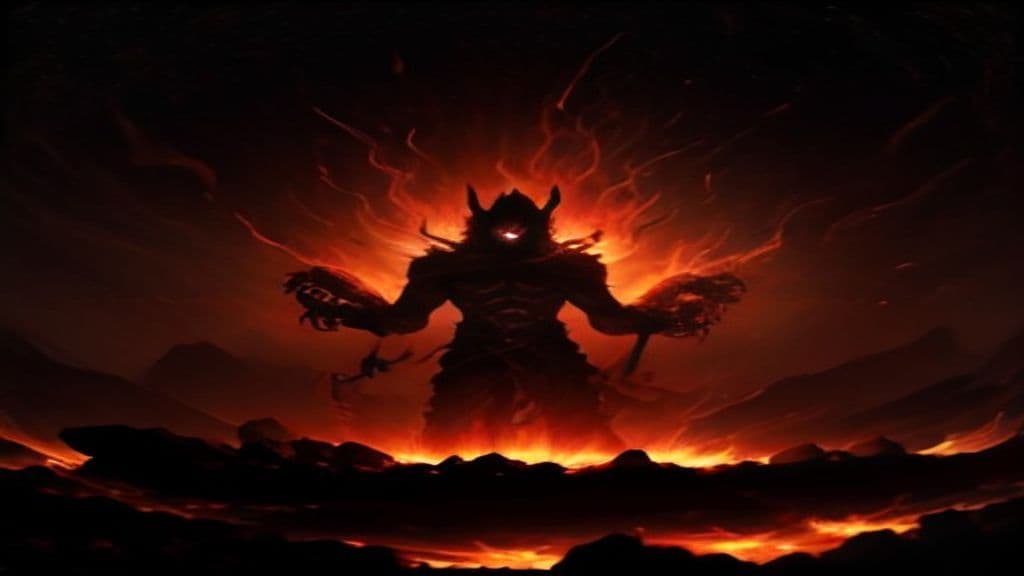
Ifrit
One of the most powerful classes of jinn in Islamic and pre-Islamic Arab tradition — a fire-born being of immense strength and cunning, capable of great works of engineering and terrible violence.
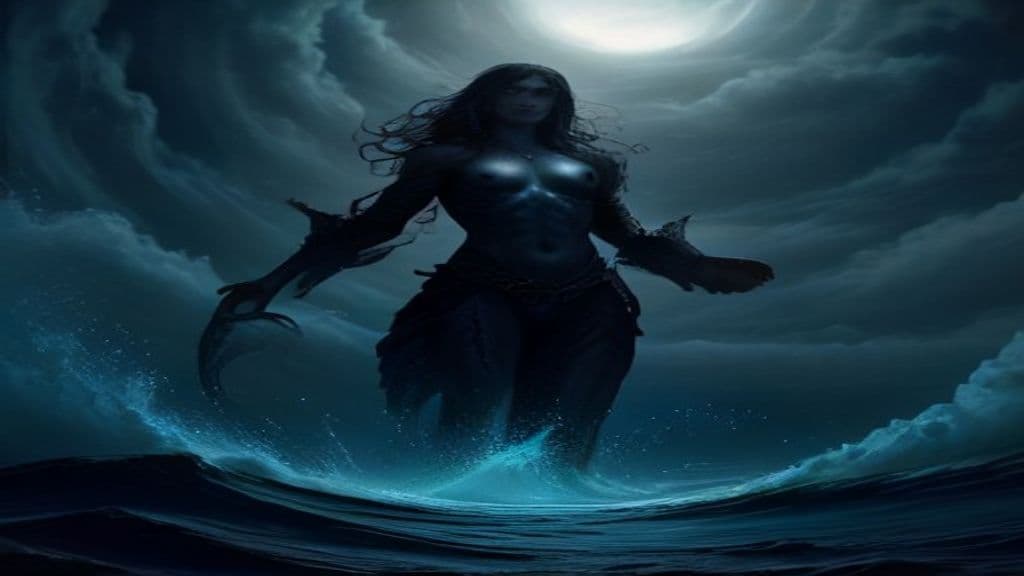
Marid
The most powerful class of jinn in Islamic tradition — beings of the sea, associated with the deep ocean, storms, and the granting of wishes at terrible cost. The classic genie of the Arabian Nights.
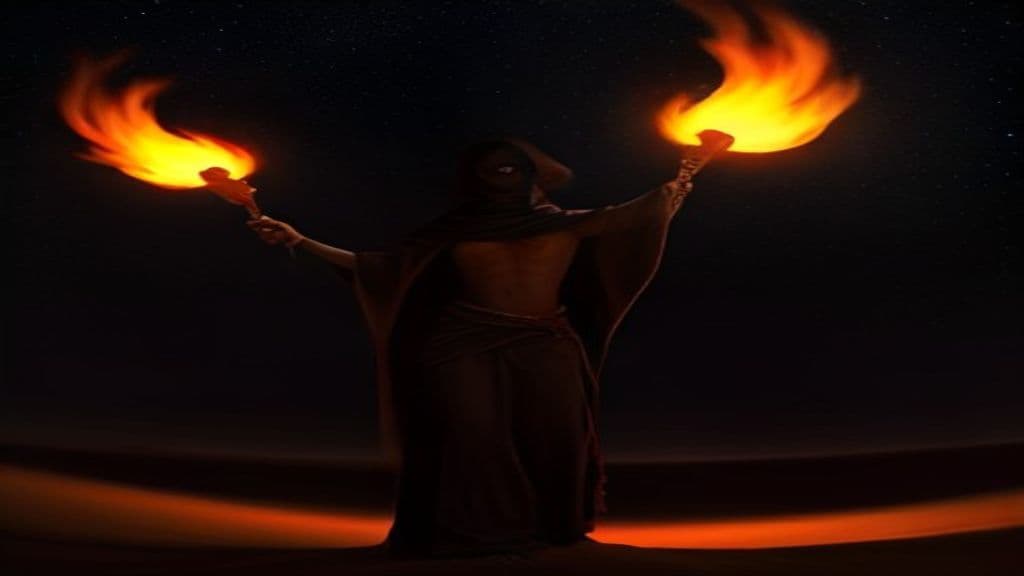
Djinn
The class of supernatural beings created from smokeless fire in Islamic cosmology — a parallel civilization to humanity, capable of belief or unbelief, with their own prophets, society, and judgment before God.
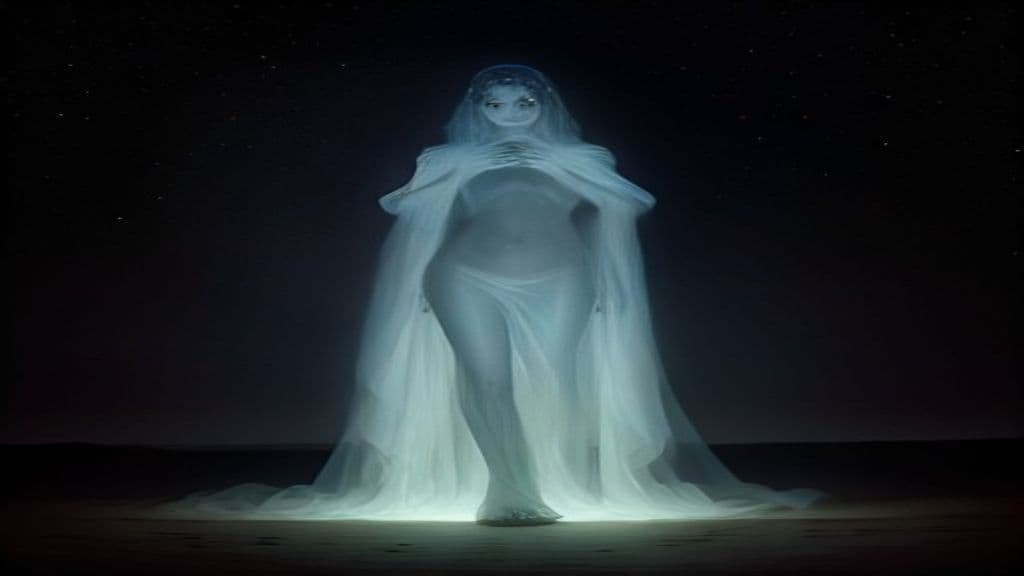
Jann
The weakest class of djinn in Islamic tradition, associated with desert winds and taking the form of snakes or whirlwinds, dwelling in empty wilderness and posing little threat to those who know the proper invocations.

Beelzebub
Originally the name of a Philistine city-deity of Ekron recorded in the Hebrew Bible (2 Kings), Baʿal-zəḇūḇ was later used in Jewish polemic as a derisive title and appears in Christian texts as a designation for a principal demonic figure (rendered Beelzebul/Beelzebub) often called the 'prince of demons.' Over subsequent centuries the name is incorporated into medieval and early modern demonological hierarchies and literary depictions of infernal powers.

Satan
A central oppositional figure in Abrahamic traditions who functions variously as an accuser, tempter, tester, and rebel. In earliest Hebrew Bible contexts the term functions as a role within the divine council; in later Jewish, Christian, and Islamic developments the figure becomes a more fully personified adversary who incites humans to sin and leads hostile spirits.
5 Ronin
5 Ronin is a 2011 Marvel Comics five-issue limited series that reimagines five Marvel superhero archetypes as rōnin (masterless samurai) in a fictionalized post‑Sekigahara feudal Japan. The work places Wolverine, Hulk, Punisher, Psylocke, and Deadpool analogues into period roles to explore displacement, revenge, and identity in an era of political upheaval.
Abumi-guchi
A Japanese yōkai classed as a tsukumogami: an animated stirrup (abumi) depicted in Sekien Toriyama's Gazu Hyakki Tsurezure Bukuro. Traditional accounts say it is formed from a stirrup that belonged to a soldier who fell in battle and that it waits where the stirrup lies for its dead owner to return.
Abura-akago
An Edo-period yōkai depicted as an oil‑licking infant or a ball of flame. First recorded in illustrated compendia (notably Toriyama Sekien's Konjaku Gazu Zoku Hyakki), the Abura-akago is tied to tales of oil‑stealing fires and functions in part as an etiological warning about wasting or stealing oil.
Abura-sumashi
A yōkai spirit from the Amakusa region of Kumamoto Prefecture, Japan, said to inhabit mountain passes. Traditionally explained as the ghost of a person who stole oil, it appears to surprise travelers and is represented in modern media with a straw-coat body and a potato- or stone-like head.
Aburabō / Abura-bōzu / Aosaginohi (traditions)
Two distinct Japanese traditions appear under related flame imagery: Aosaginohi/Aosagibi is presented as a will-o'-the-wisp type luminous night phenomenon interpreted as reflections from herons; aburabōzu (abura bōzu, "oil monk") appears in a separate anecdote as a reported fire-breathing apparition in a 12th-century Yasaka Shrine tale. The sources treat them as separate portrayals rather than a single unified being.
Acala
Acala (Sanskrit: अचल, 'The Immovable') is a wrathful protective deity (dharmapala) in Vajrayāna and East Asian esoteric Buddhism, classed among the Wisdom Kings (Vidyārāja). He functions as a ritual focus for visualization and mantra practice intended to remove obstacles and bind or destroy hostile forces.
Agaru
Agaru (attested historically as Agarum) appears in the supplied sources as a Bronze Age Near Eastern toponym—often identified with Failaka Island—and as a modern personal or media name. The provided material contains no evidence that Agaru is a supernatural being in any traditional cosmology.
Ajisukitakahikone
Ajisukitakahikone is a kami in Japanese mythic literature (Kojiki/Nihon Shoki). He appears in the transfer-of-rule cycle between heaven and earth, is described as a son of Ōkuninushi, associated with the Kamo cult (called Kamo no ōmikami in some modern museum/catalog entries), and features in narratives that explain landscape formation and meteorological genealogy.
Aka Manto
Aka Manto (赤マント, "Red Cloak") is a Japanese urban legend and schoolyard ghost-story about a masked, cloaked figure who appears in public or school toilet stalls and forces occupants to choose between colored toilet paper; each choice in the tale produces a violent supernatural consequence. The legend is part of modern popular folklore recorded in school contexts from the 1930s onward rather than a formal religious myth.
Akaname
Akaname is a Japanese yōkai associated with baths, bathtubs, toilets, and other places where scum and filth accumulate. Traditionally depicted as a child-like creature that licks grime, it functions in folklore as a cautionary figure tied to cleanliness; a few narrative variants cast it as dangerously predatory.
Akashaguma
Akashaguma is presented in the available sources as a child-like house guardian spirit in the Japanese yokai tradition, closely comparable to the regional zashiki-warashi. It is associated with domestic interiors (parlors or storage rooms) and with bringing prosperity to households where it dwells.
Akashita
Akashita (赤舌, lit. “red tongue”) is an Edo-period pictorial yōkai commonly represented as a hairy, clawed face emerging from dark clouds with a wide open mouth and a conspicuous red tongue. The figure appears in yōkai emaki and Toriyama Sekien’s Gazu Hyakki Yagyō; Sekien’s plate shows it atop a sluice, but the original pictorial tradition provides no explanatory caption. Later folklorists and popular writers (Shōwa and later) have variously interpreted the image as a punitive spirit linked to irrigation/floodgate justice or as a kidnapper in evening skies, though these narrative roles are post-hoc.
Community Record
- [1]Demon Lord Dante - Wikipedia. Wikipedia. 'Demon Lord Dante'.wiki
- [2]DEMON LORD DANTE - Enoki Films Co., Ltd.. Enoki Films company page for Demon Lord Dante.other
- [3]Wikidata: Demon Lord Dante. Wikidata entry for Demon Lord Dante.other