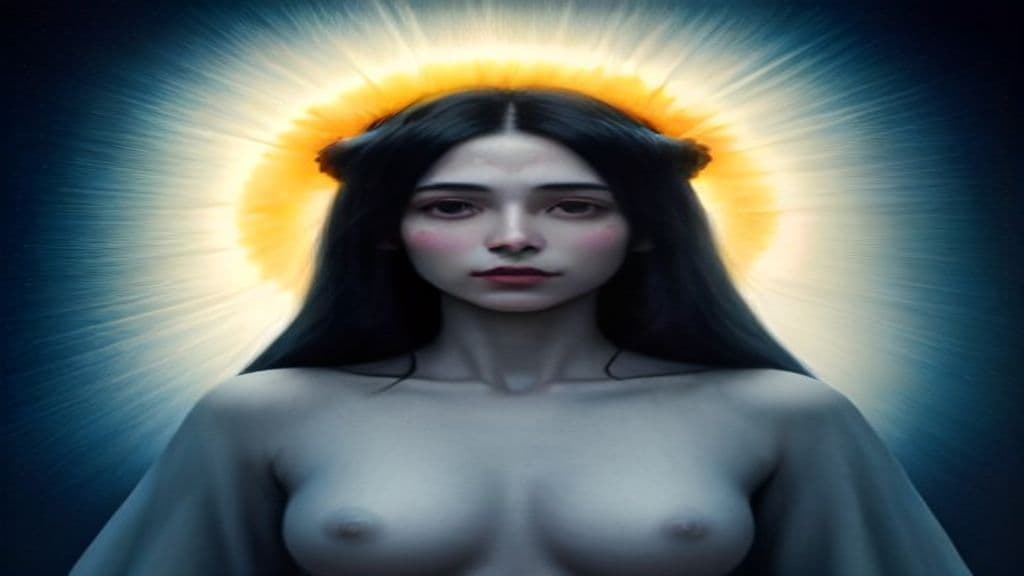
The supplied sources do not present a single, detailed cosmogonic tale for Eguzki Amandrea. Instead, ethnographic and mythographic accounts cited treat the sun as a long-recognized animate body within Basque cosmology and place it in familial relations—most notably as a daughter or mother in relation to Mother Earth and alongside the Moon (see Buber's Basque pages and the ASWM Scholar Salon framing). One interpretive source (ASWM Scholar Salon announcement) uses the heading "When the Moon and Sun are Daughters of Mother Earth," indicating a familial origin motif in some presentations; Buber's overviews repeatedly identify the sun as a personified, gendered celestial being without supplying an extended origin narrative. A broader primordial-religion overview referenced in the corpus situates personified celestial motifs within long historical discussions of Basque mythic elements but does not provide a specific origin myth for Eguzki Amandrea.
The sources do not furnish a detailed anthropomorphic description of Eguzki Amandrea (no clothing, facial, or bodily attributes are recorded in the provided materials). Descriptions in the corpus emphasize her manifestation as the brightest visible object in the heavens and as the source of warmth and light. Buber's Basque pages and the "Basque Fact of the Week" piece characterize the sun primarily by its luminosity, prominence in the sky, and life-giving presence rather than by particular humanlike visual traits.
Across the cited materials, Eguzki Amandrea's principal functions are life-giving: providing warmth, enabling growth, and sustaining visible life. The sun's brightness and warmth are repeatedly linked to its central role in the natural order (see Buber's "The Sun in the Basque Cosmos" and Basque Mythology overview). The supplied sources do not record hostile behaviors, magical trickster actions, direct speech to humans, healing or exorcistic rituals specifically performed by or to the sun, nor specific cultic liturgies; where ritual attention is implied, details are not provided in the available excerpts. The sun is therefore presented as a beneficent cosmic actor embedded in social/familial relations with other celestial beings.
Aatxe
In Basque folk mythology, Aatxe is a spirit that exists alongside humans and other entities, protecting the law-abiding and punishing malevolent individuals. (Note: 1. Power tier: The source material does not explicitly mention Aatxe as a deity-level entity, so Greater is plausible but could be clarified. 2. Abilities: While it's mentioned that Aatxe attacks male)
Akelarre (Basque Witches' Sabbath)
In Basque tradition, Akelarre is a gathering of witches presided over by a goat-like entity. (Note: - Power tier: Primordial (given it's a cosmic event and not a specific entity with supernatural power, but rather an event presided over by another entity) - Summary: In Basque tradition, the Akelarre)
Akerbeltz
Malevolent Basque spirit associated with sexual abuses and seductive powers, likely tied to the natural environment. (Note: - Power tier: Greater (Akerbeltz's abilities are more regional in scope and do not match the description of an Ancient entity) - Abilities: While source material mentions "sexual abuses" and "seductiv)
Arquetu
A Cantabrian popular-belief figure depicted as an old man marked with a green cross and seven keys on his forehead who intervenes in human economic affairs by lending money to prodigals and punishing repeat wastefulness with a curse of eternal poverty.
Artahe
Tutelary deity of Southern Gaul and Aquitania, providing protection and care to her associated group or place. (Note: - Power tier: Lower than Ancient (consider Greater, as she's a regional deity) - Sensory cues and weaknesses and wards are missing; add relevant information from source material - Abilities should inc)
Baian
A semi-divine water spirit or mermaid-like creature in Basque mythology, associated with fertility and aquatic phenomena. (Note: Power tier should be "Lesser" or possibly "Primordial", as the entity is described as semi-divine and associated with fertility and aquatic phenomena. Summary needs more detail, e.g., "Semi-divine wat)
Basajaun
A huge, hairy hominid in Basque mythology that protects flocks and teaches humans skills. (Note: * Power tier: should be "Greater" instead of "Ancient", as Basajaun's abilities suggest regional power but not deity-level. * Origin story: it is actually mentioned in the source that the origin story)
Basque Primordial Entity
Very little is known about Basque mythology due to the lack of surviving texts from the pre-Christian worldview. (Note: 1. Summary: Add that most knowledge comes from indirect sources such as legends and place names. 2. Power tier: Remove or change Primordial, as there is no information about its abilities or powers. 3)
Eacus (God)
Weather god associated with forces of nature in Basque tradition. (Note: * Power tier should be Ancient, not Primordial, as Eacus is described as a specific god associated with a particular region (Iberian Spain) rather than a cosmic entity. * The article should indicate t)
Eate, Storm God in Basque Tradition
Eate is a storm god worshipped by the ancient Basques, associated with powerful weather events and control over fire and ice. (Note: - Power tier should be Ancient, as the source describes Eate as a "storm god", implying a more deity-level power. - Abilities: add "possibly" is unnecessary; rephrase to make it clear that control ove)
Gaizkiñ (Basque Tradition)
In Basque mythology, Gaizkiñ is a malevolent entity believed to cause diseases and harm humans physically. (Note: * Power tier: Primordial seems too high given the limited scope of abilities (causing diseases and physical harm). A Greater power tier might be more fitting. * No sensory cues or weaknesses mentioned)
Galtxagorri (Galtzagorris)
Galtxagorri (also spelled Galtzagorris in the cited tourism material) are described in the supplied source as tiny elfin beings from Basque mythology who are presented in a local Zarautz tourism experience where they are hidden around the town's historic monuments for families to find.
Community Record
- [1]Basque Fact of the Week: The Sun in the Basque Cosmos. Buber's Basque Page, "Basque Fact of the Week: The Sun in the Basque Cosmos" (2020).folk
- [2]On Basque Astronymy: The Grammatical Gender of the Celestial Bodies. Buber's Basque Page, "On Basque Astronymy: The Grammatical Gender of the Celestial Bodies."folk
- [3]Basque Mythology. Buber's Basque Page, "Basque Mythology" overview.folk
- [4]Subterranean Mythology and Primordial Religion of the Basque People. Biblioteca Pleyades, "Subterranean Mythology and Primordial Religion of the Basque People."other
- [5]Announcing Scholar Salon 15: Register for October 21 – ASWM. Association for the Study of Women and Mythology (ASWM) Scholar Salon announcement, referencing "When the Moon and Sun are Daughters of Mother Earth."other
- [6]News – Page 69 – ASWM. ASWM News page referencing related program material.other