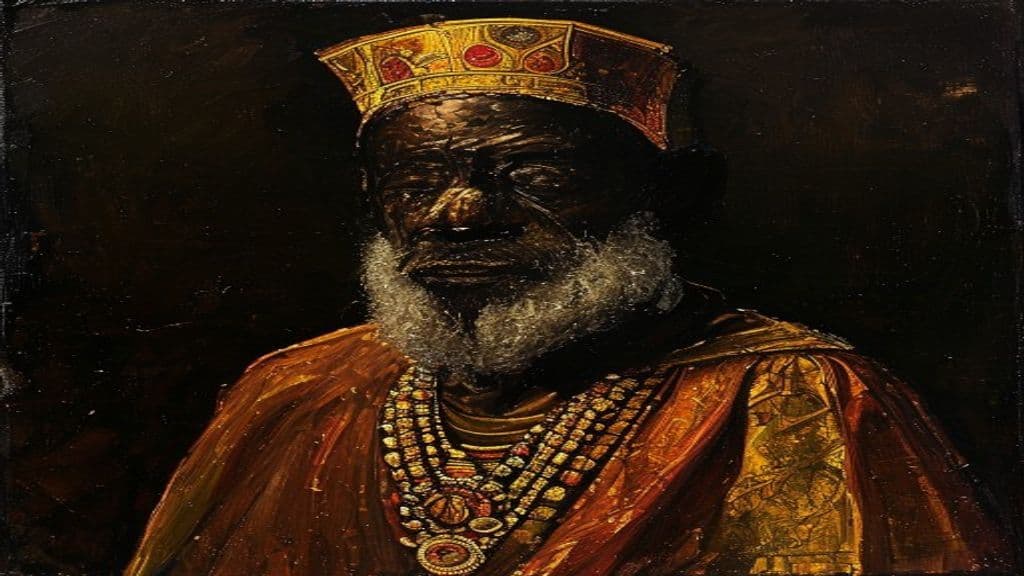
The provided source describes Èṣù as "a prominent primordial divinity who descended from Ìkọ̀lé Ọ̀run." Within the scope of that summary, this situates Èṣù among the earliest divine figures in Yoruba cosmology: he is presented as a primordial orìṣà whose origin is traced to Ìkọ̀lé Ọ̀run and whose institutional role within the pantheon is to enforce and regulate natural and divine order. The source frames his descent as part of his standing in the pantheon (a foundational or early divine presence) and links that standing directly to his authority over enforcement, judgement, and mediating thresholds; no further narrative details of the descent are provided in the source.
The supplied sources do not provide a physical description or iconographic details for Èṣù. The available material is explicit in its silence on appearance: no colors, garments, emblems, or standardized images are documented in the provided notes. Any descriptions of visual attributes or representative items are therefore not included here because they are not present in the cited sources.
The sources characterize Èṣù as governing trickery, chance, crossroads, judgement, duality, and languages, and as the chief enforcer of natural and divine laws. From these attestations he operates as a liminal mediator who can determine outcomes (chance, judgement), facilitate or complicate communication (languages), and embody ambivalence (trickery and duality). His enforcement role implies authority to hold humans and other beings accountable to moral and cosmic order, and his association with crossroads links that authority to threshold places where decisions and exchanges occur.
Abiku
In Yoruba tradition, the Abiku is a Primordial entity representing the spirits of children who die young. (Note: - Power tier: Primordial seems plausible but should be supported by additional source material confirming its cosmic or deity-level abilities. - Appearance: While the draft mentions spirits often appe)
Aganjú
Primordial Orisha associated with the sun, fire, and the untamed wilderness in Yoruba tradition. (Note: - Remove "untamed wilderness" from Power tier description as it's a trait associated with Lesser entities, not Primordial. - Add Appearance section based on source material (e.g., no specific descript)
Aje (Iyami Aje)
Aje appears in the supplied sources only as part of the compound term "Iyami Aje," which the referenced Wikipedia disambiguation entry labels as a Yoruba concept of feminine power. No further details about its nature, practices, appearance, or rituals are present in the provided materials.
Ajogun
Ajogun are a class of malevolent spiritual forces in the Yoruba religious worldview that regularly interfere with human lives, responsible for death, disease, curses, loss, conflict and related misfortunes. They are described as the polar opposite of the benevolent Oriṣa, led by Iku (Death), and can be warded off or appeased through intercession by Eṣu and by observing Ifá divinatory counsel.
Ayagunna (Yoruba Tradition)
A manifestation of Obatala, the Sky Father, embodying martial prowess and a desire for global peace through domination. (Note: - Power tier should be Greater (Ayagunna is described as manifesting the Sky Father's "fierceness" and having achieved global conquest). - Appearance needs clarification or deletion, as there is no ex)
Egbere
Malevolent humanoid supernatural beings in Yoruba mythology, residing in woods and active only at night. (Note: 1. Power tier should be Greater (powerful regional) based on the description as malevolent beings residing in woods. 2. Abilities need more specific information, such as their connection to darkness o)
Egungun (ancestral masquerade spirits)
Egungun refers both to Yoruba masked, costumed masquerades and to the collective force of departed ancestors who manifest through those masquerades. In performance the layered costumes are treated as a dwelling for ancestor presence; egungun appear periodically—especially at annual festivals—to remember the dead, bless the community, and mediate between the living and the otherworld.
Elegua
Elegua (Ẹlẹ́gbára / Eleguá / Exu / Legba variants) is an Orisha and liminal mediator in Yoruba and Yoruba-derived religions. He is guardian of roads, doorways, and crossroads, the messenger who must be acknowledged before other rituals, and a trickster-enforcer who manages balance between opposites.
Emere (Yoruba tradition)
A being that can traverse between the spiritual and physical worlds at will, misrepresenting death as life. (Note: 1. Power tier should be Primordial -> Greater (since Emere is "more powerful than witches" but not explicitly described as cosmic or deity-level). 2. Appearance description should be more specific tha)
Esu (Eshu, Elegbara)
Esu (also attested as Eshu, Elegbara, Elegua/Elegguá, Exu) is a named Orisha — a deity — in the Yoruba traditional religious system and its diasporic continuations. The provided source identifies Esu principally as an Orisha associated with roads and notes the figure's presence across Ifa/Orisha practice and several Afro-diasporic religions.
Gelede (Gẹlẹdẹ)
Gelede is a Yoruba public masquerade spectacle and the ritual institution that honors and manages the spiritual power of 'Mothers' (senior women, female ancestors and deities). As a multi-media performance of carved and painted headdresses, masks, dance and music, Gelede functions to celebrate fertility and motherhood, educate the community, and placate potentially dangerous female powers.
Ifa-Orisha
In the Yoruba tradition, Orishas are supernatural beings with divine powers and attributes, worshiped as intermediaries between humans and Olodumare. (Note: - Power tier: Should be Ancient (deity-level) instead of Primordial - Abilities: The statement "each Orisha has distinct attributes" is unclear and could be rephrased to better reflect the source mate)
Community Record
- [1]Eshu. Wikipedia, 'Eshu' (accessed via provided research notes)wiki
- [2]Eṣu. Wikipedia, 'Eṣu' (alternate rendering noted in provided research notes)wiki