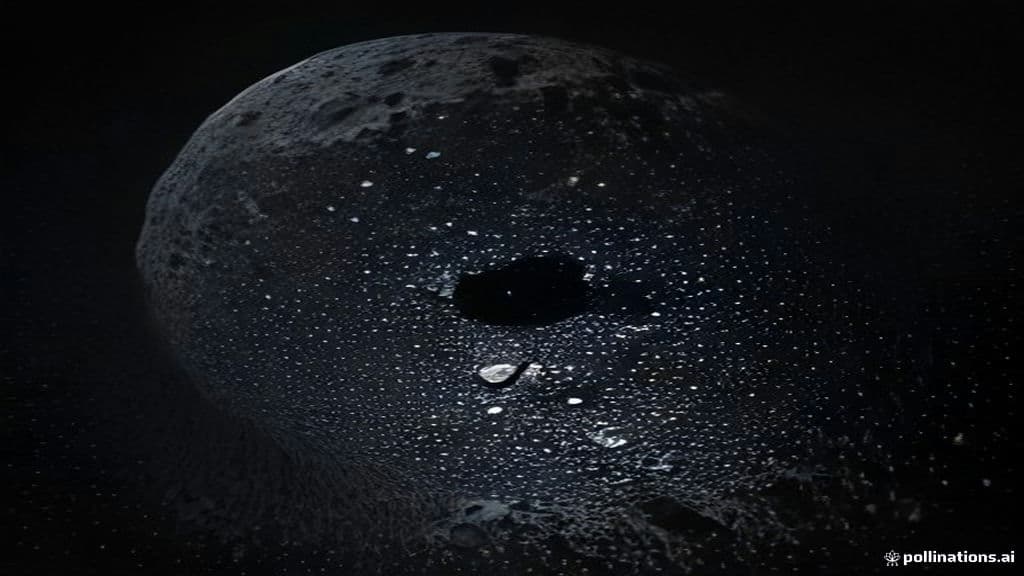
Within the scientific cosmology the object is not created in mythic time but represents a life-history stage: an active comet repeatedly heated by perihelion passages loses surface volatiles until it transitions through stages (active → transition → dormant → extinct), ending as a volatile-depleted, inert nucleus that observationally resembles an asteroid.
Appears as a small, dark, inert lump of rock or rubble with low albedo and lacking a detectable coma or tail. It may possess an inactive surface crust (centimetre-scale in examples) that seals remaining volatiles and renders the body indistinguishable in many observations from certain asteroids; some suspected examples include 3200 Phaethon, 3552 Don Quixote, and 14827 Hypnos.
As understood scientifically, an extinct comet does not emit sustained gas or dust and thus lacks cometary activity. Dynamically it behaves like other small Solar System bodies, orbiting the Sun with a range of orbital elements (some retaining eccentric, inclined orbits typical of Halley-type comets). If volatiles remain sealed beneath a crust (a dormant state), activity could in principle resume if that crust is disrupted — a distinction used by researchers to separate dormant from extinct nuclei. Practically, these objects affect classification, hazard assessment, and mission planning when they are catalogued as asteroids or recognized as cometary remnants.
Weaknesses
- conditionexposure/disruption of surface crust
- othersensitivity of classification to observational tests (spectroscopy, albedo measurement, searches for weak activity)
Wards
- ritualobservational characterization
- othercataloguing and follow-up monitoring
24 Themis
24 Themis is a large outer-main-belt asteroid and the parent body of the Themis collisional family. Scientifically notable for infrared detections of surface water ice and complex organics, it is a physical minor planet named after the Greek personification of natural law and order.
Amor asteroid
A class of near-Earth asteroids (NEAs) defined by orbital parameters: semi-major axis a > 1.0 AU and perihelion q satisfying 1.017 AU < q < 1.3 AU, placing their perihelia exterior to Earth's aphelion so they do not currently cross Earth's orbit. Named after the prototype object 1221 Amor, the group includes diverse bodies (e.g., 433 Eros) that are part of the dynamically evolving population of Earth-approaching small bodies.
Metis (name / label; disambiguation of uses)
The string 'Metis' (variants Métis, Metiş) appears across many domains — as an Indigenous ethnonym (Métis), place names (Metis Shoal, Metiş village, Metis Island), astronomical and biological names (9 Metis asteroid, Metis moon, genus names), a brief Wikipedia mention of a mythological Metis (Oceanid and wife of Zeus), and multiple modern institutional and cultural uses. The supplied sources do not document a single, coherent supernatural entity named 'Metis' with folkloric appearance, powers, or rituals.
The Indestructibles
In ancient Egyptian culture, The Indestructibles refer to two bright stars, Kochab and Mizar, associated with eternity and the afterlife. (Note: - The power tier should be Primordial. - Appearance: correct, but note that Kochab is actually located in Ursa Minor, not the "bowl of Ursa Minor", which seems to refer to the Little Dipper. Mizar is )
Evil eye
A cross-cultural folkloric belief in a harmful influence cast by a person's gaze or look, usually motivated by envy or ill will. Treated as a transmissible curse or force rather than a corporeal being, it is countered by apotropaic objects, formulas, plants, and gestures in many traditions.
Evippus (Εὔιππος)
Evippus (Ancient Greek Εὔιππος, 'having good horses') is a recurring personal name in Greek myth borne by several mortal figures — princes, warriors, and local heroes — attested in varied narrative episodes (Calydonian cycle, the Trojan War, local Megarian and Arcadian tales). The name signals aristocratic/horsemanship status rather than a distinct supernatural class.
Ewiger Jäger
A spectral huntsman from German, Belgian and Pennsylvania Dutch folklore condemned to an unending hunt. Usually portrayed as a formerly human hunter bound by oath, curse, sacrilege, or a dying injunction to pursue quarry ceaselessly, the figure is a local variant of the European wild hunt motif.
Exadius
Exadius (Ancient Greek: Ἐξάδιος) is a mortal Lapith warrior named in Greek myth who took part in the Centauromachy at the wedding of Pirithous and Hippodamia. In the surviving account he seizes a votive stag's double antler from a pine and uses it to pierce and gouge out the eyes of the centaur Gryneus.
Extraño
Extraño is a fictional Peruvian magician and superhero (Gregorio De La Vega) in DC Comics. Introduced in 1988, he is portrayed as a stage‑performer‑turned-sorcerer whose innate magical ability was heightened by a Guardians of the Universe experiment; later reintroductions present him as a powerful sorcerer and queer community leader based in Lima.
Eystein Halfdansson
Eystein Halfdansson (Old Norse: Eysteinn Hálfdansson) is presented in Norse king-list and saga tradition as a semi-legendary Norwegian petty king of the House of Yngling who ruled Romerike and acquired Vestfold by marriage. He is depicted as a dynastic ruler and Viking raider whose death is attributed in Snorri's Ynglinga saga to a magical act performed by King Skjöld of Varna.
Ezekiel
Ezekiel is a human prophet and priest of the Hebrew Bible whose recorded prophetic activity during the Babylonian exile includes vivid visionary encounters (notably the merkabah or chariot-throne and four living creatures) and symbolic enacted prophecies addressing judgment and restoration for Judah and Jerusalem.
Ezekiel's Cherub in Eden
A figure in Ezekiel 28:13–14 described as an "anointed cherub" in Eden; used within the prophetic oracle variously as a paradigmatic, exalted guardian-like being and as a figurative portrait of the King (or Prince) of Tyre. Later interpreters sometimes read the figure as a fallen celestial being linked to Satan, while other commentators insist the passage addresses a human ruler or his splendour.
Community Record
- [1]Extinct comet (Wikipedia). Wikipedia contributors. "Extinct comet." Wikipedia, The Free Encyclopedia.wiki
- [2]extinct comet (Wikidata). Wikidata entry Q1765388, 'extinct comet'.wiki
- [3]Carbon-Based Compounds and Exobiology (NTRS 19960051154). NASA Technical Reports Server. 'Carbon-Based Compounds and Exobiology.' NTRS 19960051154.academic
- [4]ScienceDaily: Could the asteroid Ryugu be a remnant of an extinct comet? Scientists now answer. ScienceDaily article discussing hypotheses that some asteroids may be extinct comets.other
- [5]365 Days of Astronomy: Rubble Pile Asteroids May Be Extinct Comets. CosmoQuest / 365 Days of Astronomy. 'Rubble Pile Asteroids May Be Extinct Comets.'other