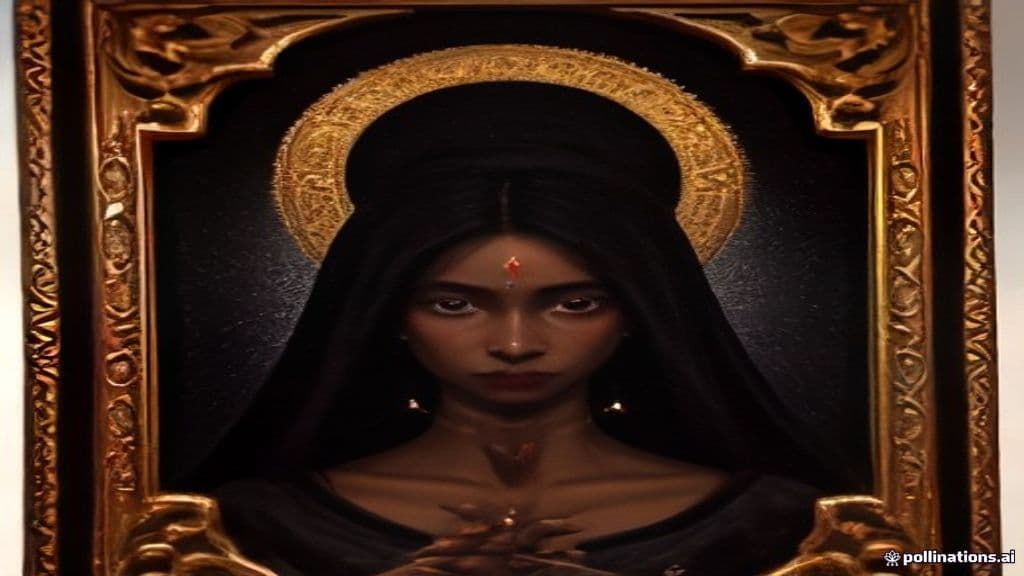
Sources present Ezili Dantor as a manifestation within the broader Erzulie locus of feminine spirits; she is identified as a senior Petro lwa. Some accounts link her to Haitian revolutionary memory: according to certain traditions she was honored at a feast after which the 1791 slave revolt began, and she is described in some sources as being considered the 'national lwa.' These narratives are presented as traditional accounts rather than uncontested historical fact.
Dantor is described as dark-complexioned and frequently represented as a Black or dark-skinned mother figure. Many modern devotional and diasporic representations syncretize her with Black Madonna imagery and Catholic images (e.g., the Black Madonna of Częstochowa, Our Lady figures). Several accounts also note scars on her cheek (twa màk), said in some stories to have been inflicted during a fight with Erzulie Freda.
Ezili Dantor is a maternal protector who fiercely defends children, single mothers, lower-class women, and gender-nonconforming people (masisi, transgender women, effeminate men). She is petitioned for work, protection, and maternal concerns. Dantor is also famed for quick anger and destructive power—sources attribute vengeance, illness, and other harmful consequences to her wrath; this ferocity yields the epithet Èzili Je Wouj (red-eyed Ezili). Traditions vary on whether she is nonspeaking (one account says her tongue was cut out by revolutionaries) or silent from exhaustion/anger; some say she utters only syllables during possession and uses her daughter Anais as an interpreter. In some sources she takes lovers (Ogoun/Ogun Feraille is named in at least one account) and is linked to revolutionary gatherings.
Weaknesses
None recorded.
Wards
- ritualdevoted service and altar maintenance
Adjassou-Linguetor
Adjassou-Linguetor is a loa in Haitian Vodou associated with spring water. The limited cited sources describe her as having protruding eyes and a bad temper; beyond these points, the available documentation (Wikipedia and Wikidata) is minimal.
Aganjú
Primordial Orisha associated with the sun, fire, and the untamed wilderness in Yoruba tradition. (Note: - Remove "untamed wilderness" from Power tier description as it's a trait associated with Lesser entities, not Primordial. - Add Appearance section based on source material (e.g., no specific descript)
Agwé
Agwé is a high-ranking lwa in Haitian Vodou associated with the sea, navigation, fishing, and certain funerary conveyances. He is portrayed as a naval officer who lives in a palace beneath the sea, commands attendant spirits, and is propitiated with maritime offerings and ceremonies.
Anansi
The spider trickster god of Akan folklore — cunning, mischievous, and wise. Keeper of stories and teacher of human beings, brought through the slave trade into Caribbean and African-American tradition.
Ayagunna (Yoruba Tradition)
A manifestation of Obatala, the Sky Father, embodying martial prowess and a desire for global peace through domination. (Note: - Power tier should be Greater (Ayagunna is described as manifesting the Sky Father's "fierceness" and having achieved global conquest). - Appearance needs clarification or deletion, as there is no ex)
Ayida Wedo
Ayida Wedo is a primordial rainbow-serpent loa of Haitian Vodou (with counterparts in Fon and Ewe vodun) associated with water, the rainbow, and the elemental forces; she often appears paired with Damballa as the dual cosmic serpent that assisted the creator in forming and upholding the world.
Ayizan
Ayizan is a racine (root loa) in Haitian Vodou and related West African-derived Vodoun traditions, functioning as the archetypal mambo (priestess) and a guardian of ritual order, initiation (kanzo), and the transmission of sacerdotal implements such as the asson. She is also associated with the marketplace and commerce and is syncretized with the Catholic Saint Clare.
Baron Samedi
A principal lwa of Haitian Vodou who serves as master of the dead and psychopomp, head of the Gede family; associated with cemeteries, crossroads, resurrection/healing, and licentious, comic behavior.
Bisimbi (Simbi)
Bisimbi (singular Simbi) are water and nature spirits in Bakongo (Kongo) traditional religion. They are associated with waters and natural sites in the Kongo-speaking region and are attested to continue, with transformation, in Atlantic diaspora spiritual systems such as Lowcountry Hoodoo and Cuban Palo.
Bizango
Bizango refers to secret societies in Haiti associated with Vodou practice and rural social governance. Sources portray them as local arbiters with contested reputations, variously remembered as community enforcers, makers of ritual objects, and — in folklore and some ethnographic accounts — practitioners of coercive or secretive magical acts.
Bloody Bones
Bloody Bones (also Rawhead, Rawhead-and-Bloody-Bones) is a vernacular bogeyman figure originating in Britain and carried into regional North American traditions; it functions chiefly as a cautionary monster used to frighten children from danger and ill speech, typically associated with deep water or dark household recesses.
Br'er Rabbit
Br'er Rabbit is an African-American folktale trickster — an anthropomorphic rabbit/hare who survives and triumphs by cunning rather than strength. Originating in oral traditions of enslaved Africans in the American South and related Caribbean communities, the character features in story cycles that teach, entertain, and comment on social relations.
Community Record
- [1]Ezili Dantor (Wikipedia). Ezili Dantor. Wikipedia. (provided research notes)wiki
- [2]Erzulie (Wikipedia). Erzulie. Wikipedia. (provided research notes)wiki
- [3]Haiti Devil Compact / Spirit Work references. Haiti Devil Compact; Jesterbear Spirit Work source referencing Dantor, Ogoun Feraille, and Bois-Caiman meeting. (provided research notes)other
- [4]Spirit Work: Blesseed Virgin of the Bright Hill. Spirit Work (Jesterbear) noting veneration in Haitian and New Orleans contexts. (provided research notes)other
- [5]Maman Brigitte (Bewildering Stories excerpt). Excerpt noting cautionary admonition 'Dont anger Ezili Dantor.' (provided research notes)other
- [6]Contemporary and archival references (Immersive art, archives). Archive materials referencing 'Ezili Dantor: Freedom & The African Diaspora' and contemporary cultural resonances. (provided research notes)other