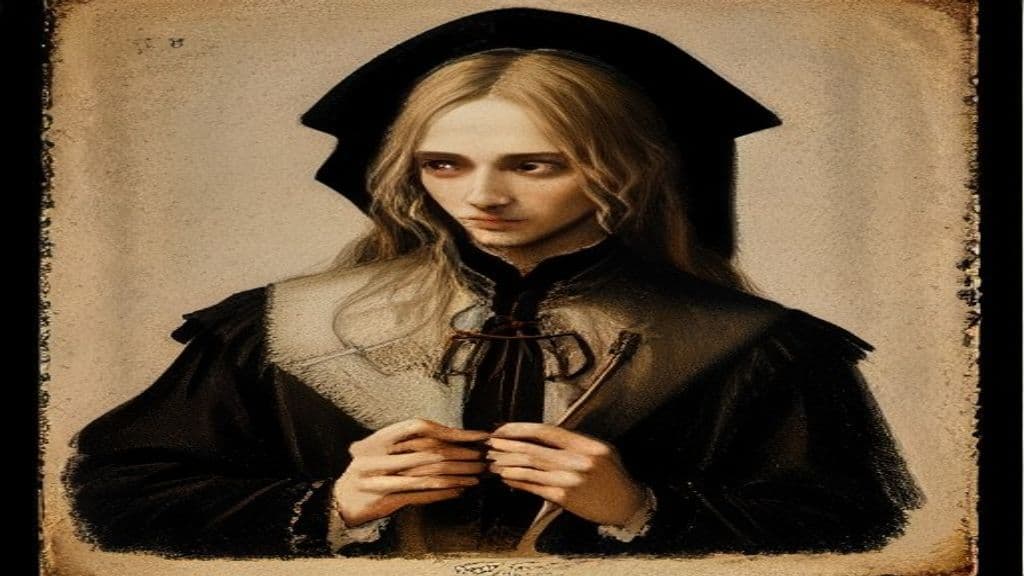
The core legend assembles around a probable historical itinerant scholar Johann Georg Faust (c. 1480–c. 1540) and first appears in print as the chapbook Historia von D. Johann Fausten (1587). In the narrative complex Faust is an erudite scholar dissatisfied with the limits of conventional learning who solicits infernal aid and makes a pact at a crossroads exchanging his soul for a term of service that grants knowledge and pleasures. Over centuries the tale circulated in popular chapbooks, puppet plays, and dramatic adaptations (notably Christopher Marlowe’s Doctor Faustus and Goethe’s Faust), and scholars note analogues and possible name-relatives (e.g., Johann Fust, Faustus in Historia Brittonum) and cognate European motifs such as the Polish Pan Twardowski and the Theophilus legend; the precise historical origins and strands remain debated in the sources.
Sources portray Faust primarily by social and intellectual markers rather than a fixed physical description: he is an erudite, learned scholar (studying theology and medicine) who is highly successful yet dissatisfied. Early chapbooks emphasize his turning away from sacred learning (“laid the Holy Scriptures behind the door… refused to be called doctor of theology, but preferred to be styled doctor of medicine”). Literary and theatrical depictions (Marlowe, Goethe, illustrated chapbooks, films and stage adaptations) provide varied visual representations tied to each medium’s conventions, but the tradition contains no single canonical bodily description beyond the scholarly persona; his story is regularly accompanied by an infernal representative (commonly Mephistopheles) who provides the supernatural powers.
Faust is a human who obtains supernatural powers by bargaining with an infernal representative (the Devil/Mephistopheles). The granted abilities are deployed to obtain forbidden or extensive knowledge and to secure worldly pleasures; narratives cite magical powers used to explore arcane knowledge and to effect seduction and worldly advantage (Goethe’s drama depicts Mephistopheles aiding Faust in seducing Gretchen, with tragic consequences). Different textual traditions diverge on consequences: early popular versions depict Faust as irrevocably damned and carried off to Hell at the bargain’s end, while Goethe’s reworking presents the possibility of salvation through ‘constant striving’ and the intercession of pure-hearted figures.
Weaknesses
- conditionsubject to theological judgment (variant outcomes: irrevocable damnation in early chapbooks; possible salvation in Goethe through striving and intercession)
Wards
- othernone documented in provided sources
*Perkʷūnos
*Perkʷūnos is the reconstructed Proto-Indo-European thunder‑god hypothesized by comparative linguistics and mythology. Scholarly reconstructions portray him as a storm or thunder figure associated with fructifying rain and as the combatant who fights a multi‑headed water‑serpent to release life‑giving waters; no direct attestations from the Proto‑Indo‑European period survive and the figure is inferred from later Indo‑European traditions.
*Péh₂usōn (reconstructed)
Péh₂usōn is a hypothetical Proto‑Indo‑European pastoral guardian reconstructed by comparative scholars from parallels in Greek and Vedic traditions. Proposed as a Graeco‑Aryan ancestor‑figure, the reconstruction describes a protector of flocks, roads, and travellers rather than an attested historical cultic personality.
3-D Man
3-D Man is a Marvel Comics superhero identity associated with a 1950s-era origin in which the body of Chuck Chandler can materialize in three-dimensional existence when activated by his brother Hal via a pair of glasses. The mantle was later assumed by Delroy Garrett (formerly Triathlon) in modern continuity.
5 Ronin
5 Ronin is a 2011 Marvel Comics five-issue limited series that reimagines five Marvel superhero archetypes as rōnin (masterless samurai) in a fictionalized post‑Sekigahara feudal Japan. The work places Wolverine, Hulk, Punisher, Psylocke, and Deadpool analogues into period roles to explore displacement, revenge, and identity in an era of political upheaval.
57 Mnemosyne
57 Mnemosyne is a large main-belt asteroid (S-type) discovered in 1859 and named after the Greek Titaness Mnemosyne. It is a non-sentient astronomical body studied for its orbital and rotational properties and has been used in dynamical measurements related to Jupiter.
A Elbereth Gilthoniel
An Elvish hymn in Sindarin addressed to Elbereth (Varda) from J. R. R. Tolkien's legendarium. Presented in The Lord of the Rings and later musical and dramatic adaptations, the hymn functions as devotional poetic language that evokes Elvish reverence for the star-kindler rather than an independent supernatural agent.
A.R.G.U.S.
A.R.G.U.S. is a fictional clandestine United States government agency in the DC Comics universe that investigates, contains, and manages superhuman, meta-human, and supernatural incidents and assets. Introduced in The New 52 continuity, it functions as an institutional actor providing intelligence, logistical support, covert task forces (notably Task Force X / the Suicide Squad), and a dedicated magic division across comics and media adaptations.
Abaddon
In Hebrew scripture Abaddon is primarily a noun meaning 'destruction' or a section/condition of the underworld paired with Sheol; in the New Testament Book of Revelation Abaddon is personified as an angelic figure (Greek Apollyon) described as the king of an army of locusts released from the abyss during the apocalypse.
Aban Yasht
The Aban Yasht is a hymn from the Persian tradition that praises Anahita, a goddess associated with water, fertility, and wisdom. It consists of 132 stanzas and is part of the 21 Yashts collection. (Note: - Power tier should be "Primordial" or possibly "Cosmic", given that it's a hymn of great spiritual significance and associated with a goddess. - The article incorrectly states that Anahita is associa)
Abath
No corroborated folkloric entity named "Abath" is documented in the provided sources. The string appears in the supplied material only as a surname/personal name in Aruban/Dutch-Caribbean archival records and as an unrelated taxonomic or encyclopedic hit; no mythic attributes, origin stories, rituals, or apotropaic practices for an entity called Abath are present in the documents reviewed.
Abatur
Abatur is an uthra (celestial emanation) in Mandaeism described as the 'father of the Uthras' and called the Ancient (ʿattīqā). He resides on the boundary between the World of Light and lower regions, functions as a judge who weighs souls (Abatur Muzania), and supplies instructions and materials to the demiurgic uthra Ptahil in accounts from the Diwan (Scroll) of Abatur.
Abatwa (Twa / Batwa)
Abatwa (also recorded as Twa, Batwa, Mutwa; singular forms Barhwa or Murhwa in some transcriptions) are indigenous hunter‑gatherer peoples of the Great Lakes region of Central Africa, historically identified as some of the earliest inhabitants of the area. The available sources treat them as human ethnic groups whose livelihoods, lands, and populations have been severely affected by conservation policies and modern violence.
Community Record
- [1]Faust. Faust — Wikipedia article (summary and bibliographic information, including note on 1587 Historia von D. Johann Fausten and discussion of variants such as Goethe and Marlowe).wiki
- [2]Faust | Project Gutenberg (Goethe's Faust — Part I). Goethe, Johann Wolfgang von. Faust — Part I (Project Gutenberg edition referenced in source list for textual treatment and outcomes in Goethe’s reworking).literary
- [3]Faust | Project Gutenberg (Faust editions). Editions/illustrated Project Gutenberg copy referenced among sources documenting print history and visual adaptations.literary
- [4]Wikidata: Faust. Wikidata entry for Faust (identifier and structured metadata referenced in source list).other
- [5]Archive item referencing Faust tradition. Archive materials listed among provided sources (used as part of the supplied source corpus).other