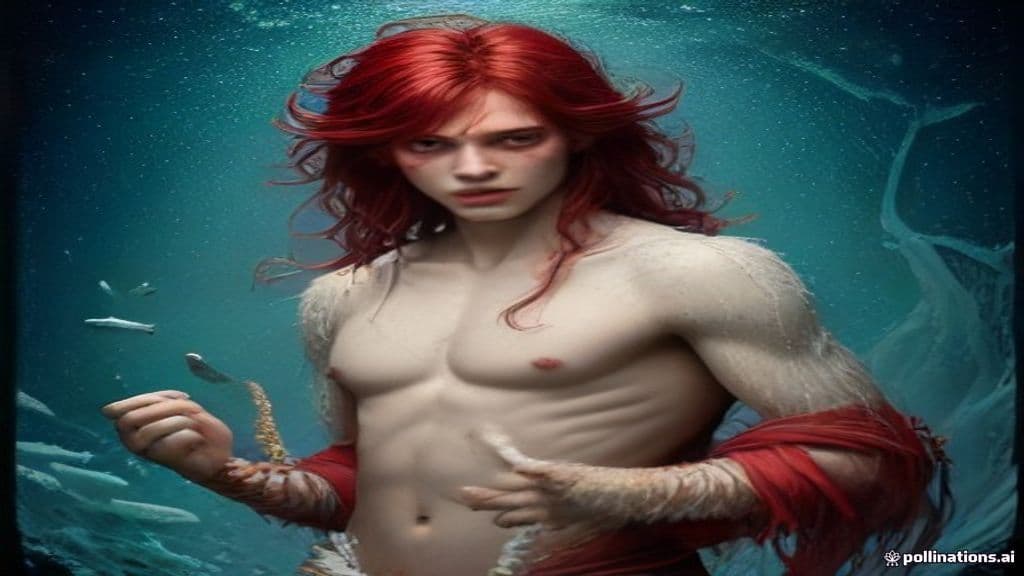
According to testimonies collected and published by Enlightenment writer Benito Jerónimo Feijoo (c.1720), Francisco de la Vega Casar disappeared while swimming in the Bilbao estuary on Saint John's Eve in 1674. Five years later, fishermen off Cádiz captured and brought to shore a human‑shaped, fish‑marked creature entangled in nets (dated 1679 in Feijoo's account). The fishermen took the being to the Franciscan convent in Cádiz where he was allegedly exorcised and questioned; the single intelligible word he later spoke identified him with Liérganes. He was escorted back to his family in Liérganes, where he lived for about nine years before returning to the sea and disappearing once more. Feijoo treated witness testimony as evidence and concluded that a fish‑man had appeared in Cádiz and lived in Liérganes for a time.
Contemporaneous accounts as summarized by Feijoo describe the creature as having an otherwise human shape and looking like a young man with pale/white skin and thin red hair matching the missing man's description. Observers reported fish‑like signs: a strip of scales running from throat to stomach, another covering the spine, and what appeared to be gills around the neck. He habitually walked barefoot and, unless clothed by others, often went about nude.
The being survived at sea and was capable of remaining at large in maritime conditions for years; fishermen reported it became entangled in nets and was difficult to secure. Initially it did not answer questioning in several languages; after days it uttered the word "Liérganes" and later muttered isolated words such as "tobacco, bread or wine." It ate with avidity when it did eat but could also go a week without eating. Behaviorally it was described as easygoing and obliging in simple tasks but socially unresponsive and minimally verbal. Clerical authorities subjected it to an alleged exorcism, indicating contemporaries regarded it as possibly supernatural or pathological.
Weaknesses
- othersusceptibility to capture and clerical handling
- otherno recorded supernatural vulnerabilities (sources do not specify)
Wards
- ritualalleged exorcism by Franciscan friars
Aernus
Aernus is a theonym attested in a small number of Roman-period inscriptions from the vicinity of Bragança (north-eastern Portugal). Scholarly discussion treats Aernus as a local or regional deity within the Lusitanian and Gallaecian pantheons, probably serving as a protector of a specific tribal group (the Zoelae) in a limited territorial horizon.
Anjana
Anjanas are benevolent female fairy beings in Cantabrian popular belief who protect forests, springs, animals and people, aid the poor and lost, leave gifts for the generous, and oppose the hostile Ojáncanu. Oral tradition presents them either as heavenly agents sent by God with a limited earthly term or as spirits of trees who care for the woodland.
Arquetu
A Cantabrian popular-belief figure depicted as an old man marked with a green cross and seven keys on his forehead who intervenes in human economic affairs by lending money to prodigals and punishing repeat wastefulness with a curse of eternal poverty.
Bandua
Bandua is a theonym attested in Roman‑period epigraphic sources from north‑west Iberia (Galaico‑Lusitanian area). The name appears with many localizing epithets and is reconstructed by scholars as a local tutelary or protective divine figure (or a set of closely related local figures) with occasional Roman syncretism to Mars.
Batea
Batea is a polysemous term found in scientific, geographic, material-culture, mythological, and modern technical contexts. In the supplied sources it appears as a genus of amphipod crustaceans, two named figures in Greek mythology (without further detail in these sources), a municipality in Catalonia, a traditional gold-panning pan, and as the name/acronym of contemporary technical and policy documents.
Caballucos del Diablu
In Cantabrian tradition the Caballucos del Diablu are supernatural horses—described as the damned souls of sinners—that are said to appear on the night of St John (June 23). They form part of a regional bestiary of fantastic beings and are linked to Christian notions of sin, punishment, and the annual bonfire rites.
Cantabrian Neptune
A Roman-name sea-deity invoked in ritual contexts along the Cantabrian coast; attested in fragmentary sources as the sacred agent associated with the open sea in local ritual taxonomy rather than a richly attested autonomous Cantabrian personality.
Carassa de Barcelona
No reliable information about a folkloric or supernatural entity called 'Carassa de Barcelona' is present in the supplied sources. References in the materials relate to Barcelona's street naming, Christmas markets, and neighborhood culture, but none document an entity by this name.
Catalina Lercaro
Catalina Lercaro is the legendary specter associated with a 16th‑century member of the Genoese Lercaro family who allegedly died by suicide in the family mansion (Casa Lercaro) in San Cristóbal de La Laguna, Tenerife. Tradition holds her ghost walks through the rooms of the mansion (now the Museum of History and Anthropology of Tenerife) and she is widely regarded in local lore as the Canary Islands' most famous ghost.
Corocotta
Corocotta is a name attested in two related registers: a Cantabrian legendary/historical human figure remembered as a guerrilla leader or bandit active during the late 1st century BC, and a classical natural-history term for an exotic canid/felid‑like beast (often equated with the spotted hyena) described in Greco‑Roman literature. The two usages overlap by name but represent distinct traditions—local oral memory of resistance and wider Roman wonder‑literature about exotic animals.
Cuegle
The cuegle is a monstrous figure from Cantabrian (northern Spain) folklore: a small, bipedal humanoid with grotesque features that attacks people and livestock and is reputed to steal babies from cradles. Household protection recorded in sources is placing oak or holly leaves in the cradle, which the creature is said to find repulsive.
Cuélebre
A legendary long‑lived reptilian guardian from Asturian and Cantabrian folklore, depicted as a giant winged serpent or dragon that inhabits caves and watery liminal places, guards treasure, and is sometimes said to hold xanas (fairy‑like beings) captive. Folktales attribute to it senescent physical changes, a miraculous healing byproduct, and specific folkloric countermeasures.
Community Record
- [1]Fish-man. Wikipedia: 'Fish-man of Liérganes' summary (accessed via provided research notes)wiki
- [2]fish-man (Wikidata entry referencing modern fictional usage). Wikidata: note on modern fictional race homonym (One Piece), distinct from Cantabrian legendother