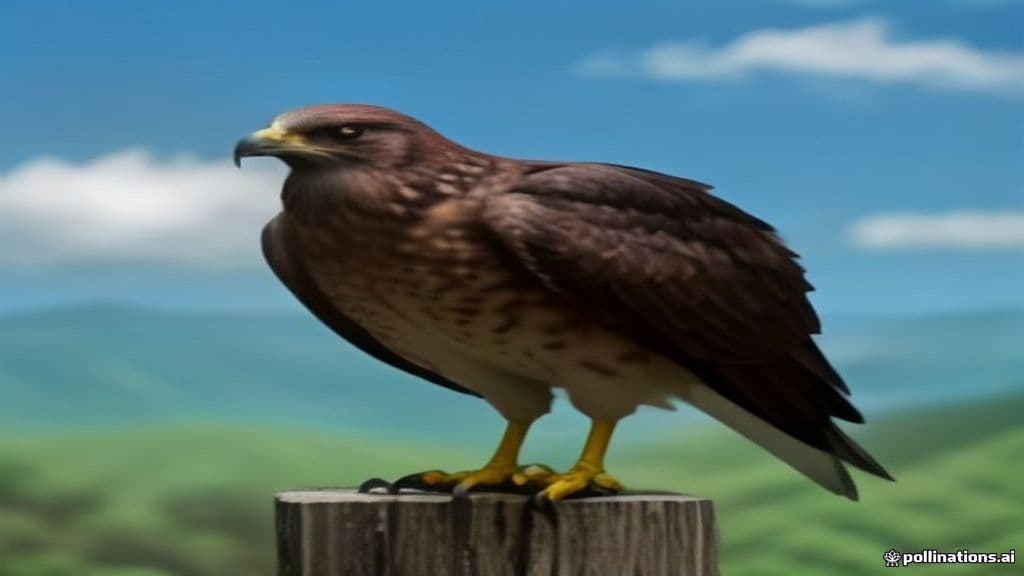
In Hawaiian cosmogony as recorded in the Kumulipo, the ʻio appears among the many birds 'unleashed' in the third period of creation (wā). This placement within the creation chant situates the species as part of the genealogical order of created life-forms in Hawaiian tradition. Separately, the compound name ʻiolani ('exalted hawk') has been used in chiefly and royal contexts (notably as the name of Kamehameha IV and of ʻIolani Palace), indicating the bird's importance as an emblem of chiefly rank and exaltation in Hawaiian cultural-political language.
The Hawaiian hawk is a medium-sized Buteo measuring about 40–46 cm (16–18 in) in length. The species shows sexual dimorphism, with females larger (average ~605 g) than males (average ~441 g). Two color phases occur: a dark phase with dark brown head, breast, and underwings, and a light phase with a dark head and lighter breast and underwings. Adult feet and legs are yellowish (juveniles greenish), and during the breeding season one member of the pair develops a distinctive yellow forecap area above the upper mandible. Its call is described as a shrill, high-pitched vocalization approximated by 'eeeh-oh'.
Descriptions in the sources are natural-history behaviors rather than supernatural powers. The ʻio is a solitary, territorial raptor that hunts from perches and by aerial dives, and is an opportunistic predator feeding on introduced animals today (rats, lizards, game birds, invertebrates) and likely feeding historically on native small birds. It breeds March–September, typically laying one egg (sometimes up to three) with an incubation period of about 38 days; females do most incubation while males hunt; chicks fledge at about 7–8 weeks. The species is a strong flier and is notably vocal during the breeding season. Symbolically, the bird's listing in the Kumulipo and its use as ʻiolani mark it as part of mythic creation order and as a royal symbol, but the provided sources do not ascribe personal supernatural agency or aumakua status to the species.
Aitu (Māori)
Malevolent spirits in Māori tradition, often taking the form of plants or animals and associated with trouble-making and mischief. (Note: - Power tier should be Greater, not Lesser (Aitu being lesser gods in some cultures, but also associated with deity-level abilities) - Abilities: Add detail about their role as patrons of specific vil)
Aiwohikupua
Aiwohikupua is a personal name attested once in the supplied corpus of collected Hawaiian-language narrative material. The available sources provide only a short fragmentary occurrence of the name and no corroborating description, role, or attributes.
Akava'ine
Akava'ine is a Cook Islands Māori social and gender category for people assigned male at birth who live or present as women or otherwise occupy a gender-variant/transgender role. The term (Cook Islands Māori) literally means "to behave as a woman" and has both historical ethnographic mentions of gender-variant individuals in the Cook Islands and a contemporary use (since the 2000s) among Cook Islands Māori, including diaspora communities.
Akua
Akua is the Hawaiian common noun for a god, deity, or divine being; in the provided sources it functions as a lexical category applied to indigenous Hawaiian deities and as the translation-term for the Christian God in Hawaiian-language liturgy and scripture.
Ascalapha odorata (Hawaiian)
A nocturnal moth associated with death or misfortune in Hawaiian tradition, possibly tied to Central and South American folklore. (Note: - Summary should note that Ascalapha odorata's association with death/misfortune is found in Central and South American folklore, not explicitly mentioned in Hawaiian tradition. - Power tier: Primordi)
Atanua
Atanua is the Marquesan (Polynesian) goddess of the dawn who, in local cosmogony, is the consort of Atea and mother of the first man; she is also credited in the surviving summary accounts with creating the seas as the result of a miscarriage.
Atea
Atea is a primordial creator-associated being in multiple Polynesian traditions (Marquesas, Tuamotu, and Māori) closely associated with light and the ordering of the cosmos. Variants depict Atea as a self-originating giver of light, a progenitor who fathers gods and humans, or as the cosmic universe that is sex-differentiated into Heaven and Earth in one reported account.
Atua (Māori Deity)
In Māori mythology, Atua are supernatural beings believed to have created the world and all living things. They are considered rulers of the spiritual realm with powers over nature, fertility, and human destiny. (Note: 1. Power tier: Based on the abilities described (controlling nature, fertility, and human destiny), Atua likely belong to the Primordial power tier, not Greater. 2. Weaknesses: Add a specific weakness)
Avatea
Avatea (also spelled Vatea in some sources) is a primordial parent figure in Mangaian (Cook Islands) mythology, described as a lunar deity and god of light whose eyes were thought to be the Sun and the Moon, and who is called the father of gods and men in the island's origin narrative.
Binabinaaine
Binabinaaine (also spelled pinapinaaine) is a culturally specific third-gender role from the Gilbert Islands (now Kiribati) that has been loaned into Tuvaluan usage; it denotes people assigned male at birth who adopt feminine gender expressions, social responsibilities, and roles and are regarded locally as neither men nor women but a distinct social category.
Dakuwaqa
Dakuwaqa is a Fijian shark deity and powerful sea-being who functions in tradition as both a fierce sea monster and a guardian of islands and fishermen. In recorded myths he can threaten islands in specific narratives but also becomes protector of places and is placated by offerings such as kava libations.
Earth deity
An earth deity is the personification or deification of the Earth in a culture's cosmology, often tied to fertility, the ground/land, chthonic or underworld aspects, and communal protection of territory or Dharma. Specific named examples include Papa (Polynesian/Maori), Geb (ancient Egyptian), and Prithivi (in Buddhist textual contexts).
Community Record
- [1]Hawaiian hawk. Wikipedia contributors, 'Hawaiian hawk', Wikipedia, The Free Encyclopedia.wiki
- [2]Hawaiian Hawk (Wikidata). Wikidata entry Q1275471.other
- [3]Archive materials (checked for relevance). Archive.org holdings referenced in research notes (no hawk-specific ritual material found).other