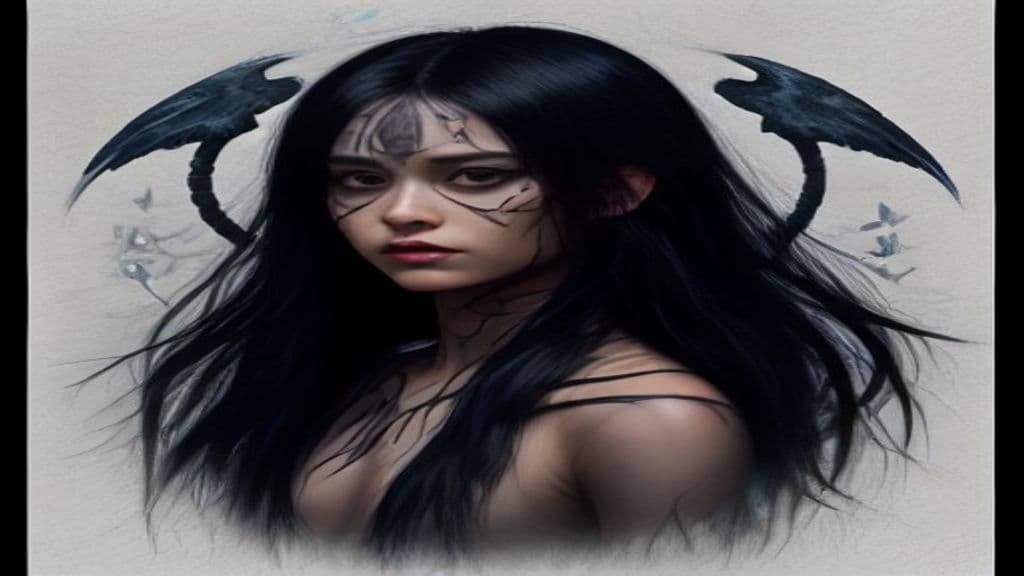
In Māori pūrākau Hine-nui-te-pō begins life as Hine-tītama, daughter of Tāne and Hine-ahu-one. After discovering the familial relationship between herself and Tāne (she learning that Tāne was both husband and father), Hine-tītama withdrew from the world of the living and descended into the underworld, becoming Hine-nui-te-pō, the atua of night and guardian of Rarohenga who receives human souls.
Sources do not offer a single consistent portrait; representations vary by narrative. In some fragmentary passages she is described performing a beak-like transformation. In the Māui narrative one frequently cited account describes a lethal anatomical detail—obsidian teeth—used in that episode. These features appear as story-specific or symbolic motifs rather than as a universally agreed physical description across traditions.
Hine-nui-te-pō's primary role is custodial: she receives and shepherds human wairua into the first level of Rarohenga and prepares them for the next stage of their journey. In mythic narrative she upholds the finality of death—most famously in the Māui episode, where Māui attempts to enter her to obtain immortality for humankind and is killed when she awakens and crushes him, an action that functions to preserve human mortality in the story tradition.

Aitu (Māori)
Malevolent spirits in Māori tradition, often taking the form of plants or animals and associated with trouble-making and mischief. (Note: - Power tier should be Greater, not Lesser (Aitu being lesser gods in some cultures, but also associated with deity-level abilities) - Abilities: Add detail about their role as patrons of specific vil)
Akava'ine
Akava'ine is a Cook Islands Māori social and gender category for people assigned male at birth who live or present as women or otherwise occupy a gender-variant/transgender role. The term (Cook Islands Māori) literally means "to behave as a woman" and has both historical ethnographic mentions of gender-variant individuals in the Cook Islands and a contemporary use (since the 2000s) among Cook Islands Māori, including diaspora communities.
Aotea (Canoe)
Ancestral waka in Māori tradition, significant in the migration of the Māori people to New Zealand. (Note: - Power tier should be at least Greater (deity-level), considering Aotea is associated with significant spiritual and cultural importance to the Māori people's migration. - Abilities should include de)
Aotearoa (Canoe)
An ancestral vessel in Māori tradition, associated with the migration and settlement of New Zealand. (Note: 1. Power tier should be Ancient, not Primordial. 2. Remove "Historical significance" from sensory cues as it is a general statement rather than a specific cue. 3. Add "Its presence is often associated)
Apakura
Female figure in Māori mythology, wife of Tūhuruhuru and/or Tūwhakararo, associated with multiple generations of whānau. (Note: 1. Power tier: Given her association with multiple generations of whānau and the miraculous birth story involving Whakatau, it's likely she should be classified as a Greater entity. 2. Abilities: Add )
Arahura (Māori canoe)
Divine Māori canoe made of pounamu, associated with the Ngāi Tahu tribe and spiritual significance. (Note: * Power tier: Not specified, assume Lower or Lesser as it's associated with the tribe and not described as a deity-level being * Abilities: Remove the mention of spiritual significance and connection )
Arautauta
The Arautauta is a significant waka (canoe) in Māori tradition, playing a key role in the migration of people to New Zealand. (Note: - Power tier: Should be Primordial (as it's a significant waka in Māori tradition) - Abilities: Should mention its use for transporting people and goods as a notable aspect of its significance - Appea)
Arawa (canoe)
In Māori tradition, the Arawa is a supernatural canoe representing the ancestors' journey to New Zealand. (Note: * Power tier: Primordial (or not specified at all, as there's no indication of supernatural powers beyond its symbolic and cultural significance) * Appearance: No physical description mentioned in sou)
Atea
Atea is a primordial creator-associated being in multiple Polynesian traditions (Marquesas, Tuamotu, and Māori) closely associated with light and the ordering of the cosmos. Variants depict Atea as a self-originating giver of light, a progenitor who fathers gods and humans, or as the cosmic universe that is sex-differentiated into Heaven and Earth in one reported account.
Atua (Māori Deity)
In Māori mythology, Atua are supernatural beings believed to have created the world and all living things. They are considered rulers of the spiritual realm with powers over nature, fertility, and human destiny. (Note: 1. Power tier: Based on the abilities described (controlling nature, fertility, and human destiny), Atua likely belong to the Primordial power tier, not Greater. 2. Weaknesses: Add a specific weakness)
Atutahi (Māori tradition)
In Māori mythology, Atutahi is a celestial entity and the second brightest star in the night-time sky, considered solitary or self-centered. It serves as a navigational aid for Māori sailors, appearing as a bright star on the evening or southern horizon. (Note: - Power tier: Primordial (due to its status as a celestial entity in Māori mythology) - Abilities: Add ability of guidance, specifically for navigation, based on source material - Weaknesses: List is )
Auahitūroa
Auahitūroa is a Māori deity described in the cited sources as the personification of comets and as the origin of fire; he is named as a son of Tama-nui-te-rā (the sun), consort of the fire goddess Mahuika, and father of the five Ngā Mānawa.
Community Record
- [1]Hine-nui-te-pō. Wikipedia, article 'Hine-nui-te-pō'.wiki
- [2]Māori mythology. Wikipedia, article 'Māori mythology'.wiki
- [3]Ep 11: Body Sovereignty with Ashlea Gillon (podcast). Archive.org podcast episode referencing Indigenous perspectives and lessons from the Atua Hine-nui-te-pō.other
- [4]Legends of Māui (summary). Online summary of Māui legends describing the Māui–Hine-nui-te-pō episode.folk
- [5]Pūrākau | Te Ipu Aronui. Te Ipu Aronui discussion of pūrākau as stories that explain origins and moral instruction in Māori tradition.other
- [6]Fantail (piwakawaka) — Māori myths (New Zealand Birds). New Zealand Birds site describing fantail names and noting the bird's role in Māori myth retellings, including the Māui episode where fantails alert Hine-nui-te-pō.other