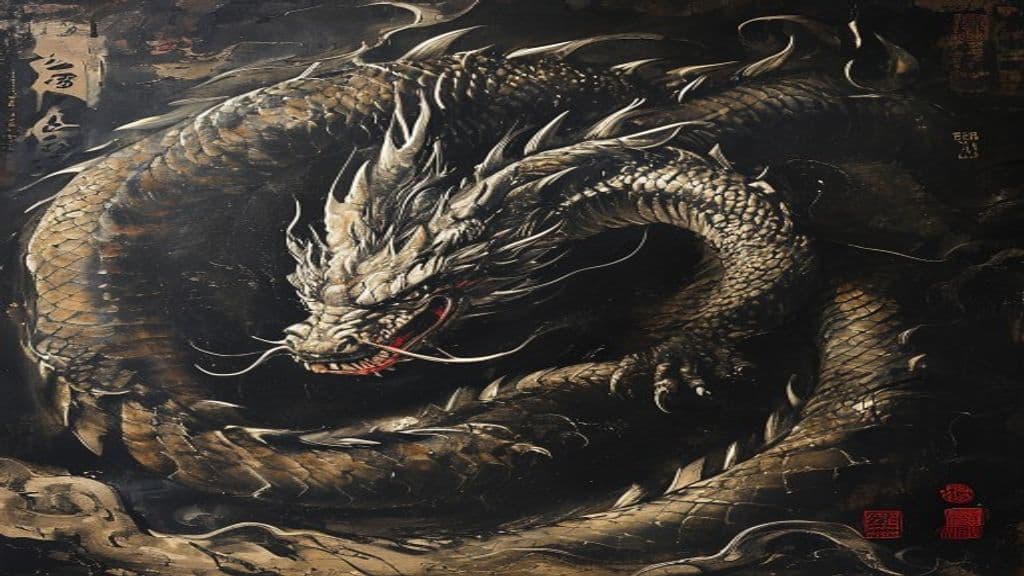
In the sourced popular summaries and folklore accounts, imugis are presented as the precursor form to fully realized Korean dragons. Multiple sources state that most Korean dragons were originally imugis and that an imugi seeking dragonhood must attain a heavenly object or favor; one commonly cited variant holds that an imugi must 'catch a yeouiju from the heavens' to become a true dragon (sources: Arun Prasad; everydayoriginal.com; Wikipedia's entry on Korean dragons). Other summaries in the collected material note variants in popular retellings — for example, accounts that emphasize long life or heavenly favor as mechanisms of elevation — but primary, classical origin narratives or ethnographic texts are not present in the supplied source set (sources: Arun Prasad; Mythlok; Frontiers of Zoology).
Across the available sources imugis are consistently described as large serpents or gigantic serpentine creatures rather than fully formed, typically horned East Asian dragons. Descriptors in the collected material emphasize a 'serpent-like' or 'giant serpent' form and label imugis as 'lesser dragons' or 'proto-dragons' (sources: Arun Prasad; Mythlok; everydayoriginal.com; Frontiers of Zoology). The sources do not provide a uniform, detailed morphological inventory (for example, presence or absence of legs, horns, or wings is not consistently specified) and some accounts note a generally benevolent aura in retellings without standardized iconography (sources: Arun Prasad; Mythlok).
The principal, repeatedly attested ability/role of the imugi in the supplied materials is aspirational: imugis are creatures in a process of becoming — traditionally said in modern summaries to require a yeouiju (heavenly orb) or heavenly favor to transform into a true Korean dragon (sources: everydayoriginal.com; Arun Prasad; Wikipedia). Beyond this transformative motif, the sources situate imugis within the wider East Asian dragon milieu (dragons associated with rain, fortune, and heavenly power) but do not directly ascribe meteorological control or other specific dragon powers to imugis in the provided material; some popular accounts emphasize a non‑malevolent or benevolent temperament in portrayals of imugis (sources: Wikipedia; Arun Prasad; Mythlok).

5 Ronin
5 Ronin is a 2011 Marvel Comics five-issue limited series that reimagines five Marvel superhero archetypes as rōnin (masterless samurai) in a fictionalized post‑Sekigahara feudal Japan. The work places Wolverine, Hulk, Punisher, Psylocke, and Deadpool analogues into period roles to explore displacement, revenge, and identity in an era of political upheaval.
A'ra
No reliable sources in the supplied material establish A'ra as a distinct supernatural entity. The token "A'ra" appears in the dataset as (a) part of general references to pre-Islamic Arabian deities, (b) a modern Korean female given name (A-ra/아라), and (c) an Arabic toponym (A'ra, one village merged into Ar'ara).
Abumi-guchi
A Japanese yōkai classed as a tsukumogami: an animated stirrup (abumi) depicted in Sekien Toriyama's Gazu Hyakki Tsurezure Bukuro. Traditional accounts say it is formed from a stirrup that belonged to a soldier who fell in battle and that it waits where the stirrup lies for its dead owner to return.
Abura-akago
An Edo-period yōkai depicted as an oil‑licking infant or a ball of flame. First recorded in illustrated compendia (notably Toriyama Sekien's Konjaku Gazu Zoku Hyakki), the Abura-akago is tied to tales of oil‑stealing fires and functions in part as an etiological warning about wasting or stealing oil.
Abura-sumashi
A yōkai spirit from the Amakusa region of Kumamoto Prefecture, Japan, said to inhabit mountain passes. Traditionally explained as the ghost of a person who stole oil, it appears to surprise travelers and is represented in modern media with a straw-coat body and a potato- or stone-like head.
Aburabō / Abura-bōzu / Aosaginohi (traditions)
Two distinct Japanese traditions appear under related flame imagery: Aosaginohi/Aosagibi is presented as a will-o'-the-wisp type luminous night phenomenon interpreted as reflections from herons; aburabōzu (abura bōzu, "oil monk") appears in a separate anecdote as a reported fire-breathing apparition in a 12th-century Yasaka Shrine tale. The sources treat them as separate portrayals rather than a single unified being.
Acala
Acala (Sanskrit: अचल, 'The Immovable') is a wrathful protective deity (dharmapala) in Vajrayāna and East Asian esoteric Buddhism, classed among the Wisdom Kings (Vidyārāja). He functions as a ritual focus for visualization and mantra practice intended to remove obstacles and bind or destroy hostile forces.
Agaru
Agaru (attested historically as Agarum) appears in the supplied sources as a Bronze Age Near Eastern toponym—often identified with Failaka Island—and as a modern personal or media name. The provided material contains no evidence that Agaru is a supernatural being in any traditional cosmology.
Ajisukitakahikone
Ajisukitakahikone is a kami in Japanese mythic literature (Kojiki/Nihon Shoki). He appears in the transfer-of-rule cycle between heaven and earth, is described as a son of Ōkuninushi, associated with the Kamo cult (called Kamo no ōmikami in some modern museum/catalog entries), and features in narratives that explain landscape formation and meteorological genealogy.
Aka Manto
Aka Manto (赤マント, "Red Cloak") is a Japanese urban legend and schoolyard ghost-story about a masked, cloaked figure who appears in public or school toilet stalls and forces occupants to choose between colored toilet paper; each choice in the tale produces a violent supernatural consequence. The legend is part of modern popular folklore recorded in school contexts from the 1930s onward rather than a formal religious myth.
Akaname
Akaname is a Japanese yōkai associated with baths, bathtubs, toilets, and other places where scum and filth accumulate. Traditionally depicted as a child-like creature that licks grime, it functions in folklore as a cautionary figure tied to cleanliness; a few narrative variants cast it as dangerously predatory.
Akashaguma
Akashaguma is presented in the available sources as a child-like house guardian spirit in the Japanese yokai tradition, closely comparable to the regional zashiki-warashi. It is associated with domestic interiors (parlors or storage rooms) and with bringing prosperity to households where it dwells.
Community Record
- [1]On Being an Imugi | Arun Prasad. Arun Prasad, 'On Being an Imugi' (blog post), accessed via provided source list.other
- [2]Imugi : The Lesser Dragon - Mythlok. Mythlok, 'Imugi : The Lesser Dragon' (popular folklore summary), accessed via provided source list.folk
- [3]Imoogi and Korean Dragons - Frontiers of Zoology (blog). Frontiers of Zoology, 'Imoogi and Korean Dragons' (blog post), accessed via provided source list.other
- [4]Korean dragon (Wikipedia). Wikipedia, 'Korean dragon' (entry includes mention of imugi as precursor to dragons), accessed via provided source list.wiki
- [5]Capture the Moon - product text (Every Day Original). Every Day Original product description, 'Capture the Moon' (summarizes imugi motif: 'must catch a yeouiju from the heavens'), accessed via provided source list.other
- [6]Imugi : Obscure Life-Forms. Obscure Life-Forms, 'Imugi' (online summary), accessed via provided source list.other
- [7]Imugi (archive/thingiverse related items). Archived item 'Girl with a dragon for CNC (3896745)' (contextual/artifact references to dragon imagery), included in provided source list.other
- [8]You Know the Chinese Dragon but Here Are the Other Dragons from other Asian Countries - Seasia.co. Seasia.co, comparative article on Asian dragons (contextualizes Korean dragons and imugis), accessed via provided source list.other