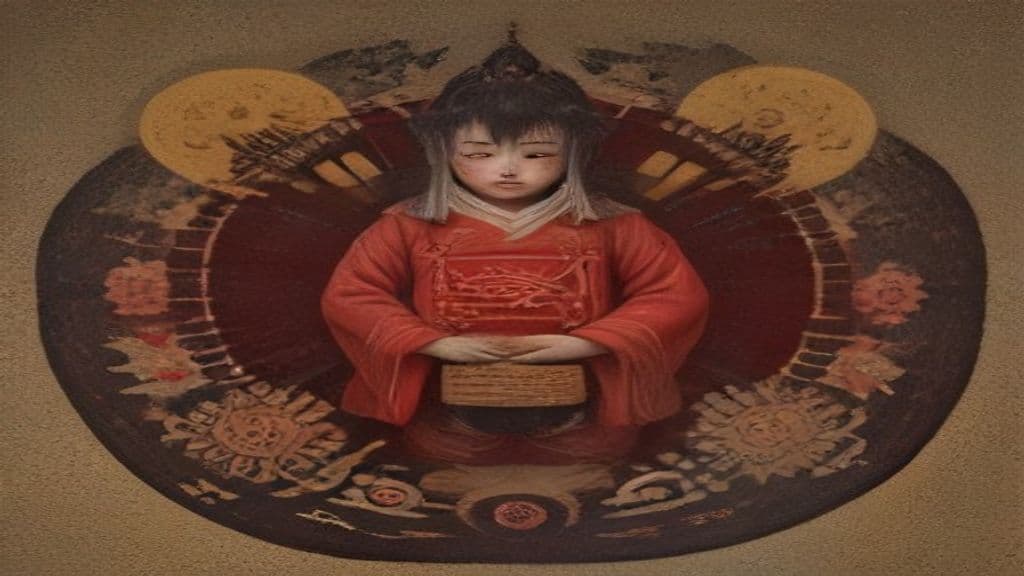
In the standard narrative found in Otogizōshi and later retellings, an otherwise childless old couple prays to the Sumiyoshi sanjin and are granted a child who measures one sun in height; this miraculous birth explains his exceptional size and provides his name, Issun-bōshi ("one-sun boy"). Scholars and summaries link the motif of the tiny child in part to older mythic small deities such as Sukuna-hikona, and the tale is attested in premodern illustrated otogizōshi collections and later popular editions. Versions and details vary between textual traditions and modern retellings.
Issun-bōshi is typically described as approximately one sun tall (about 3 cm / 1.2 in). Narrative descriptions emphasize his scale by listing the miniature items he uses—a rice-bowl as a boat, a chopstick as a paddle, a sewing needle as a sword, and straw as a scabbard—rather than elaborate bodily detail. In some variants of the tale, after acquiring a magic mallet (Uchide no kozuchi) obtained from a defeated oni, he uses it to enlarge his body to about six shaku (reported in some versions), enabling him to assume a more typical adult stature.
Issun-bōshi's primary 'powers' are human qualities emphasized by the tale: exceptional courage, resourcefulness, and tactical use of his small size. He leaves home to seek fortune in the capital, gains employment in a chancellor's house, and confronts an oni who has kidnapped a girl—entering the oni (in some tellings its stomach or eye) and stabbing it with his needle to force its surrender. In variants, the fleeing oni drops a magic mallet (Uchide no kozuchi) which Issun-bōshi picks up; some retellings say the mallet can enlarge him and conjure food and treasures, a claim present in those versions rather than a universal attribute.
Weaknesses
- conditionNo traditional weaknesses recorded
Wards
- otherNo wards applicable (Issun-bōshi is a heroic human protagonist rather than a hostile spirit)
5 Ronin
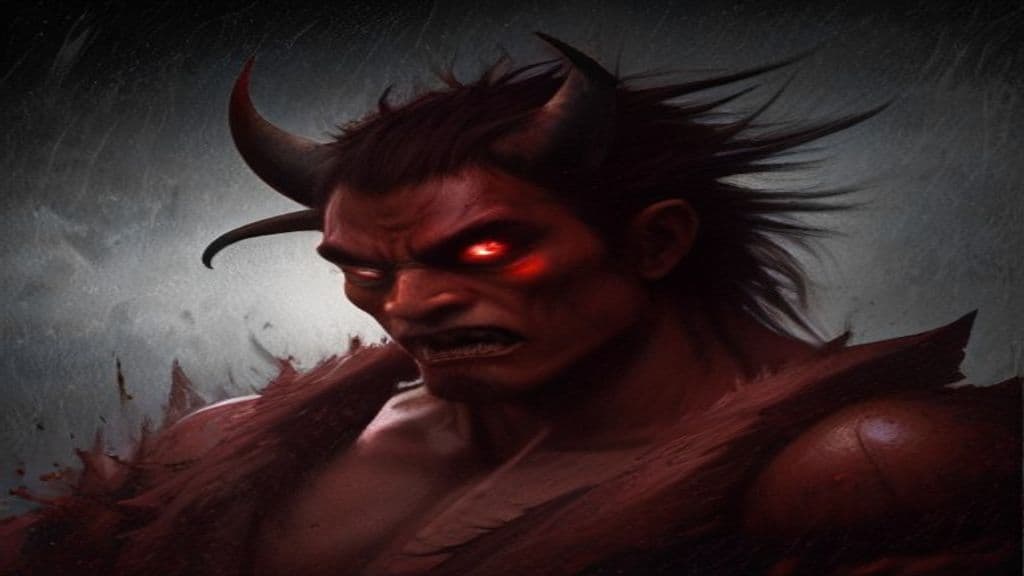
5 Ronin is a 2011 Marvel Comics five-issue limited series that reimagines five Marvel superhero archetypes as rōnin (masterless samurai) in a fictionalized post‑Sekigahara feudal Japan. The work places Wolverine, Hulk, Punisher, Psylocke, and Deadpool analogues into period roles to explore displacement, revenge, and identity in an era of political upheaval.
Abumi-guchi
A Japanese yōkai classed as a tsukumogami: an animated stirrup (abumi) depicted in Sekien Toriyama's Gazu Hyakki Tsurezure Bukuro. Traditional accounts say it is formed from a stirrup that belonged to a soldier who fell in battle and that it waits where the stirrup lies for its dead owner to return.
Abura-akago
An Edo-period yōkai depicted as an oil‑licking infant or a ball of flame. First recorded in illustrated compendia (notably Toriyama Sekien's Konjaku Gazu Zoku Hyakki), the Abura-akago is tied to tales of oil‑stealing fires and functions in part as an etiological warning about wasting or stealing oil.
Abura-sumashi
A yōkai spirit from the Amakusa region of Kumamoto Prefecture, Japan, said to inhabit mountain passes. Traditionally explained as the ghost of a person who stole oil, it appears to surprise travelers and is represented in modern media with a straw-coat body and a potato- or stone-like head.
Aburabō / Abura-bōzu / Aosaginohi (traditions)
Two distinct Japanese traditions appear under related flame imagery: Aosaginohi/Aosagibi is presented as a will-o'-the-wisp type luminous night phenomenon interpreted as reflections from herons; aburabōzu (abura bōzu, "oil monk") appears in a separate anecdote as a reported fire-breathing apparition in a 12th-century Yasaka Shrine tale. The sources treat them as separate portrayals rather than a single unified being.
Acala
Acala (Sanskrit: अचल, 'The Immovable') is a wrathful protective deity (dharmapala) in Vajrayāna and East Asian esoteric Buddhism, classed among the Wisdom Kings (Vidyārāja). He functions as a ritual focus for visualization and mantra practice intended to remove obstacles and bind or destroy hostile forces.
Agaru
Agaru (attested historically as Agarum) appears in the supplied sources as a Bronze Age Near Eastern toponym—often identified with Failaka Island—and as a modern personal or media name. The provided material contains no evidence that Agaru is a supernatural being in any traditional cosmology.
Ajisukitakahikone
Ajisukitakahikone is a kami in Japanese mythic literature (Kojiki/Nihon Shoki). He appears in the transfer-of-rule cycle between heaven and earth, is described as a son of Ōkuninushi, associated with the Kamo cult (called Kamo no ōmikami in some modern museum/catalog entries), and features in narratives that explain landscape formation and meteorological genealogy.
Aka Manto
Aka Manto (赤マント, "Red Cloak") is a Japanese urban legend and schoolyard ghost-story about a masked, cloaked figure who appears in public or school toilet stalls and forces occupants to choose between colored toilet paper; each choice in the tale produces a violent supernatural consequence. The legend is part of modern popular folklore recorded in school contexts from the 1930s onward rather than a formal religious myth.
Akaname
Akaname is a Japanese yōkai associated with baths, bathtubs, toilets, and other places where scum and filth accumulate. Traditionally depicted as a child-like creature that licks grime, it functions in folklore as a cautionary figure tied to cleanliness; a few narrative variants cast it as dangerously predatory.
Akashaguma
Akashaguma is presented in the available sources as a child-like house guardian spirit in the Japanese yokai tradition, closely comparable to the regional zashiki-warashi. It is associated with domestic interiors (parlors or storage rooms) and with bringing prosperity to households where it dwells.
Akashita
Akashita (赤舌, lit. “red tongue”) is an Edo-period pictorial yōkai commonly represented as a hairy, clawed face emerging from dark clouds with a wide open mouth and a conspicuous red tongue. The figure appears in yōkai emaki and Toriyama Sekien’s Gazu Hyakki Yagyō; Sekien’s plate shows it atop a sluice, but the original pictorial tradition provides no explanatory caption. Later folklorists and popular writers (Shōwa and later) have variously interpreted the image as a punitive spirit linked to irrigation/floodgate justice or as a kidnapper in evening skies, though these narrative roles are post-hoc.
Community Record
- [1]Issun-bōshi. Wikipedia contributors, 'Issun-bōshi,' Wikipedia, The Free Encyclopediawiki
- [2]One-inch boy (Wikidata). Wikidata entry Q1351682, 'One-inch boy'other
- [3]Issunboushi No Shusse - 1929 [Malkav]. Archive: 1929 short film adaptation 'Issunboushi No Shusse' (summary entry)literary
- [4]Little One Inch. Archive: children's retelling 'Little One Inch' (retelling/edition)literary
- [5]Issun Boshi : a Japanese tale. Archive: 'Issun Boshi : a Japanese tale' (retelling/edition)literary