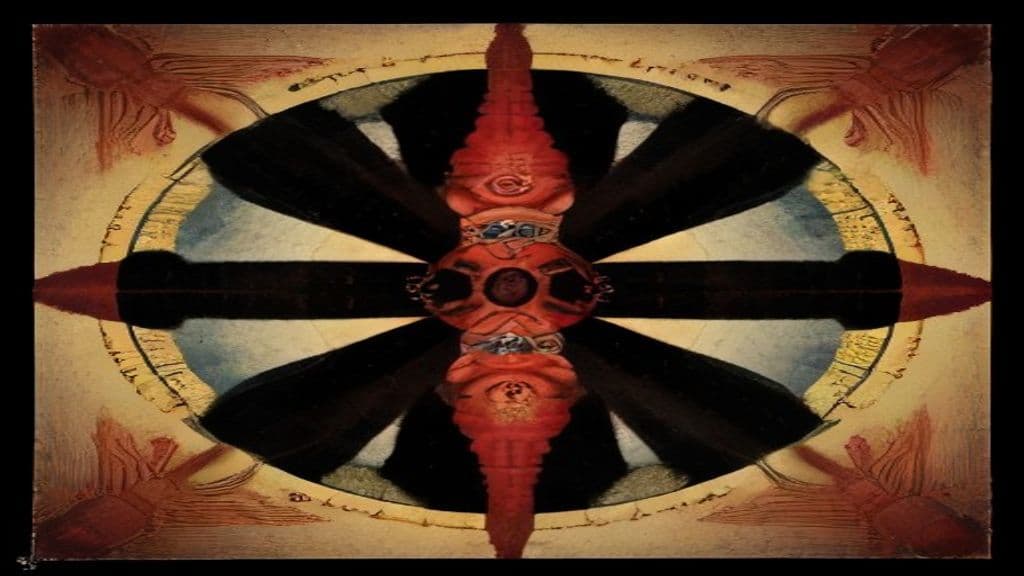
Sources present Itzamná as an upper god and creative figure in Maya cosmology. In various traditions he is credited with creative acts — including, in some accounts, creation of humankind — and with instituting priestly arts such as writing. Early‑colonial authors and the codices treat him as an elevated celestial resident seated on a throne and as a foundational patron of priestly and calendrical authority; colonial summaries sometimes associate him with invisible supreme figures (Hunab Ku) or sun aspects (Kinich Ahau), indicating flexible identifications in post‑contact texts.
Iconography and codical imagery show multiple, overlapping appearances rather than a single fixed form. He is attested as an aged, tonsured maize‑god aspect; as a Principal Bird Deity (an avian manifestation sometimes called Yaxcocahmut) whose wings bear signs for daylight and night and which may hold a two‑headed snake; and as the head placed within the maw of a two‑headed caiman (Dresden Codex New Year pages) linking him to an earth/caiman figure (Itzam Cab Ain). He is also depicted dressed as a high priest and seated on a celestial throne in codices and Classic monuments. Classic narrative scenes sometimes show him in ambivalent positions (e.g., grasping game, prepared for sacrifice, or in his bird aspect being shot), indicating a range of visual roles.
Documented roles and functions include creator acts, invention or patronage of priestly arts (including writing), governance over agricultural and hunting concerns, and patronage of ritual time (involvement in specific ritual months and a four‑year cycle year). Iconographic and codical evidence shows him identified with multiple domains (sky, maize, bird, caiman/earth) and with calendrical and medical ritual invocation (e.g., invoked as one of the gods of medicine). Sources record human appropriation of his name and regalia by rulers and priests — an institutional identification rather than literal shapeshifting. Modern popular sources sometimes ascribe extensive superhuman powers, but such modern claims are not corroborated by the cited primary codical and early‑colonial material.

Acat
Acat is a Maya deity associated with the craft and ritual of tattooing, described in the cited sources as being invoked in relation to the tools, inks, and workspaces of tattoo artists and as steadying the artists' hands so tattoos made in the image of gods could confer those gods' power.
Acolnahuacatl
Acolnahuacatl is a name attested in central Mexican sources both as a historical Tepanec ruler of Azcapotzalco and, in several modern compilations and trivia lists, as a minor chthonic or underworld-associated figure (often given the variant Acolmiztli). The evidence in the provided material is divided: the historical/genealogical reading is supported by standard reference entries, while the deity reading appears mainly in secondary online god-lists and quizzes and is not substantiated by detailed primary ritual or mythic texts in the supplied set.
Ah Muzen Cab
Ah Muzen Cab is a Yucatán Maya divine figure associated with bees and honey, attested in summary sources as protector of Melipona bees and as a participant in Chilam Balam creation and ritual chapters. He is also linked in secondary accounts to the upside-down 'Descending' or 'Diving God' image found in Maya iconography at sites such as Tulum.
Ahuiateteo
Ahuiateteo (Āhuiatēteoh; also rendered Mācuīltōnalequeh) are a quintet of Aztec deities associated with excess, pleasure, and the dangers that accompany over‑indulgence. They appear in calendrical and codical contexts, are invoked in divinatory practice, and are thematically linked to pleasures (feasting, drinking, gambling, sex, music) and the misfortunes that follow excess.
Ahuitzotl
Ahuitzotl is both the personal name of the eighth tlatoani (ruler) of Tenochtitlan (reigned ca. 1486–1502) known for military expansion and monumental rebuilding, and an onomastic term in Nahuatl for an aquatic animal/legendary creature (commonly glossed 'water thorny' and often associated with an otter or water opossum). The sources treat these registers—historical ruler and animal-name—as related but distinct uses of the same Nahuatl lexeme.
Akateko
Akateko (赤手児, lit. 'red child's hand') is a yōkai from Japanese folklore commonly told as a small, red, disembodied child's hand that appears from trees—especially the Japanese honey locust—and startles travelers; in some regional variants it is accompanied by a specter of a young woman or manifests as paired foot- or leg-like apparitions. Accounts vary between mostly harmless trickster apparition and a violent variant that attacks humans.
Akna
Akna is a female figure named in modern secondary sources as associated with childbirth and motherhood. The provided materials conflate brief mentions linking the name to both Maya and Inuit maternal goddesses; primary Maya iconographic or epigraphic evidence for a distinct Maya Akna is not supplied in the sources.
Alicante
Alicante is attested in available reference sources as the proper name of a mythological snake identified with Mexico. The surviving entries provide only the name and a categorical label (mythological snake) without accompanying narrative, attributes, or ritual context.
Alux (aluxoʼob)
The alux (plural aluxoʼob or aluxob) is a small, place-bound sprite or spirit in Maya tradition of the Yucatán Peninsula, Belize, and Guatemala, conceived as knee-high, miniature, traditionally dressed Maya-like beings created by ancient gods and normally unseen but able to assume physical form to communicate or frighten humans.
Anteater (tradition)
In the provided sources, 'Anteater' refers to the real-world mammals of the suborder Vermilingua and to modern cultural/technical items named after that animal (games, software, student media). There is no documentation in these materials of an anteater as a supernatural entity within a traditional cosmology.
Atabey
Atabey is a principal Taíno ancestral mother-spirit (a zemi) associated with fresh water, fertility, and prime matter; she appears in early ethnohistorical transmissions with multiple names and manifestations ranging from nurturing mother to violent storm-mother.
Atlacoya
Atlacoya is named in modern compilations as a figure from Aztec tradition associated with drought; some modern databases alternately classify the name under water-deity categories. The supplied sources do not provide primary-codex citations, iconography, etymology, or detailed ritual texts.
Community Record
- [1]Itzamna (Wikipedia). Wikipedia: 'Itzamná ... is, in Maya mythology, an upper god and creator deity thought to reside in the sky.' and related sections on name, iconography, and ritual months.wiki
- [2]Itzamna (Wikidata). Wikidata entry summarizing cataloging of Itzamna as creator deity.wiki
- [3]Diego de Landa summaries (as cited in secondary sources). Colonial summaries reported in secondary accounts: ritual aspersion of books in Uo under 'Kinich Ahau Itzamná'; invocation in Zip as a god of medicine; veneration in Mac alongside Chaacs.other
- [4]Dresden and Paris Codices; Classic iconography (summarized). Summaries noting the placement of Itzamná's head within a two‑headed caiman on Dresden Codex New Year pages, Principal Bird Deity transformation in the Paris Codex and San Bartolo murals, and Classic monument attestations.other
- [5]Marvunapp appendix (popular summary — non‑academic). Modern popular summary that attributes extensive superhuman powers; cited as non‑scholarly and not corroborated by primary codical/colonial materials in the provided notes.other