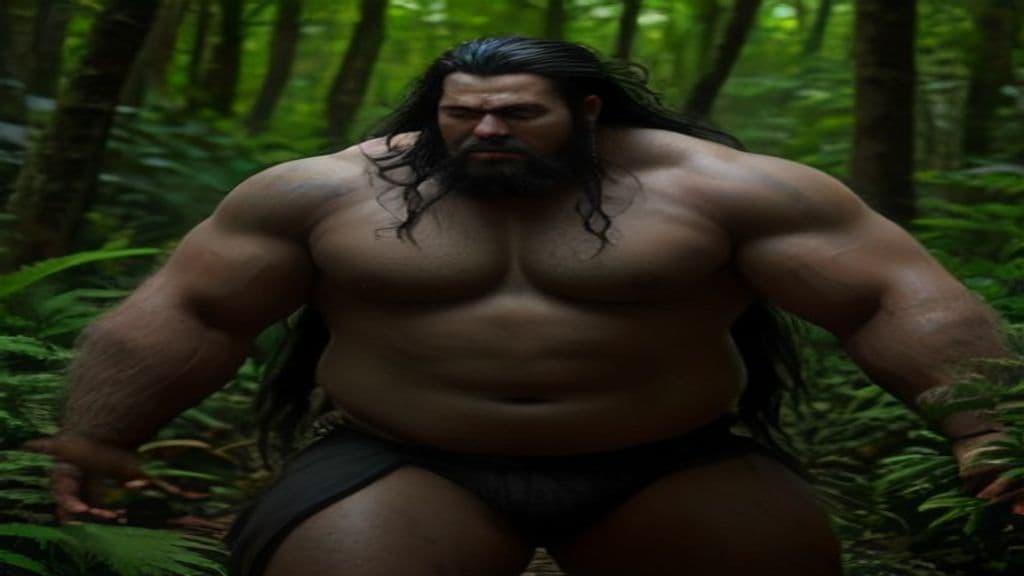
Kahungunu is presented in the sources as the son of Tamatea Urehaea (a Tākitimu/Tamatea lineage figure). He was born at Kaitaia and, after his father relocated, was raised at Mangatawa in Tauranga. After his birth Tamatea buried Kahungunu's umbilical cord with three whatu‑kura (sacred stones) as an iho‑whenua — a tangible link binding the child and his descendants to the land. Kahungunu later travelled widely, quarrelled with his older half‑brother Te Whaene, moved eastward along the coast, courted and married prominent women (notably Rongomai‑wahine), settled at Maunga‑a‑kāhia on the Māhia Peninsula, led taua (war‑parties), and fathered many descendants who became the lineages of Ngāti Kahungunu and connected groups. Episodes in the narratives (including the drowning of Tama‑taku‑tai in a capsized canoe and his courtship feats) are recounted as founding events that establish place‑names, kin ties, and rights to land and resources.
Accounts describe Kahungunu as a particularly large and physically strong man. The sources note feats that demonstrate his size and stamina — carrying and single‑handedly rolling very large bundles of fern root (aruhe) down cliffs to feed a village, repeatedly diving to gather pāua (abalone), and general prowess at labour and seamanship. No detailed descriptions of facial features, dress, or supernatural marks are given in the cited material.
The narratives attribute to Kahungunu wide practical skills and chiefly capacities rather than supernatural powers: village planning, farming and resource management (ahuwhenua), bird hunting, woodcarving, moko (tattooing), flax‑weaving, canoe‑making and navigation, fishing and shellfish gathering, leadership of war parties, negotiation and peacemaking, and socially significant courtship and gift exchanges (for example, demonstrations of provisioning such as the aruhe bundle and pāua collection). These activities are represented as both material accomplishments and actions that create genealogical and territorial claims for his descendants.
Aitu (Māori)
Malevolent spirits in Māori tradition, often taking the form of plants or animals and associated with trouble-making and mischief. (Note: - Power tier should be Greater, not Lesser (Aitu being lesser gods in some cultures, but also associated with deity-level abilities) - Abilities: Add detail about their role as patrons of specific vil)
Akava'ine
Akava'ine is a Cook Islands Māori social and gender category for people assigned male at birth who live or present as women or otherwise occupy a gender-variant/transgender role. The term (Cook Islands Māori) literally means "to behave as a woman" and has both historical ethnographic mentions of gender-variant individuals in the Cook Islands and a contemporary use (since the 2000s) among Cook Islands Māori, including diaspora communities.
Aotea (Canoe)
Ancestral waka in Māori tradition, significant in the migration of the Māori people to New Zealand. (Note: - Power tier should be at least Greater (deity-level), considering Aotea is associated with significant spiritual and cultural importance to the Māori people's migration. - Abilities should include de)
Aotearoa (Canoe)
An ancestral vessel in Māori tradition, associated with the migration and settlement of New Zealand. (Note: 1. Power tier should be Ancient, not Primordial. 2. Remove "Historical significance" from sensory cues as it is a general statement rather than a specific cue. 3. Add "Its presence is often associated)
Apakura
Female figure in Māori mythology, wife of Tūhuruhuru and/or Tūwhakararo, associated with multiple generations of whānau. (Note: 1. Power tier: Given her association with multiple generations of whānau and the miraculous birth story involving Whakatau, it's likely she should be classified as a Greater entity. 2. Abilities: Add )
Arahura (Māori canoe)
Divine Māori canoe made of pounamu, associated with the Ngāi Tahu tribe and spiritual significance. (Note: * Power tier: Not specified, assume Lower or Lesser as it's associated with the tribe and not described as a deity-level being * Abilities: Remove the mention of spiritual significance and connection )
Arautauta
The Arautauta is a significant waka (canoe) in Māori tradition, playing a key role in the migration of people to New Zealand. (Note: - Power tier: Should be Primordial (as it's a significant waka in Māori tradition) - Abilities: Should mention its use for transporting people and goods as a notable aspect of its significance - Appea)
Arawa (canoe)
In Māori tradition, the Arawa is a supernatural canoe representing the ancestors' journey to New Zealand. (Note: * Power tier: Primordial (or not specified at all, as there's no indication of supernatural powers beyond its symbolic and cultural significance) * Appearance: No physical description mentioned in sou)
Atea
Atea is a primordial creator-associated being in multiple Polynesian traditions (Marquesas, Tuamotu, and Māori) closely associated with light and the ordering of the cosmos. Variants depict Atea as a self-originating giver of light, a progenitor who fathers gods and humans, or as the cosmic universe that is sex-differentiated into Heaven and Earth in one reported account.
Atua (Māori Deity)
In Māori mythology, Atua are supernatural beings believed to have created the world and all living things. They are considered rulers of the spiritual realm with powers over nature, fertility, and human destiny. (Note: 1. Power tier: Based on the abilities described (controlling nature, fertility, and human destiny), Atua likely belong to the Primordial power tier, not Greater. 2. Weaknesses: Add a specific weakness)
Atutahi (Māori tradition)
In Māori mythology, Atutahi is a celestial entity and the second brightest star in the night-time sky, considered solitary or self-centered. It serves as a navigational aid for Māori sailors, appearing as a bright star on the evening or southern horizon. (Note: - Power tier: Primordial (due to its status as a celestial entity in Māori mythology) - Abilities: Add ability of guidance, specifically for navigation, based on source material - Weaknesses: List is )
Auahitūroa
Auahitūroa is a Māori deity described in the cited sources as the personification of comets and as the origin of fire; he is named as a son of Tama-nui-te-rā (the sun), consort of the fire goddess Mahuika, and father of the five Ngā Mānawa.
Community Record
- [1]Kahungunu — Wikipedia. Wikipedia contributors. 'Kahungunu.' Wikipedia, The Free Encyclopedia.wiki
- [2]Kahungunu — Wikidata. Wikidata entry for Kahungunu (Q104479636).other
- [3]Ngāti Kahungunu — Wikipedia. Wikipedia contributors. 'Ngāti Kahungunu.' Wikipedia, The Free Encyclopedia.wiki
- [4]Te Hononga‑marei‑kura o Ngati Kahungunu - Takitimu (whakapapa summary). Tākitimu / Ngāti Kahungunu whakapapa summary (online).other