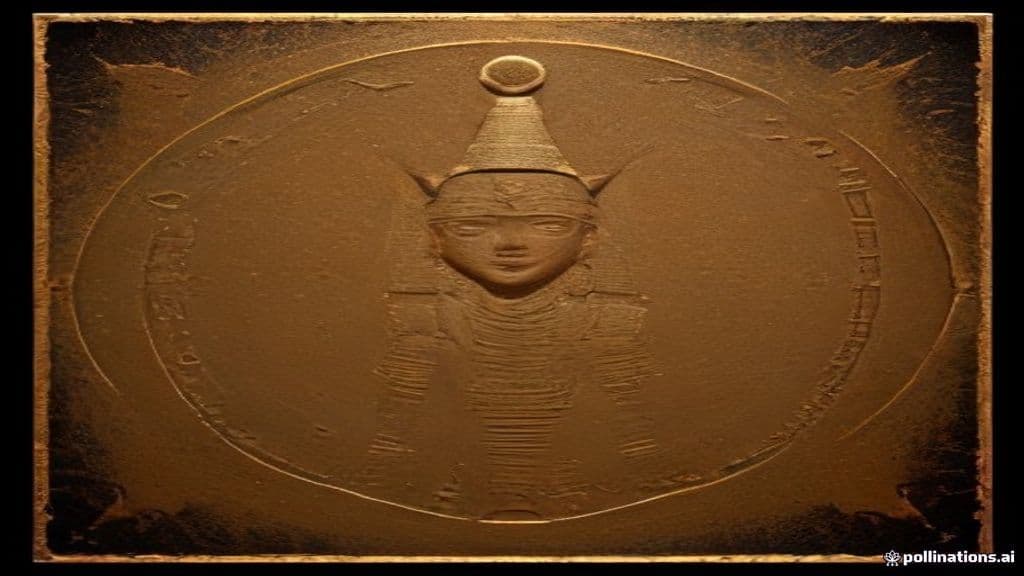
The supplied inscriptions do not provide a standalone mythic origin for Kamutef. In the textual and material record cited, the name Kamutef appears as a title or aspect appended to Amun/Amun‑Ra and is used within temple formulae and iconographic scenes that link divine maternity, royal wifehood, and creator epithets (for example, an arc sistrum inscription addressing god’s mother of Kamutef and ‘‘The-one-who-creates-what-is’’). Thus Kamutef’s 'origin' in these sources is theological: a cultic epithet embedded in the vocabulary of creation and kingship associated with Amun rather than an independently narrated origin myth.
The sources do not furnish a distinct physical description of Kamutef separate from Amun/Amun‑Ra. Visual and inscriptional evidence shows the name attached to depictions of Amun/Amun‑Ra (e.g., an archival image titled 'Darius I offering lettuces to Amun‑Ra Kamutef') and appears on ritual objects such as a metal arc sistrum that bears an inscription invoking 'god’s mother of Kamutef' alongside Hathor imagery. Therefore, any appearance in the sources is mediated through Amun/Amun‑Ra iconography and temple material culture rather than an independently described form.
No specific actions, miracles, or powers unique to Kamutef are recorded in the provided materials. Within the theological language preserved on ritual objects and inscriptions, Kamutef is associated with creative and royal dimensions of divinity — the sistrum text connects the phrase to creation ('The-one-who-creates-what-is') and to divine maternity and queenship ('god’s mother of Kamutef,' 'great royal wife') — indicating a role in the ideology of cosmic generation and legitimization of royal authority rather than enumerated supernatural feats.

Apsara
Celestial dancers and water nymphs of Hindu cosmology — beautiful semi-divine beings who dance at the court of Indra and, by his command, descend to earth to distract sages from excessive asceticism.

Huldra
A seductive forest spirit of Scandinavian folklore — beautiful from the front but with a cow's tail or hollow back — who lures men into the wilderness, sometimes to their ruin.
*Perkʷūnos
*Perkʷūnos is the reconstructed Proto-Indo-European thunder‑god hypothesized by comparative linguistics and mythology. Scholarly reconstructions portray him as a storm or thunder figure associated with fructifying rain and as the combatant who fights a multi‑headed water‑serpent to release life‑giving waters; no direct attestations from the Proto‑Indo‑European period survive and the figure is inferred from later Indo‑European traditions.
*Péh₂usōn (reconstructed)
Péh₂usōn is a hypothetical Proto‑Indo‑European pastoral guardian reconstructed by comparative scholars from parallels in Greek and Vedic traditions. Proposed as a Graeco‑Aryan ancestor‑figure, the reconstruction describes a protector of flocks, roads, and travellers rather than an attested historical cultic personality.
57 Mnemosyne
57 Mnemosyne is a large main-belt asteroid (S-type) discovered in 1859 and named after the Greek Titaness Mnemosyne. It is a non-sentient astronomical body studied for its orbital and rotational properties and has been used in dynamical measurements related to Jupiter.
Aani
Aani (ancient Egyptian jꜥnr) is the lexical term for the baboon in ancient Egyptian language and functions in religious contexts as an animal icon and theophoric epithet. Attested repeatedly in Egyptian texts and images, the baboon image is used to represent or denote aspects of gods such as Thoth, Hapy, Khonsu, and Osiris rather than implying the animal itself is an independent deity.
Aati
Aati (also rendered Ati) is one of the 42 judges of the dead in ancient Egyptian funerary literature, attested in the Book of the Dead tradition (notably the Papyrus of Nebsemy). Described as originating 'from Heliopolis', Aati's documented function is to question the deceased about a specific moral accusation during the Duat judgment; the funerary texts supply a formulaic denial the soul must recite.
Abaddon
In Hebrew scripture Abaddon is primarily a noun meaning 'destruction' or a section/condition of the underworld paired with Sheol; in the New Testament Book of Revelation Abaddon is personified as an angelic figure (Greek Apollyon) described as the king of an army of locusts released from the abyss during the apocalypse.
Abadiu of Antinoe
Abadiu of Antinoe was a fourth‑century bishop of Antinoe (Antinoopolis, in Roman Egypt) commemorated as a martyr and saint in the Coptic Orthodox Church, with a feast day on 26 December. Sources record that he was killed during a theological dispute with Arian opponents and reference him in collections of Egyptian martyrs.
Aban Yasht
The Aban Yasht is a hymn from the Persian tradition that praises Anahita, a goddess associated with water, fertility, and wisdom. It consists of 132 stanzas and is part of the 21 Yashts collection. (Note: - Power tier should be "Primordial" or possibly "Cosmic", given that it's a hymn of great spiritual significance and associated with a goddess. - The article incorrectly states that Anahita is associa)
Abaset
Abaset is a localized ancient Egyptian goddess attested in tomb decoration at El‑Bawiti in the Bahariya Oasis during the 26th Dynasty. She is depicted anthropomorphically with a hedgehog motif incorporated into her headdress and appears on the walls of Qarat Qasr Salim, including twice in the Tomb of Bannentiu. No cult texts, myth narratives, or ritual prescriptions for her are recorded in the cited corpus.
Abath
No corroborated folkloric entity named "Abath" is documented in the provided sources. The string appears in the supplied material only as a surname/personal name in Aruban/Dutch-Caribbean archival records and as an unrelated taxonomic or encyclopedic hit; no mythic attributes, origin stories, rituals, or apotropaic practices for an entity called Abath are present in the documents reviewed.
Abatur
Abatur is an uthra (celestial emanation) in Mandaeism described as the 'father of the Uthras' and called the Ancient (ʿattīqā). He resides on the boundary between the World of Light and lower regions, functions as a judge who weighs souls (Abatur Muzania), and supplies instructions and materials to the demiurgic uthra Ptahil in accounts from the Diwan (Scroll) of Abatur.
Abatwa (Twa / Batwa)
Abatwa (also recorded as Twa, Batwa, Mutwa; singular forms Barhwa or Murhwa in some transcriptions) are indigenous hunter‑gatherer peoples of the Great Lakes region of Central Africa, historically identified as some of the earliest inhabitants of the area. The available sources treat them as human ethnic groups whose livelihoods, lands, and populations have been severely affected by conservation policies and modern violence.
Community Record
- [1]Amun (Wikipedia). Wikipedia, article 'Amun'.wiki
- [2]Wikidata: Kamutef. Wikidata entry Q1723406 for Kamutef.other
- [3]Darius I offering lettuces to Amun‑Ra Kamutef (Archive item). Archive item titled 'Darius I offering lettuces to Amun‑Ra Kamutef.'other
- [4]Arc Sistrum (MMA object description). Arc sistrum description with inscription invoking 'god’s mother of Kamutef' and Hathor titulary.other
- [5]The Endlos Museum — Elf (Archive collection). Archive collection containing related museum/object records referenced in the notes.other