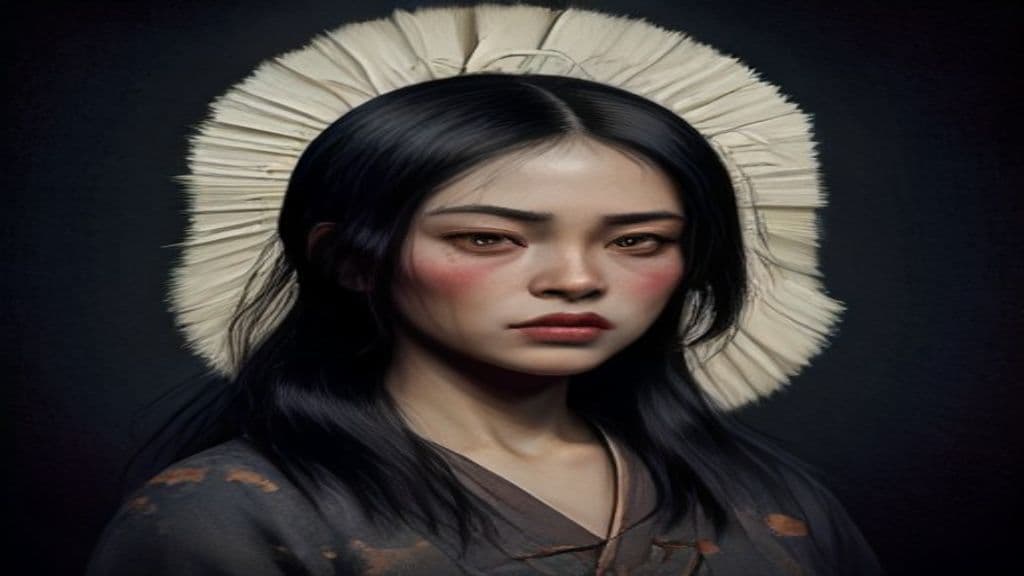
Sources present two overlapping origin framings rather than a single canonical origin story. In Edo-period anecdotal collections Ōkubi appears as a named yōkai encountered in households or at walls, treated as an apparition-type; some commentary in modern summaries characterizes Ōkubi as arising when human vengeful spirits or obsessive states are externalized into yōkai. A separate interpretive note reported in sources suggests that at least some accounts treat Ōkubi as a satirical invention aimed at monks who violated their precepts, but that reading is cited as an uncertain or secondary explanation rather than a universally attested origin.
Classical descriptions and images emphasize a mostly huge female head: an enormous old woman's face, sometimes shown with the cosmetic convention of painted-black teeth associated with married women. Edo-period anecdotes relate tactile details — e.g., a giant face in a storage room that felt sticky when touched and did not react when poked with tongs; a haiku-poet's account describes an Ōkubi roughly two meters high appearing atop a wall on a rainy night. Modern literary authors (Natsuhiko Kyogoku) depict Ōkubi as a morgue vision that can transmute into the faces of sexual partners, and manga artists (Shigeru Mizuki) have further visualized grotesque augmentations (limb degeneration, enlarged head, sunken eye) as fictional elaborations; these modern features are artistic reinterpretations rather than classical folklore attestations.
Classical accounts attribute localized harmful effects to an Ōkubi: the haiku-poet anecdote reports an Ōkubi that 'blew' on a person and caused the touched part to turn yellow and swell, an injury later treated with a medicated bath. Edo-period tales also give corporeal-seeming qualities (sticky surface; nonresponsive to poking). Modern literary and manga sources expand Ōkubi's capacities for psychological manifestation (transforming into faces of sexual partners, embodying sexual guilt) and, in specific fictional works, grant additional supernatural powers (e.g., bone-telekinesis, air-manipulation) — these latter abilities are explicitly modern fictional elements and are not documented in the classical anecdotal material.
Weaknesses
- otherNo documented folkloric weakness; medical remedy recorded
Wards
- otherNo specific traditional wards recorded in the cited sources
5 Ronin
5 Ronin is a 2011 Marvel Comics five-issue limited series that reimagines five Marvel superhero archetypes as rōnin (masterless samurai) in a fictionalized post‑Sekigahara feudal Japan. The work places Wolverine, Hulk, Punisher, Psylocke, and Deadpool analogues into period roles to explore displacement, revenge, and identity in an era of political upheaval.
Abumi-guchi
A Japanese yōkai classed as a tsukumogami: an animated stirrup (abumi) depicted in Sekien Toriyama's Gazu Hyakki Tsurezure Bukuro. Traditional accounts say it is formed from a stirrup that belonged to a soldier who fell in battle and that it waits where the stirrup lies for its dead owner to return.
Abura-akago
An Edo-period yōkai depicted as an oil‑licking infant or a ball of flame. First recorded in illustrated compendia (notably Toriyama Sekien's Konjaku Gazu Zoku Hyakki), the Abura-akago is tied to tales of oil‑stealing fires and functions in part as an etiological warning about wasting or stealing oil.
Abura-sumashi
A yōkai spirit from the Amakusa region of Kumamoto Prefecture, Japan, said to inhabit mountain passes. Traditionally explained as the ghost of a person who stole oil, it appears to surprise travelers and is represented in modern media with a straw-coat body and a potato- or stone-like head.
Aburabō / Abura-bōzu / Aosaginohi (traditions)
Two distinct Japanese traditions appear under related flame imagery: Aosaginohi/Aosagibi is presented as a will-o'-the-wisp type luminous night phenomenon interpreted as reflections from herons; aburabōzu (abura bōzu, "oil monk") appears in a separate anecdote as a reported fire-breathing apparition in a 12th-century Yasaka Shrine tale. The sources treat them as separate portrayals rather than a single unified being.
Acala
Acala (Sanskrit: अचल, 'The Immovable') is a wrathful protective deity (dharmapala) in Vajrayāna and East Asian esoteric Buddhism, classed among the Wisdom Kings (Vidyārāja). He functions as a ritual focus for visualization and mantra practice intended to remove obstacles and bind or destroy hostile forces.
Agaru
Agaru (attested historically as Agarum) appears in the supplied sources as a Bronze Age Near Eastern toponym—often identified with Failaka Island—and as a modern personal or media name. The provided material contains no evidence that Agaru is a supernatural being in any traditional cosmology.
Ajisukitakahikone
Ajisukitakahikone is a kami in Japanese mythic literature (Kojiki/Nihon Shoki). He appears in the transfer-of-rule cycle between heaven and earth, is described as a son of Ōkuninushi, associated with the Kamo cult (called Kamo no ōmikami in some modern museum/catalog entries), and features in narratives that explain landscape formation and meteorological genealogy.
Aka Manto
Aka Manto (赤マント, "Red Cloak") is a Japanese urban legend and schoolyard ghost-story about a masked, cloaked figure who appears in public or school toilet stalls and forces occupants to choose between colored toilet paper; each choice in the tale produces a violent supernatural consequence. The legend is part of modern popular folklore recorded in school contexts from the 1930s onward rather than a formal religious myth.
Akaname
Akaname is a Japanese yōkai associated with baths, bathtubs, toilets, and other places where scum and filth accumulate. Traditionally depicted as a child-like creature that licks grime, it functions in folklore as a cautionary figure tied to cleanliness; a few narrative variants cast it as dangerously predatory.
Akashaguma
Akashaguma is presented in the available sources as a child-like house guardian spirit in the Japanese yokai tradition, closely comparable to the regional zashiki-warashi. It is associated with domestic interiors (parlors or storage rooms) and with bringing prosperity to households where it dwells.
Akashita
Akashita (赤舌, lit. “red tongue”) is an Edo-period pictorial yōkai commonly represented as a hairy, clawed face emerging from dark clouds with a wide open mouth and a conspicuous red tongue. The figure appears in yōkai emaki and Toriyama Sekien’s Gazu Hyakki Yagyō; Sekien’s plate shows it atop a sluice, but the original pictorial tradition provides no explanatory caption. Later folklorists and popular writers (Shōwa and later) have variously interpreted the image as a punitive spirit linked to irrigation/floodgate justice or as a kidnapper in evening skies, though these narrative roles are post-hoc.
Community Record
- [1]Ōkubi. Wikipedia article 'Ōkubi' (excerpts provided in research notes)wiki
- [2]Wikidata: Okubi. Wikidata entry for Okubi (referenced in research notes)other
- [3]Yokai Ōkubi A Cabeça Gigante Voadora (Mitos & Corvos #16) (archive item). Archive item listed among provided sources referencing Ōkubi modern retellingsother
- [4]Yaksa. Umbuso wensimbi uyakhala. (archive item). Archive item listed in provided research notes (included to show modern circulation; does not add classical detail)other