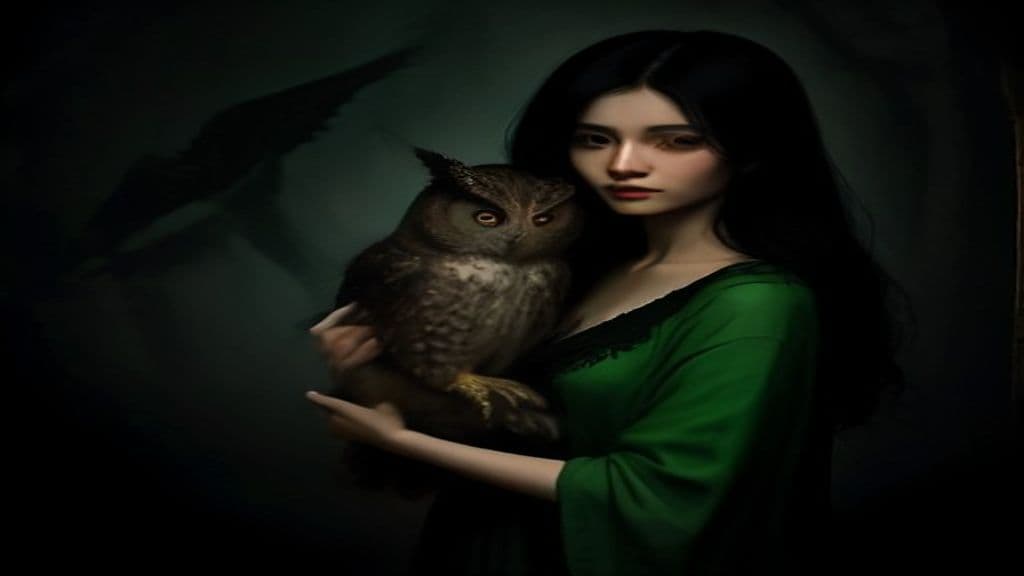
The Langsuir is the original, fully-transformed form of which the Pontianak is a variant. She is the spirit of a woman who died hearing that her child was stillborn — her grief and shock were so extreme that she transformed. She can fly like an owl and attacks infants. She can be domesticated if her long nails are cut and the hair stuffed into the hole in her neck — she will then live normally as a human woman. One tale records a Langsuir who married and lived in a village undetected until allowed to dance, at which point she flew away.
A beautiful woman with extremely long black hair and long nails, wearing green robes. She can fly silently like an owl. The telltale sign is the hole in the back of her neck, through which she feeds. Her hair conceals this hole.
Flight. Could feed on infants' blood through the neck-hole. Could be tamed through nail-cutting and hair-stuffing rites. Could live undetected among humans if tamed. Was dangerous again if allowed to dance.
Weaknesses
- ritualCutting her nails and stuffing her hair into the neck-hole tames her
- substanceSalt
Wards
- ritualProper burial rites for women who die in childbirth (prevents transformation)
- substanceThorny branches at windows
Badang
Badang is a legendary Malay culture-hero and supernaturally empowered strongman who gains immense physical strength after capturing a water spirit. Told in Malay Annals–style tradition and later retellings, his tales link feats of strength to local place-myths (split rock, thrown palace stone, graves) and to values of service and loyalty in a pre‑modern court setting.
Bawang Merah dan Bawang Putih
A widely told Malay/Indonesian folktale about two eponymous human stepsisters — Bawang Putih (the humble, patient sister) and Bawang Merah (the vain, cruel sister). The story uses small supernatural motifs (magic pumpkins, a talking fish, a gift-bearing old woman) set in rural liminal spaces to reward virtue and punish vice; it functions as a didactic children's tale rather than an account of a discrete spirit being.
Bisan
A female Malay/Jakun nature spirit who presides over camphor-bearing trees. She signals the presence of camphor by cicada-like song, is jealous of those seeking the resource, and must be propitiated or confused to allow harvest.
Datuk Keramat
Datuk Keramat denotes a class of locally venerated shrine-presences—respected ancestral or saintly figures associated with keramat (sacred graves/shrines)—forming a syncretic cult in parts of Malaysia and Singapore. Shrines are typically yellow, often sited under trees or at junctions, and receive offerings (food, joss sticks, paper money) from Malay and Chinese devotees seeking protection, wealth, or favors.
Ghost Child (toyol, urn)
A named supernatural figure appearing in the 2013 Singaporean horror film Ghost Child (Chinese: 鬼仔), identified in the film as a toyol kept within an urn that brings malicious domestic disturbances to a household. The film is the only supplied source that presents this discrete spirit as an agent in a folk-derived domestic narrative.
Hang Jebat
Hang Jebat is a legendary Malaccan warrior of the early 15th century notable in Malay court literature for his martial prowess and for rebelling against what he perceived as an unjust sultan after the apparent execution of his friend Hang Tuah. The figure embodies a moral tension between loyalty to ruler and opposition to tyranny and is commemorated in modern Malaysian and Singaporean toponyms and institutions.
Hang Tuah
Hang Tuah is a legendary Malay warrior-admiral and court retainer remembered in the Hikayat Hang Tuah and the Sejarah Melayu; he functions as an idealized silat master, diplomat, and exemplar of loyalty associated with 15th‑century Malacca. The figure appears in narrative cycles that mix court historiography and wonder-tale elements (notably an enchanted kris), while his actual historicity remains debated in scholarship.
Hantu
Hantu is a Malay and Indonesian lexical and conceptual category for spirits and invisible beings that includes ancestral souls, animistic nature spirits, and, in modern usage, ghosts or demons. The term covers many named subtypes (e.g., Hantu Raya, Hantu Tinggi) whose forms and roles vary across local traditions.
Hantu Penanggal (Penanggalan)
A nocturnal vampiric entity in Malay ghost myth, the penanggalan appears as a floating disembodied woman's head with trailing organs and entrails and is said from a distance to twinkle like a ball of flame.
Hantu Pocong
A Southeast Asian folkloric ghost understood as a dead body wrapped in an Islamic burial shroud (kain kafan), commonly associated with improper funerary procedure or unresolved death-related matters. Representations range from a hopping wrapped corpse in popular media to esoteric readings that interpret the phenomenon as residual energetic or liminal-layer disturbance.
Hantu Raya
A Malay spirit-familiar (hantu) described as a "great" or potent double that serves and substitutes for a human master, especially associated in sources with practitioners of black magic. It performs labor, provides alibis, and requires regular offerings to be kept under control.
Hantu Tetek
Hantu Tetek is named in Malay-language sources as a local hantu (ghost/spirit) variant within the broad family of female revenant or vampiric spirits found in Malay-region folklore. The available source treats it as one of many hantu types but provides no detailed, attested description specific to Hantu Tetek itself.
Community Record
- [1]Malay Magic. Skeat, Walter William. 1900. Malay Magic. Macmillan.academic
- [2]Malay Poisons and Charm Cures. Gimlette, John D. 1923. Malay Poisons and Charm Cures. J. & A. Churchill.academic