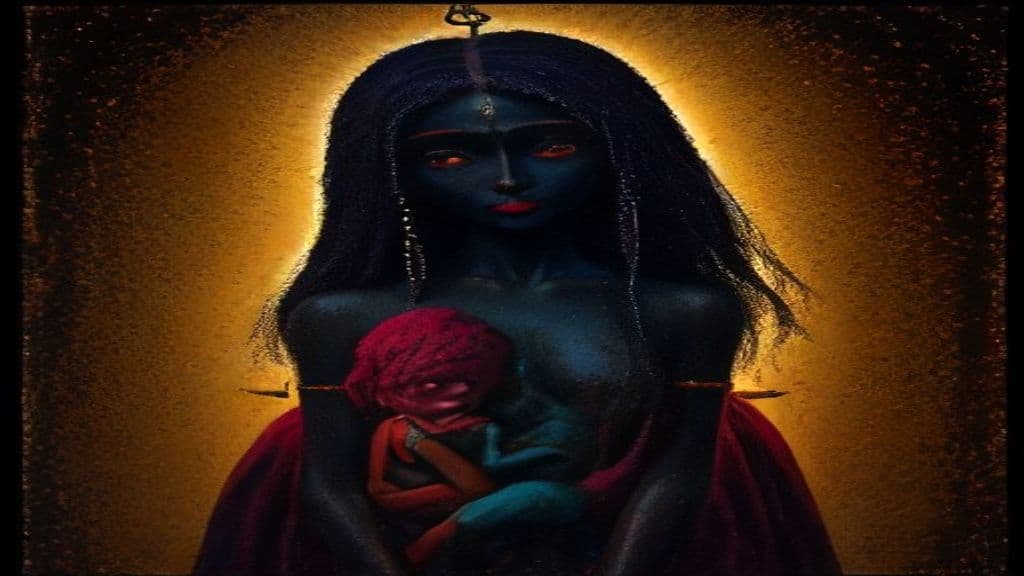
The source presents the Marassa as 'divine twins' (Marassa Jumeaux). They are described as children while simultaneously being 'more ancient than any other loa.' The same source frames them as synthesizing the vodou loa as a 'personification of divine power and the human impotence.' No narrative origin tale or cosmogonic story is provided in the cited excerpt.
The cited material depicts the Marassa as children and uses the phrase 'children mysteries.' Beyond this childlike characterization the provided excerpt offers no additional iconographic details (such as clothing, colors, or objects) or standardized visual form.
According to the source, the Marassa are described as embodying 'Love, truth and justice' and as being 'Directed by reason.' They are called 'mysteries of liaison between earth and heaven' and are said to 'personify astronomic-astrological learning.' The excerpt states they 'synthesize the vodou Loa as personification of divine power and the human impotence.' It also describes them as having a 'double life' and 'considerable power' which 'allow them manage people through the stomach.' The source presents these formulations without detailed operational explanations.
Adjassou-Linguetor
Adjassou-Linguetor is a loa in Haitian Vodou associated with spring water. The limited cited sources describe her as having protruding eyes and a bad temper; beyond these points, the available documentation (Wikipedia and Wikidata) is minimal.
Aganjú
Primordial Orisha associated with the sun, fire, and the untamed wilderness in Yoruba tradition. (Note: - Remove "untamed wilderness" from Power tier description as it's a trait associated with Lesser entities, not Primordial. - Add Appearance section based on source material (e.g., no specific descript)
Agwé
Agwé is a high-ranking lwa in Haitian Vodou associated with the sea, navigation, fishing, and certain funerary conveyances. He is portrayed as a naval officer who lives in a palace beneath the sea, commands attendant spirits, and is propitiated with maritime offerings and ceremonies.
Anansi
The spider trickster god of Akan folklore — cunning, mischievous, and wise. Keeper of stories and teacher of human beings, brought through the slave trade into Caribbean and African-American tradition.
Ayagunna (Yoruba Tradition)
A manifestation of Obatala, the Sky Father, embodying martial prowess and a desire for global peace through domination. (Note: - Power tier should be Greater (Ayagunna is described as manifesting the Sky Father's "fierceness" and having achieved global conquest). - Appearance needs clarification or deletion, as there is no ex)
Ayida Wedo
Ayida Wedo is a primordial rainbow-serpent loa of Haitian Vodou (with counterparts in Fon and Ewe vodun) associated with water, the rainbow, and the elemental forces; she often appears paired with Damballa as the dual cosmic serpent that assisted the creator in forming and upholding the world.
Ayizan
Ayizan is a racine (root loa) in Haitian Vodou and related West African-derived Vodoun traditions, functioning as the archetypal mambo (priestess) and a guardian of ritual order, initiation (kanzo), and the transmission of sacerdotal implements such as the asson. She is also associated with the marketplace and commerce and is syncretized with the Catholic Saint Clare.
Baron Samedi
A principal lwa of Haitian Vodou who serves as master of the dead and psychopomp, head of the Gede family; associated with cemeteries, crossroads, resurrection/healing, and licentious, comic behavior.
Bisimbi (Simbi)
Bisimbi (singular Simbi) are water and nature spirits in Bakongo (Kongo) traditional religion. They are associated with waters and natural sites in the Kongo-speaking region and are attested to continue, with transformation, in Atlantic diaspora spiritual systems such as Lowcountry Hoodoo and Cuban Palo.
Bizango
Bizango refers to secret societies in Haiti associated with Vodou practice and rural social governance. Sources portray them as local arbiters with contested reputations, variously remembered as community enforcers, makers of ritual objects, and — in folklore and some ethnographic accounts — practitioners of coercive or secretive magical acts.
Bloody Bones
Bloody Bones (also Rawhead, Rawhead-and-Bloody-Bones) is a vernacular bogeyman figure originating in Britain and carried into regional North American traditions; it functions chiefly as a cautionary monster used to frighten children from danger and ill speech, typically associated with deep water or dark household recesses.
Br'er Rabbit
Br'er Rabbit is an African-American folktale trickster — an anthropomorphic rabbit/hare who survives and triumphs by cunning rather than strength. Originating in oral traditions of enslaved Africans in the American South and related Caribbean communities, the character features in story cycles that teach, entertain, and comment on social relations.
Community Record
- [1]Marassa (Marassa Jumeaux) — Wikipedia. Wikipedia: Marassa Jumeauxwiki