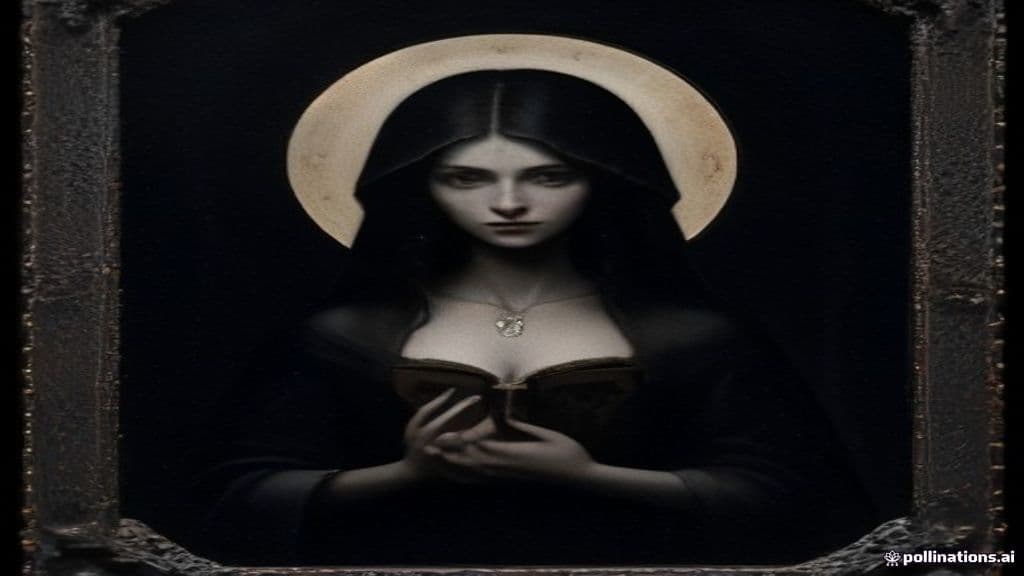
The provided sources do not contain any origin story for an entity called 'Mater Deva'. No primary or secondary texts cited here attest to its mythological genesis or narrative role. Any claim about origins would be speculative beyond the materials supplied.
No physical description of 'Mater Deva' is present in the consulted materials; the sources provide no imagery, iconography, or descriptive attributes tied to this name.
The consulted documents contain no information on abilities, powers, behaviors, or interactions with humans for an entity named 'Mater Deva'.
Masan
Masan (Korean: 마산) is documented in the provided sources solely as a geographic and administrative place in South Gyeongsang Province, South Korea — a former independent city now part of Changwon. No material in the supplied research notes describes a South Asian folk supernatural entity named "Masan."
Maschalismos (Undead Entity)
In Greek tradition, Maschalismos refers to the practice of rendering the dead unable to rise or haunt the living. (Note: - Power tier: Lesser (as it's a local, regional concept rather than a powerful deity-level entity) - Abilities: The source material doesn't support specific details about its powers; should be rephras)
Mataaho
Mataaho (also Mataaoho, Mataoho) is an atua (deity/ancestral atua) in Tāmaki Makaurau (Auckland) Māori tradition associated with volcanic and subterranean forces. He is credited in local narratives with creating or instigating the creation of many volcanic features in the Auckland volcanic field and is a tupuna (ancestor) for specific iwi.
Matahourua
A cultural and historical vessel in Māori tradition, associated with legendary hero Kupe's discovery of Aotearoa (New Zealand). (Note: - Power tier should be Primordial, not Greater. As a cultural and historical vessel associated with the discovery of an entire region (Aotearoa), it should be considered on a cosmic level. - Abilities)
Matangi
Matangi (Sanskrit: मातङ्गी, Mātaṅgī) is a Hindu Tantric goddess, one of the ten Mahavidyas. She is an esoteric form of the Divine Mother associated with speech, music, learning and the arts and—within Tantric contexts—invoked for worldly and occult powers such as mastery of the arts, attraction of people and control over enemies.
Matariki
In Māori culture, Matariki is the Pleiades star cluster marking the beginning of the new year in the lunar calendar. (Note: * Power tier: Primordial (since it's a celestial event, not a deity-level entity) * Summary: Inaccurate (Matariki is a celebration marking the beginning of the new year, not just the Pleiades star clu)
Matrikas
Matrikas (Sanskrit: mātṛkā, 'mothers') are a group of related mother-goddess figures in Hindu tradition, commonly rendered as seven (Saptamatrikas) or eight (Ashtamatrikas). They function ambivalently as protectors and as dangerous female powers tied to fertility, child mortality, disease, and martial activity, and were incorporated into temple and tantric/Shakta practice by the Kushana–Gupta and early medieval periods.
Matsigenka spirits and demons
In Matsigenka ethnography, a class of active lesser supernatural beings—commonly rendered in English as "spirits and demons"—are held to influence everyday life, while remote creator gods are viewed as withdrawn. Shamans historically mediated with these beings; today many functions are performed by healers amid increasing Christianization and cultural change.
Matsés (animist tradition)
The Matsés are an Indigenous people of the Peruvian and Brazilian Amazon whose worldview is animist: there is no strict separation between physical and spiritual worlds, and animals, plants and trees are inhabited by spirits that shape health, hunting success and medicinal efficacy. The supplied sources document this distributed set of nonhuman persons and shamanic practices (including sapo frog medicine) rather than a single named supernatural entity.
Mau rākau (Māori martial art)
Mau rākau is a traditional Māori martial art emphasizing physical and spiritual discipline, practiced by warriors in New Zealand. (Note: * Power tier should be Primordial, as the article states it was practiced by warriors in New Zealand, which implies a high level of cultural and spiritual significance. * The ability to wield traditio)
Maudgalyayana
Maudgalyayana is a devout spiritual practitioner and one of the Buddha's closest disciples, revered as the second foremost male disciple in Buddhist tradition. (Note: - The power tier should be Ancient, not Greater, given his attainment of enlightenment shortly after ordination. - There is no mention of a search for spiritual truth with Śāriputra in the source mate)
Maugrim
Maugrim is a fictional Talking Animal — a large, sentient Narnian wolf — who serves as the Captain of the White Witch's Secret Police in C. S. Lewis's The Lion, the Witch and the Wardrobe. He functions as an armed enforcer of the Witch's tyranny, is described as very large and fearsome, and is ultimately killed in single combat by Peter Pevensie.
Community Record
- [1]Cantabrian mythology. Wikipedia, 'Cantabrian mythology' (excerpt noting corpus and syncretism; does not mention 'Mater Deva')wiki
- [2]CIA Reading Room document cia-rdp91-00772r000201410006-4. Scanned CIA Reading Room document (consulted; contains no reference to 'Mater Deva')other
- [3]Shloggfather's Fancy-Free Fun Festival. Radio program page/archive listing (consulted; contains no reference to 'Mater Deva')other
- [4]Sri Sundara Kanda is nothing but Kundalini yoga. Excerpt asserting ritual reading of the Ramayana and references to Gayatri mantra and Kundalini yoga (consulted; no link to 'Mater Deva')other