Sources do not give a single birth myth for Pomba Gira; rather she emerges within Afro-Brazilian ritual cosmologies as a spirit linked to Exu and to networks of orixás and spirits. The name Pomba Gira is etymologically connected in the sources to a Kimbundu root (pambuanjila) meaning 'crossroads,' tying her identity to liminal space. She appears in many local avatars or 'falanges' (for example Maria Padilha, Rosa Caveira, Pombajira Cigana, Rainha do Cemitério) rather than as a single unified origin narrative, and functions relationally as Exu's consort within ritual practice.
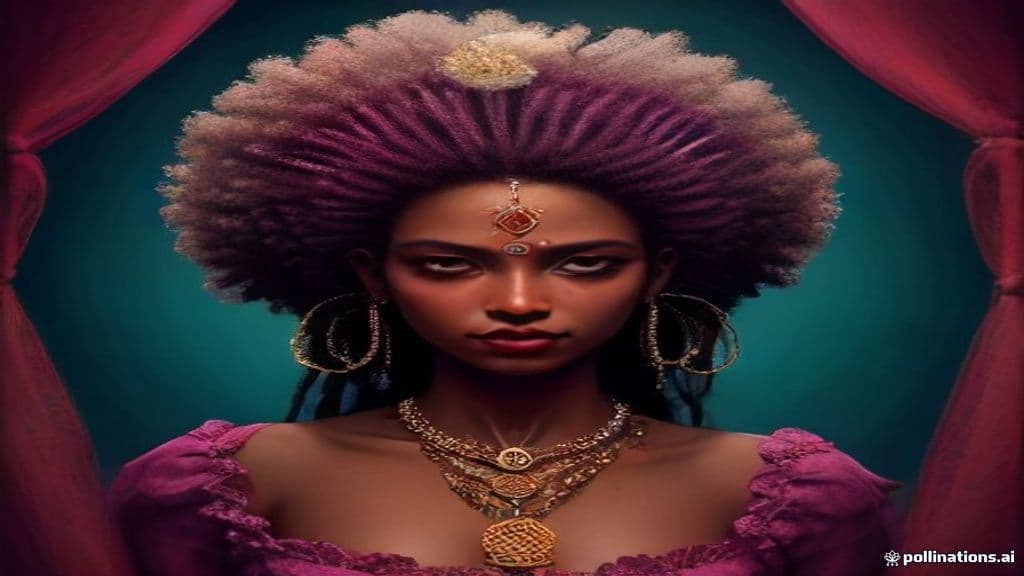
Pomba Gira is generally depicted as a beautiful woman; many sources emphasize her association with female sexuality, glamour, and flirtatious or outspoken behavior in certain avatars. Descriptions note that particular manifestations may emphasize sexualized or vulgar traits (promiscuous, talkative, vulgar) but representations vary by avatar and local practice. Ritual contexts associated with her (roses, perfumes, candles, cigarettes) form part of her iconography in devotional settings, though no single standardized clothing or color scheme is given in the cited material.
Within Umbanda and Quimbanda ritual practice Pomba Gira is a spirit of possession and intercession: she is reputed to possess devotees (including transgender women and effeminate male worshippers) and is often invoked for assistance in matters of love, desire, and relationships. She functions as a powerful liminal force associated with crossroads, cemeteries, and other marginal spaces and may reward petitioners or punish those who disrespect her; sources stress her capacity for great wrath and the need for careful, respectful ritual engagement.
Weaknesses
- conditionDisrespect or improper ritual treatment provokes wrath
Wards
- ritualRespectful ritual engagement and propitiation (offerings of candles, roses, perfumes, cigarettes)
Adjassou-Linguetor
Adjassou-Linguetor is a loa in Haitian Vodou associated with spring water. The limited cited sources describe her as having protruding eyes and a bad temper; beyond these points, the available documentation (Wikipedia and Wikidata) is minimal.
Aganjú
Primordial Orisha associated with the sun, fire, and the untamed wilderness in Yoruba tradition. (Note: - Remove "untamed wilderness" from Power tier description as it's a trait associated with Lesser entities, not Primordial. - Add Appearance section based on source material (e.g., no specific descript)
Agwé
Agwé is a high-ranking lwa in Haitian Vodou associated with the sea, navigation, fishing, and certain funerary conveyances. He is portrayed as a naval officer who lives in a palace beneath the sea, commands attendant spirits, and is propitiated with maritime offerings and ceremonies.
Alicanto
A nocturnal, flightless bird-like being from Chilean Atacama desert folklore whose glowing wings indicate the presence of underground ores; it can guide a stealthy prospector to a mother lode or, if offended or detected, extinguish its light and mislead or endanger the seeker.
Aloja
Aloja is listed in available sources as a named figure in Catalan legend; beyond a brief disambiguation listing, traditional folkloric details are absent in the consulted material. A contemporary commercial design note reinterprets Aloja as a Mediterranean/sea goddess with energetic yet tender character, but this is explicitly a modern creative description rather than documented folk belief.
Anansi
The spider trickster god of Akan folklore — cunning, mischievous, and wise. Keeper of stories and teacher of human beings, brought through the slave trade into Caribbean and African-American tradition.
Ascalapha odorata (Hawaiian)
A nocturnal moth associated with death or misfortune in Hawaiian tradition, possibly tied to Central and South American folklore. (Note: - Summary should note that Ascalapha odorata's association with death/misfortune is found in Central and South American folklore, not explicitly mentioned in Hawaiian tradition. - Power tier: Primordi)
Ayagunna (Yoruba Tradition)
A manifestation of Obatala, the Sky Father, embodying martial prowess and a desire for global peace through domination. (Note: - Power tier should be Greater (Ayagunna is described as manifesting the Sky Father's "fierceness" and having achieved global conquest). - Appearance needs clarification or deletion, as there is no ex)
Ayida Wedo
Ayida Wedo is a primordial rainbow-serpent loa of Haitian Vodou (with counterparts in Fon and Ewe vodun) associated with water, the rainbow, and the elemental forces; she often appears paired with Damballa as the dual cosmic serpent that assisted the creator in forming and upholding the world.
Ayizan
Ayizan is a racine (root loa) in Haitian Vodou and related West African-derived Vodoun traditions, functioning as the archetypal mambo (priestess) and a guardian of ritual order, initiation (kanzo), and the transmission of sacerdotal implements such as the asson. She is also associated with the marketplace and commerce and is syncretized with the Catholic Saint Clare.
Badalona giants
The Badalona giants (Catalan: gegants de Badalona) are eight large, anthropomorphic effigies used in the civic festival life of Badalona, Catalonia. Constructed of wood, plaster and carton, they represent locally prominent historical or mythological figures and are carried and made to 'dance' in processions during the city's spring festival (May), its principal festival around 15 August, and other municipal occasions.
Baron Samedi
A principal lwa of Haitian Vodou who serves as master of the dead and psychopomp, head of the Gede family; associated with cemeteries, crossroads, resurrection/healing, and licentious, comic behavior.
Community Record
- [1]Pomba Gira - Wikipedia. Wikipedia entry 'Pomba Gira' (cited etymology, roles, avatar lists, associations with Exu, liminal places, and offerings).wiki
- [2]Wikidata: Pomba Gira. Wikidata entry summarizing Pomba Gira as a figure in Brazilian mythology.other
- [3]Pomba Gira and the Quimbanda of Mbùmba Nzila | Scarlet Imprint (publication listing). Publication/monograph listing referenced as comprehensive English-language work on the cult and ritual practice.other
- [4]Pomba Gira and the Quimbanda of Mbùmba Nzila | Scarlet Imprint (digital edition). Digital edition listing noted in bibliography as detailed study of Quimbanda and Pomba Gira cult practice.other
- [5]Pomba Gira | Metapsychosis (podcast episode). Popular-cultural/podcast treatment that discusses Pomba Gira's cultic and cultural presence.other
- [6]Turbo Rock 28-04-2022 (archive). Archived cultural material referencing Pomba Gira in a musical/creative context.other
- [7]Dragonscale Jewelry & Fine Arts - Pomba Gira listing. Commercial listing referencing Pomba Gira and popular imagery (noted in research notes).other
- [8]Blog/commentary and practitioner note (Daniel Pellizzari / Necronomi). Commentary noting practitioner perspectives about Pomba Gira and Exu, including warnings that these are 'hardcore' entities and not to be trifled with.other