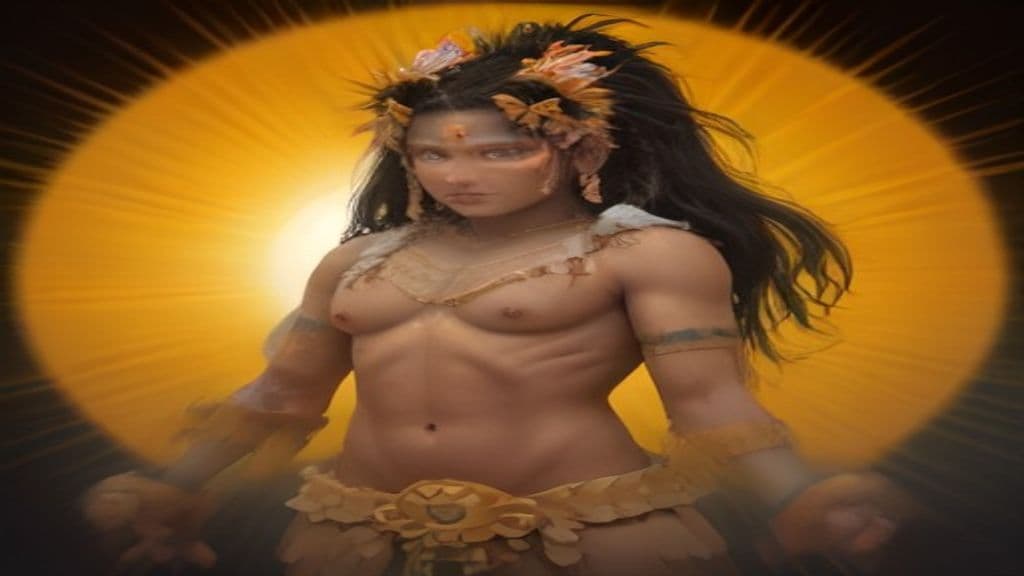
Within the corpus of Māori myth Tama-nui-te-rā functions as the sun-person who occupies the place of the sun in cosmological and origin narratives. He appears in stories where culture-heroes interact with solar motion—most notably in accounts collected and taught in Māori educational support materials of the tale commonly titled 'How Māui slowed the sun,' in which Māui and his brothers take action to change the sun's movement so that daylight lasts longer. Broad survey sources of Māori mythology present Tama-nui-te-rā as part of the mythic network that explains observable phenomena and seasonal patterns, and as an agent integrated into kinship-like relations with other personified beings (for example, his marriage to Hine Raumati and parentage of Tānerore).
The available sources consistently treat Tama-nui-te-rā as a personified sun or sun god but do not provide a detailed, consistent bodily description. Te Papa and encyclopedia summaries describe him as the personification of the sun (Tamanuiterā); Matauranga Māori materials present him in relational roles (husband, father) and as an active figure in narrative and performance contexts. Where imagery exists it emphasizes his status as the sun-person rather than giving fixed physical features, coloration, or anthropomorphic detail in the cited materials.
As the personified sun, Tama-nui-te-rā governs daylight and the sun's motion in Māori narrative contexts: his movement across the sky is a phenomenon that can be engaged by mythic actors (for example, Māui's well-known deed in the story of slowing the sun). He has familial and generative roles—recorded sources name Hine Raumati as one of his wives and Tānerore as his son; Tānerore's dancing is linked to the shimmering of the air on hot days and to the foundational light, rapid movements in haka. Tama-nui-te-rā therefore functions both as a cosmological agent affecting day length and as a figure embedded in cultural explanation and performance practice.
Aitu (Māori)
Malevolent spirits in Māori tradition, often taking the form of plants or animals and associated with trouble-making and mischief. (Note: - Power tier should be Greater, not Lesser (Aitu being lesser gods in some cultures, but also associated with deity-level abilities) - Abilities: Add detail about their role as patrons of specific vil)
Akava'ine
Akava'ine is a Cook Islands Māori social and gender category for people assigned male at birth who live or present as women or otherwise occupy a gender-variant/transgender role. The term (Cook Islands Māori) literally means "to behave as a woman" and has both historical ethnographic mentions of gender-variant individuals in the Cook Islands and a contemporary use (since the 2000s) among Cook Islands Māori, including diaspora communities.
Aotea (Canoe)
Ancestral waka in Māori tradition, significant in the migration of the Māori people to New Zealand. (Note: - Power tier should be at least Greater (deity-level), considering Aotea is associated with significant spiritual and cultural importance to the Māori people's migration. - Abilities should include de)
Aotearoa (Canoe)
An ancestral vessel in Māori tradition, associated with the migration and settlement of New Zealand. (Note: 1. Power tier should be Ancient, not Primordial. 2. Remove "Historical significance" from sensory cues as it is a general statement rather than a specific cue. 3. Add "Its presence is often associated)
Apakura
Female figure in Māori mythology, wife of Tūhuruhuru and/or Tūwhakararo, associated with multiple generations of whānau. (Note: 1. Power tier: Given her association with multiple generations of whānau and the miraculous birth story involving Whakatau, it's likely she should be classified as a Greater entity. 2. Abilities: Add )
Arahura (Māori canoe)
Divine Māori canoe made of pounamu, associated with the Ngāi Tahu tribe and spiritual significance. (Note: * Power tier: Not specified, assume Lower or Lesser as it's associated with the tribe and not described as a deity-level being * Abilities: Remove the mention of spiritual significance and connection )
Arautauta
The Arautauta is a significant waka (canoe) in Māori tradition, playing a key role in the migration of people to New Zealand. (Note: - Power tier: Should be Primordial (as it's a significant waka in Māori tradition) - Abilities: Should mention its use for transporting people and goods as a notable aspect of its significance - Appea)
Arawa (canoe)
In Māori tradition, the Arawa is a supernatural canoe representing the ancestors' journey to New Zealand. (Note: * Power tier: Primordial (or not specified at all, as there's no indication of supernatural powers beyond its symbolic and cultural significance) * Appearance: No physical description mentioned in sou)
Atea
Atea is a primordial creator-associated being in multiple Polynesian traditions (Marquesas, Tuamotu, and Māori) closely associated with light and the ordering of the cosmos. Variants depict Atea as a self-originating giver of light, a progenitor who fathers gods and humans, or as the cosmic universe that is sex-differentiated into Heaven and Earth in one reported account.
Atua (Māori Deity)
In Māori mythology, Atua are supernatural beings believed to have created the world and all living things. They are considered rulers of the spiritual realm with powers over nature, fertility, and human destiny. (Note: 1. Power tier: Based on the abilities described (controlling nature, fertility, and human destiny), Atua likely belong to the Primordial power tier, not Greater. 2. Weaknesses: Add a specific weakness)
Atutahi (Māori tradition)
In Māori mythology, Atutahi is a celestial entity and the second brightest star in the night-time sky, considered solitary or self-centered. It serves as a navigational aid for Māori sailors, appearing as a bright star on the evening or southern horizon. (Note: - Power tier: Primordial (due to its status as a celestial entity in Māori mythology) - Abilities: Add ability of guidance, specifically for navigation, based on source material - Weaknesses: List is )
Auahitūroa
Auahitūroa is a Māori deity described in the cited sources as the personification of comets and as the origin of fire; he is named as a son of Tama-nui-te-rā (the sun), consort of the fire goddess Mahuika, and father of the five Ngā Mānawa.
Community Record
- [1]Tamanuiterā | Te Papa’s Blog (glossary entry). Te Papa Blog, 'Tamanuiterā' glossary entryother
- [2]Tamanuiterā (Tama-nui-te-rā) — Wikipedia. Wikipedia, 'Tamanuiterā' / 'Tama-nui-te-rā'wiki
- [3]How Māui slowed the sun / Māori Myths, Legends and Contemporary Stories — Mātauranga Māori Support Materials. Mātauranga Māori, 'How Māui slowed the sun' support materialother
- [4]Kapa Haka / Hine Raumati – Level 1 — Mātauranga Māori (Tamanuiterā, Hine Raumati, Tānerore). Mātauranga Māori, 'Kapa Haka / Hine Raumati' support materialother
- [5]Māori mythology — Wikipedia (general context on Māori myth functions). Wikipedia, 'Māori mythology' overviewwiki
- [6]Wikidata: Tama-nui-te-rā. Wikidata entry for Tama-nui-te-rāother