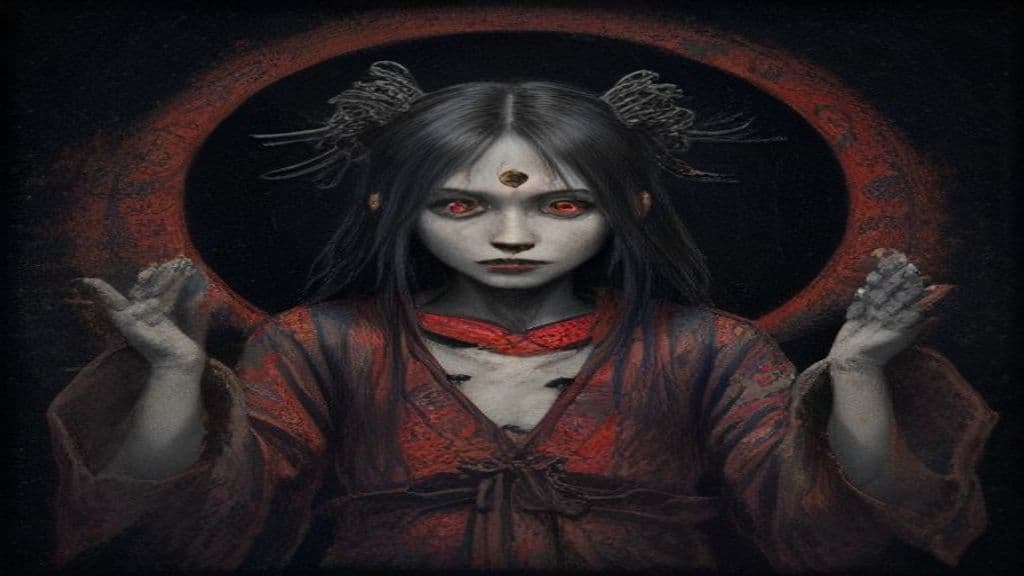
The core pictorial source (Toriyama Sekien's emaki) supplies no explanatory text; later regional setuwa and compilations supply origin narratives. In several local tales the tenome is presented as the transformed or vengeful spirit of a blind person who was killed or robbed and who, in death, acquires eyes on the palms of the hands in order to look for or at those wrongdoers. Other emaki/companion manuscripts offer variant or playful origins tied to visual-wordplay rather than a single uniform birth legend.
Typically shown as an aged, humanoid figure (often zatō-like or robed) who raises its hands to display an eyeball embedded in each palm; the face appears lacking normal eyes. Sekien-style prints place the figure in nocturnal settings (moonlit plain, grasses). Some emaki label variants teme-bōzu (手目坊主). Related motifs (distinct but comparable) include kurayami me with eyes on the fronts of the knees.
Primary folkloric motifs attest that the palm-eyes are functional: they enable the creature or transformed blind person to 'look' in darkness or to search (Iwate tale: 'these eyes seemed to be looking for something'). Regional anecdotes portray vengeful seeking behavior tied to grievance against criminals. At least one anecdote (Shokoku Hyaku Monogatari) records a gruesome act: after a victim hid in a chest, the victim was later found with all the bones removed, body reduced to skin. Modern roleplaying or film adaptations expand these traits, but such adaptations are derivative and not original folkloric documentation.
5 Ronin
5 Ronin is a 2011 Marvel Comics five-issue limited series that reimagines five Marvel superhero archetypes as rōnin (masterless samurai) in a fictionalized post‑Sekigahara feudal Japan. The work places Wolverine, Hulk, Punisher, Psylocke, and Deadpool analogues into period roles to explore displacement, revenge, and identity in an era of political upheaval.
Abumi-guchi
A Japanese yōkai classed as a tsukumogami: an animated stirrup (abumi) depicted in Sekien Toriyama's Gazu Hyakki Tsurezure Bukuro. Traditional accounts say it is formed from a stirrup that belonged to a soldier who fell in battle and that it waits where the stirrup lies for its dead owner to return.
Abura-akago
An Edo-period yōkai depicted as an oil‑licking infant or a ball of flame. First recorded in illustrated compendia (notably Toriyama Sekien's Konjaku Gazu Zoku Hyakki), the Abura-akago is tied to tales of oil‑stealing fires and functions in part as an etiological warning about wasting or stealing oil.
Abura-sumashi
A yōkai spirit from the Amakusa region of Kumamoto Prefecture, Japan, said to inhabit mountain passes. Traditionally explained as the ghost of a person who stole oil, it appears to surprise travelers and is represented in modern media with a straw-coat body and a potato- or stone-like head.
Aburabō / Abura-bōzu / Aosaginohi (traditions)
Two distinct Japanese traditions appear under related flame imagery: Aosaginohi/Aosagibi is presented as a will-o'-the-wisp type luminous night phenomenon interpreted as reflections from herons; aburabōzu (abura bōzu, "oil monk") appears in a separate anecdote as a reported fire-breathing apparition in a 12th-century Yasaka Shrine tale. The sources treat them as separate portrayals rather than a single unified being.
Acala
Acala (Sanskrit: अचल, 'The Immovable') is a wrathful protective deity (dharmapala) in Vajrayāna and East Asian esoteric Buddhism, classed among the Wisdom Kings (Vidyārāja). He functions as a ritual focus for visualization and mantra practice intended to remove obstacles and bind or destroy hostile forces.
Agaru
Agaru (attested historically as Agarum) appears in the supplied sources as a Bronze Age Near Eastern toponym—often identified with Failaka Island—and as a modern personal or media name. The provided material contains no evidence that Agaru is a supernatural being in any traditional cosmology.
Ajisukitakahikone
Ajisukitakahikone is a kami in Japanese mythic literature (Kojiki/Nihon Shoki). He appears in the transfer-of-rule cycle between heaven and earth, is described as a son of Ōkuninushi, associated with the Kamo cult (called Kamo no ōmikami in some modern museum/catalog entries), and features in narratives that explain landscape formation and meteorological genealogy.
Aka Manto
Aka Manto (赤マント, "Red Cloak") is a Japanese urban legend and schoolyard ghost-story about a masked, cloaked figure who appears in public or school toilet stalls and forces occupants to choose between colored toilet paper; each choice in the tale produces a violent supernatural consequence. The legend is part of modern popular folklore recorded in school contexts from the 1930s onward rather than a formal religious myth.
Akaname
Akaname is a Japanese yōkai associated with baths, bathtubs, toilets, and other places where scum and filth accumulate. Traditionally depicted as a child-like creature that licks grime, it functions in folklore as a cautionary figure tied to cleanliness; a few narrative variants cast it as dangerously predatory.
Akashaguma
Akashaguma is presented in the available sources as a child-like house guardian spirit in the Japanese yokai tradition, closely comparable to the regional zashiki-warashi. It is associated with domestic interiors (parlors or storage rooms) and with bringing prosperity to households where it dwells.
Akashita
Akashita (赤舌, lit. “red tongue”) is an Edo-period pictorial yōkai commonly represented as a hairy, clawed face emerging from dark clouds with a wide open mouth and a conspicuous red tongue. The figure appears in yōkai emaki and Toriyama Sekien’s Gazu Hyakki Yagyō; Sekien’s plate shows it atop a sluice, but the original pictorial tradition provides no explanatory caption. Later folklorists and popular writers (Shōwa and later) have variously interpreted the image as a punitive spirit linked to irrigation/floodgate justice or as a kidnapper in evening skies, though these narrative roles are post-hoc.
Community Record
- [1]Tenome (Wikipedia). Wikipedia, 'Tenome' article (as cited in research notes)folk
- [2]Gazu Hyakki Yagyō (Toriyama Sekien) and emaki tradition (discussion in Source 1). Discussion of Sekien's depiction and companion emaki labels (Source 1, research notes)literary
- [3]Iwate setuwa (regional anecdote). Iwate tale describing a blind person with an eyeball on each palm 'these eyes seemed to be looking for something' (Source 1, research notes)folk
- [4]Shokoku Hyaku Monogatari anecdote (bone removal). Shokoku Hyaku Monogatari anecdote: after hiding in a nagamochi the man was later found 'to have all the bones in his body removed, his body reduced to just skin' (Source 1, research notes)folk
- [5]Katsumi Tada commentary on Sekien's visual-wordplay. Scholarly interpretation that Sekien's image may function as visual pun or joke within Edo-period yōkai vernacular (Source 1, research notes)academic
- [6]PathfinderWiki / modern adaptations (derivative). Modern RPG and monster-encyclopedia adaptations illustrate later fictional elaborations but are derivative of emaki imagery (research notes)wiki
- [7]Pan's Labyrinth 'Pale Man' comparisons (modern media influence). Discussion noting visual resemblance between Sekien's tenome and film's 'Pale Man'—an example of modern adaptation/influence (research notes)other