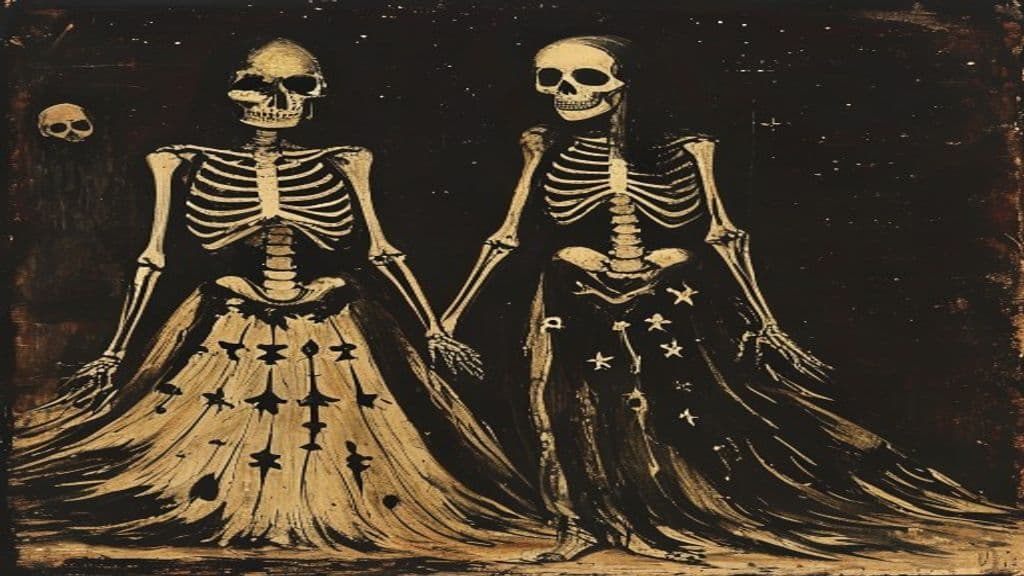
The provided sources do not record a detailed, sourced mythic birth narrative for the Tzitzimime in the excerpts available. What is attested is their placement within Aztec cosmology as celestial beings associated with stars; this situates them among the pantheon of deified cosmic phenomena rather than household or ancestral spirits. Post‑conquest accounts and later summaries sometimes recast them with Christianized language (for example calling them "demons" or "devils"), but the primary attested role in the supplied material is as star‑associated supernatural figures within the Aztec sacred landscape rather than as figures defined by the later European interpretive framework.
Sources describe the Tzitzimime as skeletal female figures. Iconography commonly shows them wearing skirts, and those skirts are frequently decorated with skull‑and‑crossbones motifs. The emphasis in the available descriptions is on a skeletal, female form combined with skull imagery, making their visual presentation tied to death iconography while simultaneously marking them as distinctively feminine celestial personae.
The sources provided identify the Tzitzimime primarily by their association with stars and by their iconography; they do not supply detailed, sourced descriptions of specific supernatural powers, actions, or behaviors in the primary Aztec corpus within the given material. Modern post‑conquest descriptions sometimes label them as "demons" or "devils," but the supplied source cautions that such labels may misrepresent their pre‑contact function. A modern database entry (Wikidata) classifies them as "female fertility deities," indicating that some contemporary taxonomies associate them with fertility, but this classification is not elaborated or supported by details in the supplied texts and must be treated as a later or secondary categorization rather than a documented set of abilities in the primary material.
Acolnahuacatl
Acolnahuacatl is a name attested in central Mexican sources both as a historical Tepanec ruler of Azcapotzalco and, in several modern compilations and trivia lists, as a minor chthonic or underworld-associated figure (often given the variant Acolmiztli). The evidence in the provided material is divided: the historical/genealogical reading is supported by standard reference entries, while the deity reading appears mainly in secondary online god-lists and quizzes and is not substantiated by detailed primary ritual or mythic texts in the supplied set.
Ahuiateteo
Ahuiateteo (Āhuiatēteoh; also rendered Mācuīltōnalequeh) are a quintet of Aztec deities associated with excess, pleasure, and the dangers that accompany over‑indulgence. They appear in calendrical and codical contexts, are invoked in divinatory practice, and are thematically linked to pleasures (feasting, drinking, gambling, sex, music) and the misfortunes that follow excess.
Ahuitzotl
Ahuitzotl is both the personal name of the eighth tlatoani (ruler) of Tenochtitlan (reigned ca. 1486–1502) known for military expansion and monumental rebuilding, and an onomastic term in Nahuatl for an aquatic animal/legendary creature (commonly glossed 'water thorny' and often associated with an otter or water opossum). The sources treat these registers—historical ruler and animal-name—as related but distinct uses of the same Nahuatl lexeme.
Ahuizotl
Ahuizotl is identified in the provided sources as an Aztec mythological creature; the same lexical form also names an historical Aztec emperor (Ahuitzotl). The available materials for this entry are limited to modern reference pages and a small set of artistic and popular-culture uses of the name, and do not contain primary indigenous mythic accounts or detailed ethnographic descriptions.
Amimitl (Opochtli)
A Mexica/Aztec deity associated with fishing, hunting, and water-related technologies; identified in sources with the better-documented figure Opochtli, "The Left," who functions as a specialized patron of implements and as a representative or attendant of the rain god Tlaloc. A temple in the Tira de la Peregrinación has been interpreted by a scholar as possibly belonging to a figure labeled Amimitl, but that identification is uncertain.
Atlacoya
Atlacoya is named in modern compilations as a figure from Aztec tradition associated with drought; some modern databases alternately classify the name under water-deity categories. The supplied sources do not provide primary-codex citations, iconography, etymology, or detailed ritual texts.
Atlahua
Atlahua is an Aztec water-associated deity attested in colonial and modern summaries as a water god described as a fisherman and archer, identified in sources as a blue/aspectual form of Tlaloc and invoked in contexts of deaths in water.
Atlaua
Atlaua (also recorded as Atlahua, Ahtlahua, Atlahoa, Atlavâ) is an Aztec water deity described in the provided sources as a water god, fisherman and archer who was worshiped at multiple temples and was prayed to by the Aztecs when there were deaths in water.
Aztec Creator-Brothers
A quaternity of primordial divine offspring in Aztec (Mexica) myth who dwell in the highest heaven Ilhuicatl-Omeyocan as children of Omecihuatl and Ometecuhtli. Identified in sources with fourfold aspects (conventionally four Tezcatlipocas / colored aspects such as Black, Red, White, Blue) they act as cosmological agents who create living beings, take turns ruling as the Sun in successive world-ages, and participate in sacrificial acts that sustain cosmic cycles.
Camaxtle (Mixcoatl)
Camaxtle (also spelled Camaxtli) identified with Mixcoatl is a Mesoamerican deity of the hunt who is associated with the Milky Way, the stars, and the heavens and served as a patron god for groups such as the Otomi and Chichimecs and as a central cult figure in Huejotzingo and Tlaxcala.
Centeōtl
Centeōtl is the Nahua/Aztec maize deity — the divine personification of maize, its growth, cultivation and role in human subsistence. The name (Cintli + teōtl) ties the deity to the maize ear; Centeōtl features centrally in planting and harvest rites, calendrical offices, and Aztec cosmological genealogy.
Centzon Tōtōchtin
A collective of Aztec pulque deities literally rendered 'Four Hundred Rabbits', the Centzon Tōtōchtin function within the pulque cult and are associated with pulque production, ritual use, regulated intoxication, and related night/lunar symbolism.
Community Record
- [1]Tzitzimime (Wikipedia). Wikipedia contributors, "Tzitzimime," Wikipedia, The Free Encyclopedia, https://en.wikipedia.org/wiki/Tzitzimitlwiki
- [2]Wikidata: Q650572 (Tzitzimitl). Wikidata entry Q650572, "Tzitzimitl," http://www.wikidata.org/entity/Q650572wiki