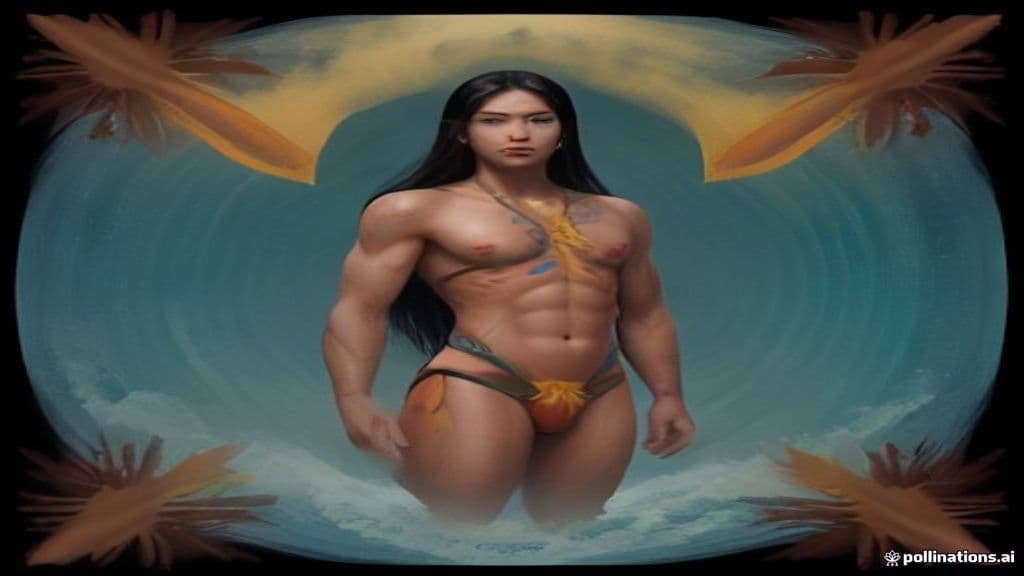
In Hawaiian genealogical cosmology Wākea (whose name means expansive space, zenith, or heaven) is the sky parent who, together with Papahānaumoku (the earth mother), produces the islands, staple crops, and human lineages. Variants record Wākea and Papahānaumoku creating land and sea from Papahānaumoku's calabash (‘ipu); in some accounts Wākea throws the calabash up to become the heavens, makes rain from its juice, and fashions the sun, moon, and stars from seeds he made (Wikipedia). Wākea is described as the ancestor of the aliʻi and as a High Chief when on earth; genealogical placements in the sources name him as a son of Kahiko ('Ancient One') in tradition (Wikipedia; Internet Sacred Text Archive).
Traditional sources provided in the cited corpus offer little sustained physical description or fixed iconography of Wākea; he is primarily represented as a sky/ancestral force and progenitor rather than by detailed bodily features. The meaning of his name—expansive space or zenith—frames him conceptually as the personification or agency of the sky and celestial expanse, and some narratives also present him as a High Chief when dwelling on earth (Wikipedia; Internet Sacred Text Archive).
Accounts attribute cosmogenic actions to Wākea in certain versions: co‑creating islands with Papahānaumoku, forming land and sea from Papahānaumoku's calabash, producing rain from its juice, and making the sun, moon and stars from seeds (Wikipedia). He is the progenitor in the origin of kalo (taro) and humans: after an incestuous union with his daughter Hoʻohokukalani the stillborn child Haloa‑naka becomes the first kalo and a later child, Haloa, becomes the first human—establishing the reciprocal kinship between land and people (Wikipedia; Internet Sacred Text Archive). Socially and ritually, Wākea institutes the ʻaikapu (a sacred eating regimen separating men and women and specifying food taboos) and is associated with priestly authority (his first high priest is named Komoʻawa in the sources). He is also described as the destination where departed souls are judged for purity; the impure are sent to Lua‑o‑Milu while the pure remain in his realm (Wikipedia).
Aitu (Māori)
Malevolent spirits in Māori tradition, often taking the form of plants or animals and associated with trouble-making and mischief. (Note: - Power tier should be Greater, not Lesser (Aitu being lesser gods in some cultures, but also associated with deity-level abilities) - Abilities: Add detail about their role as patrons of specific vil)
Aiwohikupua
Aiwohikupua is a personal name attested once in the supplied corpus of collected Hawaiian-language narrative material. The available sources provide only a short fragmentary occurrence of the name and no corroborating description, role, or attributes.
Akava'ine
Akava'ine is a Cook Islands Māori social and gender category for people assigned male at birth who live or present as women or otherwise occupy a gender-variant/transgender role. The term (Cook Islands Māori) literally means "to behave as a woman" and has both historical ethnographic mentions of gender-variant individuals in the Cook Islands and a contemporary use (since the 2000s) among Cook Islands Māori, including diaspora communities.
Akua
Akua is the Hawaiian common noun for a god, deity, or divine being; in the provided sources it functions as a lexical category applied to indigenous Hawaiian deities and as the translation-term for the Christian God in Hawaiian-language liturgy and scripture.
Ascalapha odorata (Hawaiian)
A nocturnal moth associated with death or misfortune in Hawaiian tradition, possibly tied to Central and South American folklore. (Note: - Summary should note that Ascalapha odorata's association with death/misfortune is found in Central and South American folklore, not explicitly mentioned in Hawaiian tradition. - Power tier: Primordi)
Atanua
Atanua is the Marquesan (Polynesian) goddess of the dawn who, in local cosmogony, is the consort of Atea and mother of the first man; she is also credited in the surviving summary accounts with creating the seas as the result of a miscarriage.
Atea
Atea is a primordial creator-associated being in multiple Polynesian traditions (Marquesas, Tuamotu, and Māori) closely associated with light and the ordering of the cosmos. Variants depict Atea as a self-originating giver of light, a progenitor who fathers gods and humans, or as the cosmic universe that is sex-differentiated into Heaven and Earth in one reported account.
Atua (Māori Deity)
In Māori mythology, Atua are supernatural beings believed to have created the world and all living things. They are considered rulers of the spiritual realm with powers over nature, fertility, and human destiny. (Note: 1. Power tier: Based on the abilities described (controlling nature, fertility, and human destiny), Atua likely belong to the Primordial power tier, not Greater. 2. Weaknesses: Add a specific weakness)
Avatea
Avatea (also spelled Vatea in some sources) is a primordial parent figure in Mangaian (Cook Islands) mythology, described as a lunar deity and god of light whose eyes were thought to be the Sun and the Moon, and who is called the father of gods and men in the island's origin narrative.
Binabinaaine
Binabinaaine (also spelled pinapinaaine) is a culturally specific third-gender role from the Gilbert Islands (now Kiribati) that has been loaned into Tuvaluan usage; it denotes people assigned male at birth who adopt feminine gender expressions, social responsibilities, and roles and are regarded locally as neither men nor women but a distinct social category.
Dakuwaqa
Dakuwaqa is a Fijian shark deity and powerful sea-being who functions in tradition as both a fierce sea monster and a guardian of islands and fishermen. In recorded myths he can threaten islands in specific narratives but also becomes protector of places and is placated by offerings such as kava libations.
Earth deity
An earth deity is the personification or deification of the Earth in a culture's cosmology, often tied to fertility, the ground/land, chthonic or underworld aspects, and communal protection of territory or Dharma. Specific named examples include Papa (Polynesian/Maori), Geb (ancient Egyptian), and Prithivi (in Buddhist textual contexts).
Community Record
- [1]Wākea. Wikipedia: Wākea (entry summarizing Hawaiian mythic traditions, etymology, cosmogenic acts, genealogies, ʻaikapu, Komoʻawa, Haloa narrative, and afterlife adjudication).wiki
- [2]Hawaiian Mythology: Part Three. The Chiefs: XX. Papa and .... Internet Sacred Text Archive: Hawaiian Mythology (accounts of Papa and Wākea including the Haloa narrative and genealogical material).folk
- [3]Mauna a Wākea — Terra Incognita Media. Terrain Incognita Media feature discussing contemporary invocations of Mauna a Wākea (Mauna Kea) as sacred and linked to the Sky Father in modern cultural and activist contexts.other
- [4]First Light: Kanaka 'Oiwi Resistance to Settler Science at Mauna a Wakea. Reference to contemporary work treating Wākea/Mauna a Wākea in present‑day cultural and scientific contestation (cited in research notes).other
- [5]The Triumph of Wakea. A Mythological Reoccurrence (ScholarSpace Manoa reference). Scholarly title referenced in the research notes addressing Wakea's role in mytho‑historical patterns and chiefly sovereignty.academic
- [6]Last Real Indians: Niijii Radio summary — Mauna Kea. Radio summary referenced in research notes linking Mauna Kea to Wakea in contemporary discourse.other