
In the presented source Naayééʼ Neizghání is introduced as a mythic hero whose principal deed is a campaign, undertaken with his brother Tóbájízhchíní, to rid the world of a class of harmful beings called the Naayééʼ. The account frames him as a restorative figure who removes these monsters from the world, returning order through direct action. The source does not provide a fuller birth narrative, genealogy beyond his brother, or ritualized origin, and therefore offers only this brief outline of his role as monster-slayer within Navajo myth.
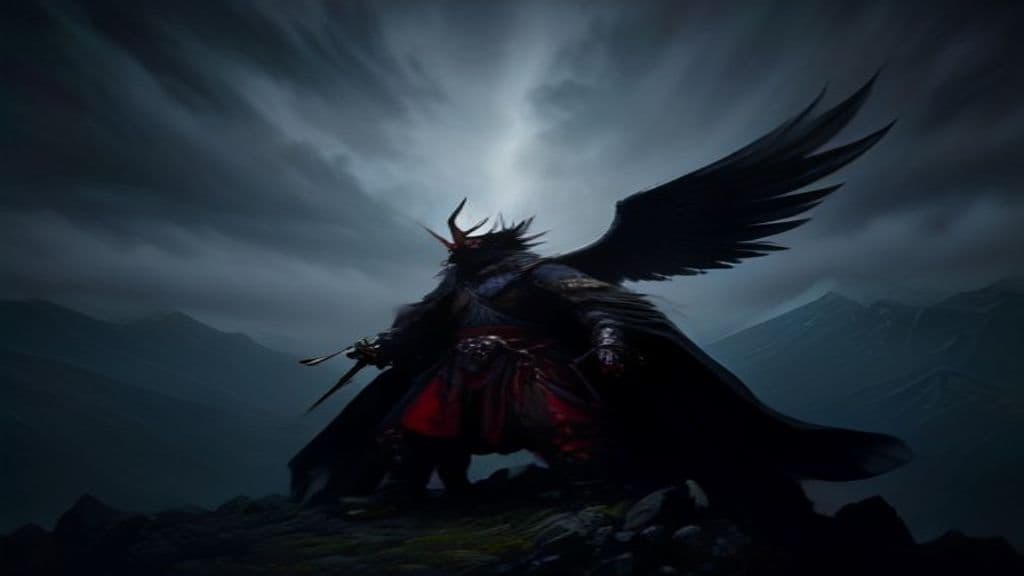
The provided source does not supply any physical description, iconography, or canonical appearance for Naayééʼ Neizghání. There is no information on his size, facial features, clothing, or distinguishing marks in the cited material. Because this single source is limited to a short summary, it does not record any standardized visual depiction; as with many oral traditions, fuller descriptive detail may vary across tellings and other sources not cited here.
According to the cited material, Naayééʼ Neizghání's primary attributed ability is to rid the world of the Naayééʼ — a campaign of monster-slaying undertaken with his brother Tóbájízhchíní. This phrasing implies competence in combat and the capacity to remove or destroy a class of harmful beings, but the source gives no further specifics about supernatural powers, weapons, methods, or other capabilities. No additional behaviors, magical skills, or ongoing interventions in the world are described in the provided excerpt.
Weaknesses
- otherno weaknesses or wards specified in the source
Wards
- otherno weaknesses or wards specified in the source
Anaye (Navajo tradition)
A 'race of monsters or evil gods' in Navajo mythology, killed by the hero Nayenezgani. (Note: - Power tier: Primordial (as they are described as "evil gods") - Appearance: Add that it's unclear and no physical description is provided - Abilities: Clarify that their powers were formidable enoug)
Angak (Angak'china)
Angak, or Angak'china, is a male Hopi kachina spirit represented both by spirit dancers in village ceremonies and by carved kachina dolls. He is a rain‑bringing, fertility, healing, and protective figure whose songs and slow dances are intended to bring rain and flowers to Hopi villages.
Asdzá́ą́ Nádleehé
A creation spirit in Navajo tradition, involved in the formation of the world and creation of the Navajo people. (Note: - Power tier should be Primordial (no issue) - Origin story is accurate - Appearance needs to be added, stating that no physical description is available - Abilities are mostly accurate, but more deta)
Diné Bahaneʼ (Navajo Creation Story)
A Navajo creation story that forms the basis of their spiritual beliefs, traditional way of life, and ceremonies. (Note: 1. Power tier should be revised to Primordial is accurate, but it's not explicitly stated that Diné Bahaneʼ has primordial powers; instead, it shapes the Navajo worldview. 2. Appearance should be incl)
Ghost Sickness (Navajo Tradition)
A cultural and psychological concept describing a state of being consumed by grief or preoccupation with the deceased. (Note: - Power tier: Primordial (Ghost Sickness is not an entity with concrete abilities, but rather a psychological state that affects individuals) - Appearance: No description needed, as it's a psychologic)
Haashchʼééshzhiní (Black God)
A creator deity in Navajo folklore responsible for placing the stars and possessing supernatural powers. (Note: 1. Power tier should be Primordial, but this needs clarification as it's not explicitly stated in the sources. 2. Abilities section only mentions placing stars and inventing the fire drill. The source)
Kúngoʼí (Wind People / wind spirits)
No substantive information about a Navajo entity called Kúngoʼí (Wind People or wind spirits) is present in the supplied source material. The only consulted record refers to a geographic Wikidata item unrelated to Navajo cosmology.
Monster Slayer (Nayenezgani)
Within the limited sources supplied, 'Monster Slayer' is used as an English label on a Wikipedia disambiguation page to refer to Nayenezgani, identified there only as "a character from the Navajo creation myth." The provided materials contain no narrative, descriptive, or ritual information about this figure beyond that single listing.
Navajo Ghosts (Yéʼiitsoh-related spirits)
Spirits of the deceased in Navajo contexts that are invoked in accounts of 'ghost sickness' and in folktales; they are experienced as agents or influences tied to pathological grief and may be discussed alongside concerns about witchcraft and skinwalkers in contemporary sources.
Nayenezgani (Naayééʼ Neizghání)
Mythical hero from Navajo mythology who rid the world of the Naayééʼ alongside his brother Tóbájízhchíní, playing a significant role in Navajo cosmology. (Note: - Summary: Add "play a significant role in Navajo cosmology" after "world's creation". - Power tier: Reduce from Primordial to Ancient (deity-level), as Nayenezgani is considered a hero and not a cosm)
Naʼashjéʼii Asdzą́ą́ (Naashjeii Asdzaa) — "Spider Woman / Spider Grandmother"
Naʼashjéʼii Asdzą́ą́, commonly rendered in English as Spider Woman or Spider Grandmother, is a Navajo ancestral/feminine figure entrusted by the Holy People to weave the pattern of the universe. She functions in Navajo narrative as a teacher and guide encountered by culture heroes and embodies an instructional, creative, and guardian role rather than a malicious spirit in the provided sources.
Naʼashjéʼii Asdzą́ą́ (Spider Woman)
A central Diné (Navajo) sacred figure credited in cited museum and media sources with weaving the world into existence and transmitting the art of weaving, wool, and design motifs to Navajo women; invoked as an origin figure for forms, symbols, and textile practice in contemporary cultural contexts.
Community Record
- [1]Yéʼiitsoh (Nayenezgani) — Wikipedia. Wikipedia: Yéʼiitsoh (Nayenezgani) entrywiki