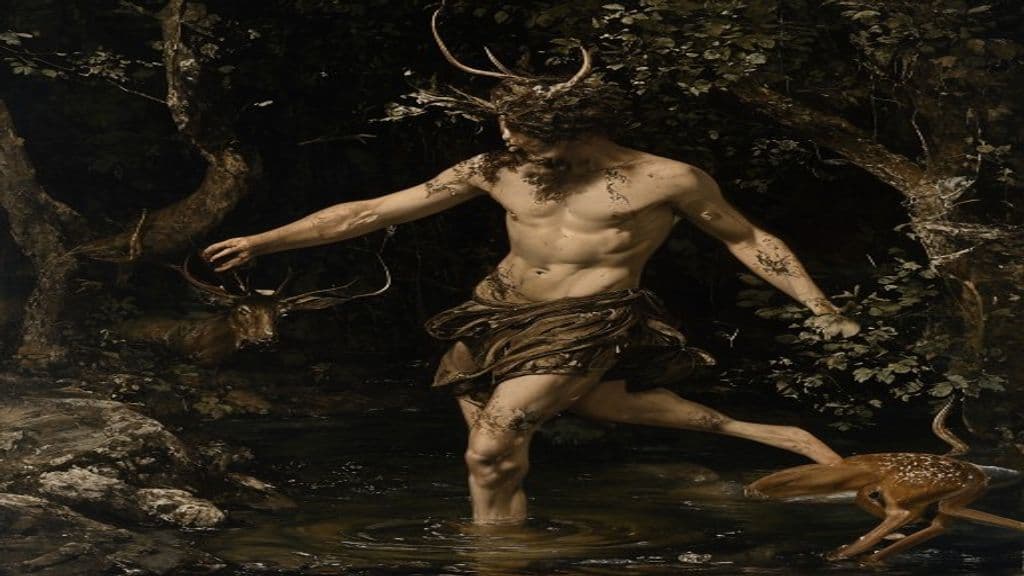
Actaeon is presented in the Greek tradition as a noble-born hunter, son of Aristaeus (father) and Autonoë (mother) of the Cadmean house. Trained in hunting and heroic pursuits—traditionally counted among those tutored by the centaur Chiron—Actaeon appears in versions of a myth in which a mortal's encounter with a goddess (most commonly Artemis) produces a punitive metamorphosis: he is turned into a stag and slain by hunting dogs. Variant accounts attribute the transgression to seeing Artemis bathing, boasting of hunting skill, rivalry over a lover (as in a claim involving Semele), or an attempted sexual approach toward the goddess; the consistent outcome across sources is his transformation and death.
As a mortal Actaeon is described only in functional terms—a famed Theban hunter and hero—without a fixed individualized physical portrait. Literary and visual traditions emphasize three recurrent scenes: discovery of a bathing Artemis, metamorphosis into a stag, and the subsequent mauling by his hounds. In the moment of metamorphosis he is explicitly described as becoming a stag; vase-paintings and poetic accounts often focus on the stag-form and the attacking dogs rather than on a detailed human likeness.
Actaeon possesses exceptional hunting skill and the upbringing of a heroic youth (training by Chiron is a classical motif associated with his education). He has no inherent supernatural powers; rather, the central supernatural element is the divine action inflicted on him—Artemis (in many tellings) transforms him into a stag and sometimes deprives him of speech (Callimachus' version). Some iconographic and literary strands add Lyssa (divine frenzy) as the force that drives the hounds to attack him. Actaeon's behaviors in the narrative tradition include hunting competence, occasional boasting, and—across variants—variously framed transgressive conduct toward the goddess.
Weaknesses
- conditionmortal vulnerability to divine punishment
Wards
- ritualritual deference to Artemis at her sacred springs

Apsara
Celestial dancers and water nymphs of Hindu cosmology — beautiful semi-divine beings who dance at the court of Indra and, by his command, descend to earth to distract sages from excessive asceticism.
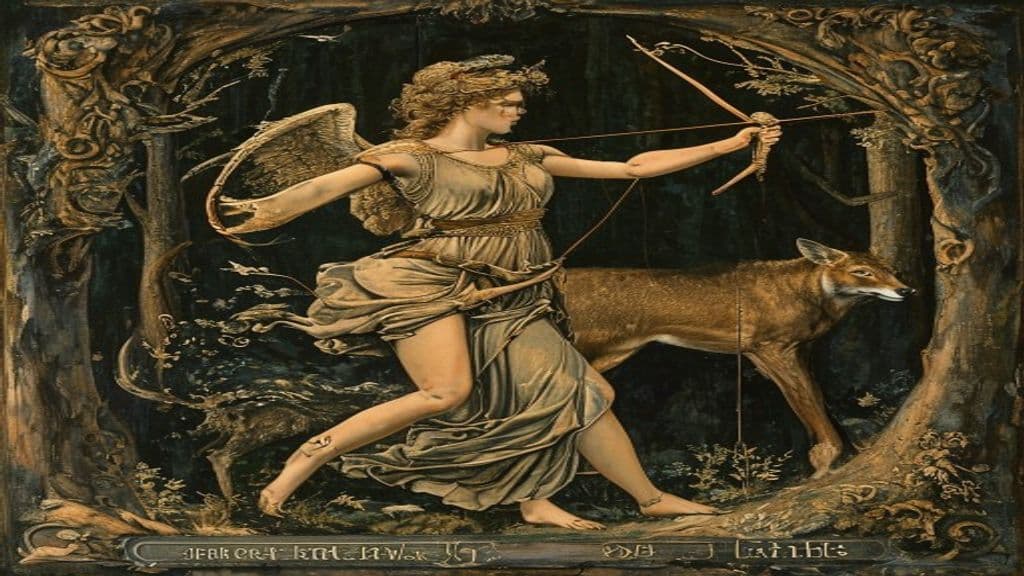
Artemis
Artemis is an ancient Greek goddess of hunting, the wilderness and wild animals, transitions (especially childbirth and puberty), vegetation, and chastity. Twin sister of Apollo and daughter of Zeus and Leto, she functions as a protector of young children and maidens while also capable of inflicting disease or punishment for transgressions against her sacred laws.
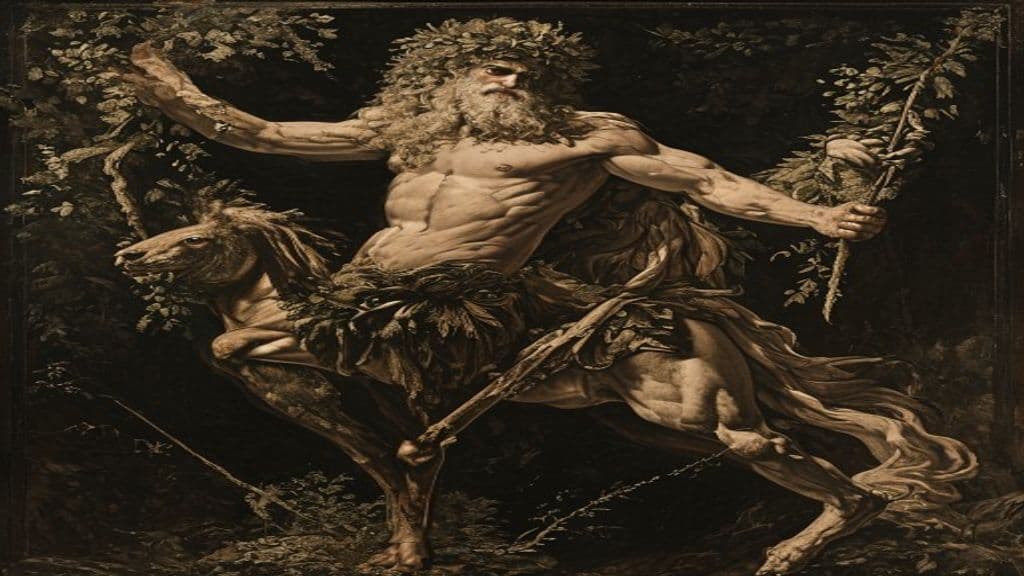
Chiron
Chiron (Ancient Greek: Χείρων, Kheírōn) is a unique centaur of Greek myth, famed as a cultured tutor, healer, and oracle who taught skills such as medicine, music, archery, hunting, and prophecy to culture-heroes. Associated with Mount Pelion in Thessaly, he is presented as wise and civilized in contrast to other, wilder centaurs.
*Péh₂usōn (reconstructed)
Péh₂usōn is a hypothetical Proto‑Indo‑European pastoral guardian reconstructed by comparative scholars from parallels in Greek and Vedic traditions. Proposed as a Graeco‑Aryan ancestor‑figure, the reconstruction describes a protector of flocks, roads, and travellers rather than an attested historical cultic personality.
Aba (disambiguation / name-form)
Aba is a polyvalent name-form attested across many unrelated contexts (place names, personal names, animal names, and brief mythological listings). The provided sources do not support a single, coherent supernatural entity called "Aba" and offer no descriptive or ritual material for such a being.
Abarbarea
Abarbarea is a name attested in classical Greek and Roman sources for freshwater nymphs (naiads). The name appears for at least two individual mythic figures — a naiad wife of Bucolion and a naiad counted among ancestors of the Tyrians — and Hesychius records plural forms that may indicate the name was also used as a class-name (Abarbareai / Abarbalaiai).
Abas
Abas (Ancient Greek: Ἄβας, gen.: Ἄβαντος) is not a single mythic being but a recurring personal name borne by multiple mortals and minor mythic figures in Greek epic and genealogical traditions — kings, founders, seers, warriors, attendants, a centaur, and a youth transformed by a goddess. The name is glossed in the sources as 'guileless' or 'good-hearted' and appears across Argive, Theban, Trojan, Euboean, and other local cycles.
Abderus
Abderus (Ancient Greek: Ἄβδηρος, romanized Ábdēros) is a mortal heroic figure in Greek myth closely associated with Heracles, remembered as the youth left in charge of the Mares of Diomedes who was killed by them. He functions as an eponymous local/divine-hero ancestor for the city of Abdera and received funerary commemoration and athletic agones at his tomb.
Abomination of Desolation
An apocalyptic prophetic phrase originating in the Book of Daniel designating a profaning thing or act that renders the Jerusalem Temple cult desolate; later reused in the Synoptic Gospels as an eschatological sign prompting urgent flight. The term denotes ritual/cultic impurity (Hebrew shiqquts) and is variously interpreted as pagan offerings or altar, a foreign cult statue, or (in some New Testament readings) an acting agent.
Absyrtus
Absyrtus (Ancient Greek: Ἄψυρτος) is a Colchian prince in the Greek Argonautic cycle, son of King Aeëtes and brother or half-brother of Medea. He appears in variant traditions either as a companion taken by Medea during her flight with Jason and murdered/dismembered to delay pursuit, or as a pursuer sent by Aeëtes who is overtaken and slain by Jason; his death functions as a key narrative device in the escape from Colchis.
Acacallis
Acacallis (Ancient Greek: Ἀκακαλλίς; also Acalle) is a mythological princess of Crete in Greek tradition, daughter of King Minos and Pasiphae. She functions primarily as a dynastic and etiological figure: in varying accounts she is mother, by gods such as Hermes (Mercury) or Apollo, of eponymous or founder-figures like Cydon (founder of Cydonia), Miletus, or Lydon/ Lydus.
Acacus
Acacus (Ancient Greek: Ἄκακος) is, in Arcadian Greek tradition, a mortal eponymous founder-king of Acacesium and is remembered as the foster-father who reared the infant Hermes (Mercury) in that local tradition. He is presented in genealogies as a son of Lycaon and functions as a local ancestral/onomastic figure rather than a supernatural spirit.
Academus
Academus (Greek: Akádemos / Hekádemos) is an Attic hero-eponym tied to a sacred grove (Akademeia) on the Cephissus near Athens. In myth he revealed where Helen was hidden to the Dioskouroi, an act said to have saved the city, and the place bearing his name became a long-lived sacred precinct, later the site of Plato's Academy.
Acamas
Acamas (Ancient Greek: Ἀκάμας) is a personal name recurrent in ancient Greek narrative traditions applied to multiple human characters (warriors, princes, suitors), once to a Cyclops, and once as a hound's name. Rather than a single supernatural entity, bearers of the name appear episodically across the Trojan War, Theseid, and Theban cycles as mortal actors whose deeds intersect with gods and fate.
Acantha
Acantha (Ancient Greek: Ἀκάνθα, 'thorn') is a late or secondary mythological figure known from modern retellings as a nymph transformed into the acanthus plant. The tale that she scratched Apollo and was changed into a spiny-leaved plant is not attested in surviving classical corpora and appears to be a modern compilation or invention rather than a firmly documented ancient myth.
Community Record
- [1]Actaeon. Wikipedia. 'Actaeon.'wiki
- [2]Wikidata entry: Actaeon. Wikidata: Actaeonother
- [3]LP0114 philE1A14 Pasiphae & Semele (Archive recording). Archive recording LP0114: philE1A14 Pasiphae & Semeleother
- [4]A Harvest of World Folk Tales (Archive). A harvest of world folk tales (archive collection)folk
- [5]Pausanias, Description of Greece (as quoted in secondary summary). Pausanias' report on Orchomenus tradition (quoted in secondary source summaries)literary