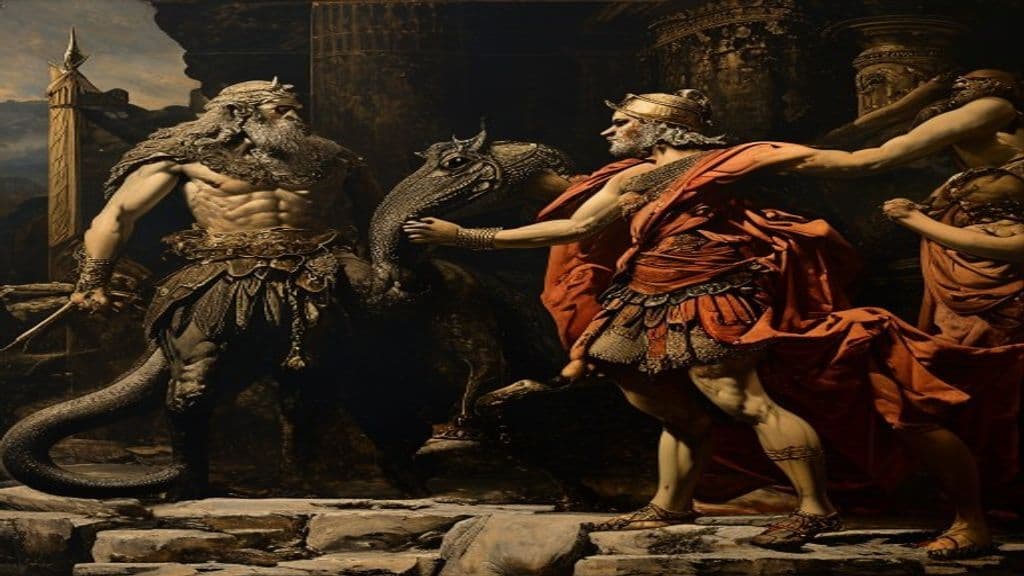
The term 'Abas' functions as an anthroponym in Greek myth rather than denoting a single origin. Individual bearers include: (1) Abas, king of Argos (a royal figure in the Argive genealogical cycle); (2) Abas, son of Poseidon and Arethusa, a Thracian-born founder who gave his name to the Abantians/Abantes and migrated to rule in Euboea; (3) Abas, son of Metaneira (in one version), a boy who mocked the wandering Demeter and was changed into a lizard (this metamorphosis narrative is alternatively told of a boy named Ascalabus with mother Misme in other traditions); (4) Abas, son of Melampus, an Argive seer in the prophetic lineage of Melampus; (5) various martial and attendant figures called Abas who serve as defenders of Thebes, companions of heroes such as Perseus, Diomedes, and Aeneas, a centaur present at the wedding of Pirithous and Hippodamia, and a servant/watchman of King Lycomedes on Scyros. These disparate genealogies and episodes derive from a range of classical authors and scholiasts summarized in the available sources.
No single physical description unites all bearers of the name. Descriptions follow the individual's narrative role: the metamorphosed boy is explicitly transformed into a lizard in the Demeter episode; one Abas is a centaur (implying the conventional half-man, half-horse form); royal, seer, attendant, and warrior Abases are described only by their social roles and actions in the surviving summaries rather than by distinctive corporeal traits.
Bearer-specific, generally mortal capacities consistent with their narrative roles. Abas son of Poseidon functions as a dynastic founder and king who leads migrations and rules (founding the Abantians/Abantes in Euboea). Abas son of Melampus is placed in the prophetic tradition (a seer), though no discrete prophetic acts are preserved in the provided summaries. Several Abases act as warriors and defenders who engage in battle and may be slain by named opponents; others serve as attendants or watchkeepers (e.g., the servant of Lycomedes who reports approaching ships). The metamorphosed youth exhibits the outcome of divine transformation rather than an innate supernatural ability.
Weaknesses
- otherNot applicable (name-bearers are mortal figures; no collective weaknesses are attested)
Wards
- otherNot applicable (no warding practices associated with the name are recorded)

Kitsune
Fox spirits of Japanese mythology — intelligent, long-lived beings who gain additional tails (up to nine) as they age and grow in power. They serve as messengers of the god Inari and as powerful tricksters.

Kappa
A water-dwelling imp of Japanese folklore with a bowl of water on its head. Mischievous but bound by strict codes of politeness; dangerous near rivers.

Iblis
The primordial deceiver in Islamic theology; a jinn who refused God's command to bow before Adam and was expelled from heaven. The source of all temptation and whispered suggestion.
*Péh₂usōn (reconstructed)
Péh₂usōn is a hypothetical Proto‑Indo‑European pastoral guardian reconstructed by comparative scholars from parallels in Greek and Vedic traditions. Proposed as a Graeco‑Aryan ancestor‑figure, the reconstruction describes a protector of flocks, roads, and travellers rather than an attested historical cultic personality.
Aba (disambiguation / name-form)
Aba is a polyvalent name-form attested across many unrelated contexts (place names, personal names, animal names, and brief mythological listings). The provided sources do not support a single, coherent supernatural entity called "Aba" and offer no descriptive or ritual material for such a being.
Abandinus
Abandinus is a locally attested Romano‑Celtic theonym known from a single inscribed bronze feather (votive object) dedicated at Godmanchester (the Roman fort Durovigutum) in Cambridgeshire. Scholars interpret him as a local god or male spirit tied to a specific place and possibly associated with a nearby spring or stream; this association is tentative and based on etymological readings of the name.
Abarbarea
Abarbarea is a name attested in classical Greek and Roman sources for freshwater nymphs (naiads). The name appears for at least two individual mythic figures — a naiad wife of Bucolion and a naiad counted among ancestors of the Tyrians — and Hesychius records plural forms that may indicate the name was also used as a class-name (Abarbareai / Abarbalaiai).
Abderus
Abderus (Ancient Greek: Ἄβδηρος, romanized Ábdēros) is a mortal heroic figure in Greek myth closely associated with Heracles, remembered as the youth left in charge of the Mares of Diomedes who was killed by them. He functions as an eponymous local/divine-hero ancestor for the city of Abdera and received funerary commemoration and athletic agones at his tomb.
Abellio
Abellio is a theonym attested in Roman‑period inscriptions from the Comminges area of the Pyrenees and reported as worshipped in the Garonne Valley of ancient Gallia Aquitania. Surviving evidence is limited to a small number of inscriptions; scholars have variously hypothesized solar or arboreal associations and compared the name to forms of Apollo or to Celtic Belenus, but the deity's precise role in local cosmology remains uncertain.
Abnoba
Abnoba is a Gaulish theonym and toponym attested in Roman-era sources and inscriptions: a localized deity associated with woods, springs and the sources of rivers (notably the Danube) and simultaneously the name applied to a mountain or mountain range in the Black Forest/Baar/Odenwald region. Roman altars equate her with Diana, reflecting syncretic cult practice in frontier provinces.
Abomination of Desolation
An apocalyptic prophetic phrase originating in the Book of Daniel designating a profaning thing or act that renders the Jerusalem Temple cult desolate; later reused in the Synoptic Gospels as an eschatological sign prompting urgent flight. The term denotes ritual/cultic impurity (Hebrew shiqquts) and is variously interpreted as pagan offerings or altar, a foreign cult statue, or (in some New Testament readings) an acting agent.
Aborigines (mythology)
A mytho-historical label used in Roman and general reference sources to denote the oldest inhabitants of a region (specifically central Italy in the cited Roman context). The term functions as an identity/category for original human populations rather than as a characterized supernatural being in the provided sources.
Absyrtus
Absyrtus (Ancient Greek: Ἄψυρτος) is a Colchian prince in the Greek Argonautic cycle, son of King Aeëtes and brother or half-brother of Medea. He appears in variant traditions either as a companion taken by Medea during her flight with Jason and murdered/dismembered to delay pursuit, or as a pursuer sent by Aeëtes who is overtaken and slain by Jason; his death functions as a key narrative device in the escape from Colchis.
Abundantia
Abundantia is the Roman divine personification of abundance and material plenty, used primarily in imperial propaganda and public iconography to signify secure grain supplies, wealth, and the promise of a 'Golden Age' under the emperor. She also appears in later medieval European folklore as Domina Abundia / Dame Habonde, a household benefactor in accounts condemned by ecclesiastical writers.
Acacallis
Acacallis (Ancient Greek: Ἀκακαλλίς; also Acalle) is a mythological princess of Crete in Greek tradition, daughter of King Minos and Pasiphae. She functions primarily as a dynastic and etiological figure: in varying accounts she is mother, by gods such as Hermes (Mercury) or Apollo, of eponymous or founder-figures like Cydon (founder of Cydonia), Miletus, or Lydon/ Lydus.
Community Record
- [1]Abas (mythology) — Wikipedia. Wikipedia, 'Abas (mythology)' (summary of classical sources including Apollodorus, Ovid, Homer, Pausanias, Hyginus, Statius, Antoninus Liberalis).wiki
- [2]LP0047 Labors End (archive). Archive item referenced in research notes (contextual collection).other
- [3]For The Record #249 - Bush-Whacked (archive). Archive item referenced in research notes (included in supplied material list).other
- [4]Lecture Series #9 - What Does the 'W' in George W. Bush Stand For? (archive). Archive item referenced in research notes (included in supplied material list).other
- [5]Abas (disambiguation). Wikipedia, 'Abas' (disambiguation) — lists multiple uses of the name including mythological persons.wiki
- [6]Abas (son of Lynceus). Wikipedia, 'Abas (son of Lynceus)' — identifies Abas as the twelfth king of Argos, great-grandfather of Perseus, founder of Abae and Argos Pelasgikon, and notes Hera's favour and a blessed shield (excerpt truncated in source).wiki
- [7]Abas (mythology). Wikipedia, 'Abas (mythology)' — gives the Ancient Greek name Ἄβας (gen.: Ἄβαντος), glosses the name as 'guileless' or 'good-hearted', and notes the name belongs to multiple figures including two companions of Aeneas.wiki
- [8]Abas (Wikidata). Wikidata entry for 'Abas' (aggregated identifiers for name uses and persons).wiki