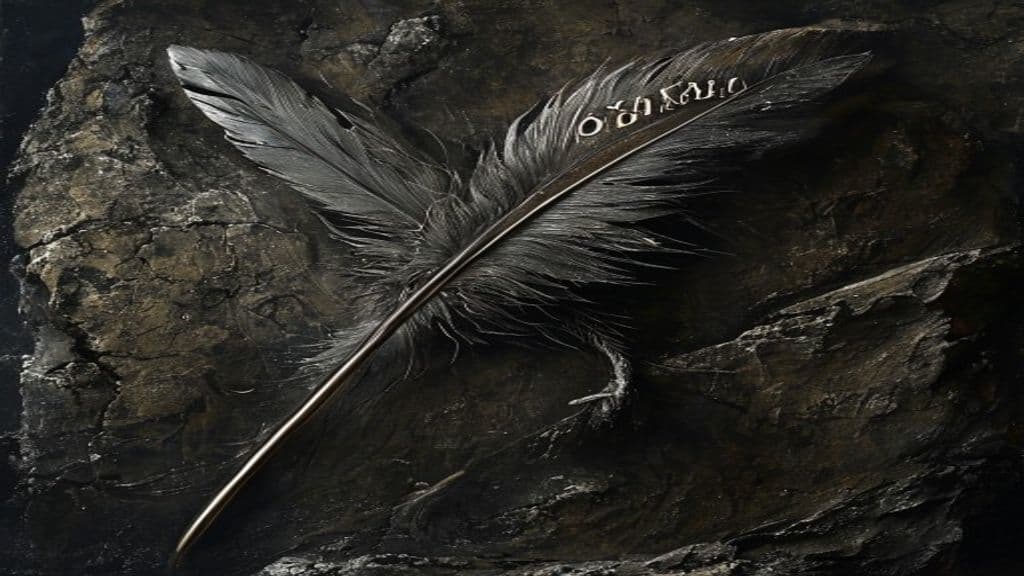
Abandinus is not attested in any surviving mythic narrative. He is known only from a single votive inscription found at Godmanchester, and scholars interpret him as a local Romano‑Celtic god or male spirit worshipped at that settlement during the Romano‑Celtic period. The name survives epigraphically and has been the subject of linguistic hypotheses linking it either to verbal roots (suggesting an agentive meaning) or to a hydronymic element associating the theonym with a river or spring.
No iconography or descriptive portrait of Abandinus is preserved. The sole physical evidence is an inscribed bronze feather (described in the source as a votive object/altarstone) bearing the inscription DEO ABANDINO VATIAVCVS D S D, which records a dedication to the deity by an individual named Vatiacus. Apart from this object, no bodily depiction or attributes are attested.
No powers, deeds, or behaviors are recorded for Abandinus in the surviving evidence. Any suggestion that he governed springs, streams, healing, binding, or song is speculative: such hypotheses derive from etymological readings of the name (one analysis links elements meaning 'to sing/rejoice' or 'to bind', another links a hydronym *abon- 'river') and from the findspot near a crossing and probable water feature. The sources themselves provide no direct attestations of abilities.
Weaknesses
- otherNo weaknesses attested in sources
Wards
- otherNo warding practices attested in sources
Abarbarea
Abarbarea is a name attested in classical Greek and Roman sources for freshwater nymphs (naiads). The name appears for at least two individual mythic figures — a naiad wife of Bucolion and a naiad counted among ancestors of the Tyrians — and Hesychius records plural forms that may indicate the name was also used as a class-name (Abarbareai / Abarbalaiai).
Abarta (Ábartach)
Abarta (also Ábartach) is a figure of Irish myth who, in surviving accounts, tricks Fionn mac Cumhaill's warriors by giving them a supernatural grey horse that bears them into the Otherworld. Sources variably identify him as a member of the Tuatha Dé Danann or as a Fomorian; after the incident he is compelled to release the captured warriors and is refused entry to the Fianna.
Abas
Abas (Ancient Greek: Ἄβας, gen.: Ἄβαντος) is not a single mythic being but a recurring personal name borne by multiple mortals and minor mythic figures in Greek epic and genealogical traditions — kings, founders, seers, warriors, attendants, a centaur, and a youth transformed by a goddess. The name is glossed in the sources as 'guileless' or 'good-hearted' and appears across Argive, Theban, Trojan, Euboean, and other local cycles.
Abcán (Abhcán)
Abcán (modern spelling Abhcán) is a named dwarf poet and musician of the Tuatha Dé Danann in Irish myth. He appears in a small number of narratives as a musician whose art has soporific power and as the ferryman who brings the goddess Ruad from the Otherworld to the human world.
Abellio
Abellio is a theonym attested in Roman‑period inscriptions from the Comminges area of the Pyrenees and reported as worshipped in the Garonne Valley of ancient Gallia Aquitania. Surviving evidence is limited to a small number of inscriptions; scholars have variously hypothesized solar or arboreal associations and compared the name to forms of Apollo or to Celtic Belenus, but the deity's precise role in local cosmology remains uncertain.
Abhean
Abhean is a named poet of the Tuatha Dé Danann in medieval Irish literature, described as a poet in particular of Lugh and recorded as having been killed by Óengus before Midir in a poem by Fland Mainistreach preserved in the Lebor Gabála Érenn.
Abnoba
Abnoba is a Gaulish theonym and toponym attested in Roman-era sources and inscriptions: a localized deity associated with woods, springs and the sources of rivers (notably the Danube) and simultaneously the name applied to a mountain or mountain range in the Black Forest/Baar/Odenwald region. Roman altars equate her with Diana, reflecting syncretic cult practice in frontier provinces.
Aborigines (mythology)
A mytho-historical label used in Roman and general reference sources to denote the oldest inhabitants of a region (specifically central Italy in the cited Roman context). The term functions as an identity/category for original human populations rather than as a characterized supernatural being in the provided sources.
Abundantia
Abundantia is the Roman divine personification of abundance and material plenty, used primarily in imperial propaganda and public iconography to signify secure grain supplies, wealth, and the promise of a 'Golden Age' under the emperor. She also appears in later medieval European folklore as Domina Abundia / Dame Habonde, a household benefactor in accounts condemned by ecclesiastical writers.
Acamas
Acamas (Ancient Greek: Ἀκάμας) is a personal name recurrent in ancient Greek narrative traditions applied to multiple human characters (warriors, princes, suitors), once to a Cyclops, and once as a hound's name. Rather than a single supernatural entity, bearers of the name appear episodically across the Trojan War, Theseid, and Theban cycles as mortal actors whose deeds intersect with gods and fate.
Acantha
Acantha (Ancient Greek: Ἀκάνθα, 'thorn') is a late or secondary mythological figure known from modern retellings as a nymph transformed into the acanthus plant. The tale that she scratched Apollo and was changed into a spiny-leaved plant is not attested in surviving classical corpora and appears to be a modern compilation or invention rather than a firmly documented ancient myth.
Accolon
Accolon is a mortal knight of the Arthurian court, presented in the Post-Vulgate Merlin tradition and Malory's Le Morte d'Arthur as Morgan le Fay's paramour and instrument in a plot to supplant King Arthur; his tale centers on enchanted weapons (Excalibur and its scabbard), love-manipulation, and a tragic duel with Arthur.
Community Record
- [1]Abandinus (Wikipedia). Wikipedia: Abandinus — entry on attestation, inscription text, site context, and etymological interpretations; inscription quoted as 'DEO ABANDINO VATIAVCVS D S D' with the translation given in the article.wiki
- [2]Abandinus (Wikidata). Wikidata: Abandinus — brief classification as 'Celtic god'.wiki
- [3]Wishful Thinking (archive.org blurb). Archive.org: modern literary mention noting Abandinus as a little-known Celtic deity; cited to show contemporary cultural reuse but provides no historical ritual detail.other