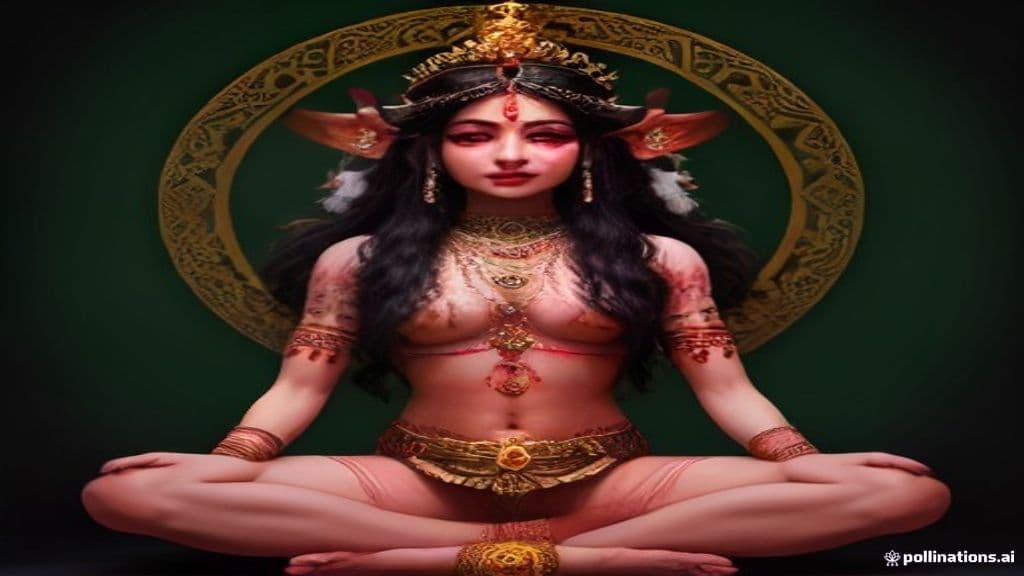
In Shakta theological accounts cited in the sources, Adi Shakti is identified as Mahadevi or Adi Parashakti, the supreme goddess who is the ultimate reality or Para Brahman. Shakta texts call her Mulaprakriti (primordial nature) and describe the major goddesses (notably Parvati, Lakshmi, Sarasvati, Gayatri and Radha in a cited schema of five primary forms) as manifestations of this single ground of being. Other powerful goddess-forms such as Durga, Kali and Tripura Sundari are similarly equated with Adi Shakti or worshiped as her highest aspect; through these identifications the theology presents the Goddess as the origin, creative principle and sustaining ground of the cosmos.
No single canonical iconography is specified in the provided excerpts; instead Adi Shakti is represented through the varied, established imagery of the major goddesses with whom she is identified. Popular and devotional sources treat forms such as Durga, Kali, Tripura Sundari, and local shrine manifestations (e.g., Tara at the Tara Tarini Adi Shakti Peetha) as visual expressions of the one Supreme Goddess. Thus representations vary by regional and sectarian tradition and by which goddess-aspect is being invoked.
Sources describe Adi Shakti in metaphysical and theological terms rather than as a folk creature with a catalogue of tricks. She is described as the primordial and most powerful energy in the universe, the creative and active principle that underlies and animates beings (present in the "vital airs") and even the energizing force in divine weapons. Theological functions attested include creation, manifestation of other deities (all gods/goddesses as her manifestations in Shaktism), and sustaining power; devotional sources portray her as an invoked presence accessed through mantra and puja rather than as an adversarial force.
*Péh₂usōn (reconstructed)
Péh₂usōn is a hypothetical Proto‑Indo‑European pastoral guardian reconstructed by comparative scholars from parallels in Greek and Vedic traditions. Proposed as a Graeco‑Aryan ancestor‑figure, the reconstruction describes a protector of flocks, roads, and travellers rather than an attested historical cultic personality.
Abhimanyu
Abhimanyu is a youthful Kuru/Pandava warrior-hero in the Sanskrit epic Mahābhārata. Son of Arjuna and Subhadra, he is famed for entering the Chakravyuha battle formation on the thirteenth day of the Kurukshetra War and dying at age sixteen; his posthumous son Parikshit continues the Kuru line.
Achyuta
Achyuta (Sanskrit: अच्युत, acyuta) is primarily an epithet/theonym in Vaishnava Hindu tradition applied to Vishnu and Krishna, signifying the divine quality of being 'not fallen' — immutable, infallible, and imperishable. It functions as a devotional name in scripture, liturgy, and Pancharatra lists of divine emanations rather than as an autonomous folkloric spirit.
Acintya
Acintya is an Indonesian Hindu theological-symbolic representation of the ineffable supreme divine principle. In Balinese and Javanese practice it functions as a way to make ultimate reality present in ritual and art—often aniconically as an empty throne (padmasana) or anthropomorphically as a naked, flame-surrounded figure—rather than as a narrative, intervening deity.
Adi (asura)
Adi is attested in modern reference works as the name of an Asura who 'appears in the Matsya Purāṇa.' Beyond this single-line citation in secondary sources, no descriptive material about the figure is provided in the supplied research notes.
Adi Vinayaka
Adi Vinayaka (Ādi Vināyaka; also called Nara Mukha Vinayaka) is a named iconographic and devotional form of the Hindu god Ganesha portraying the deity with a human head, described in sources as the form before the episode of decapitation by Shiva. It is rarely worshipped and appears in a small number of South Indian shrines and in devotional/musical repertoires.
Aditi
Aditi is a major Vedic goddess in Hindu tradition who personifies the boundless, infinite cosmic principle and functions as the maternal matrix from which many celestial deities (the Ādityas and other groups) are born. In the Vedic hymns she is invoked as a protective liberator who guards petitioners, provides wealth and safety, and frees devotees from hindrances such as sin and sickness.
Agastya
Agastya (also Agathiyar/Agasti) is a revered Vedic and later-period Indian rishi (sage) figure credited in textual traditions as an inspired seer, ascetic, teacher, culture-founder, and attributed author of Vedic, Puranic and Tamil works; in South Indian tradition he is associated with origins of Tamil grammar and Siddha medicine and is identified astronomically with the star Canopus.
Aghasura
Aghasura is an asura from the Vaishnava/Hindu narrative tradition (notably the Srimad‑Bhāgavatam) who, at the command of Kamsa, assumed the form of a vast serpent to ambush Kṛṣṇa and the cowherd boys in Vṛndāvana. The episode demonstrates Kṛṣṇa’s protective, divine power as he enters and destroys the demon from within.
Agiya Baital
The fire-form of the Vetala — a cremation ground spirit of UP and Bihar that manifests as a wandering flame rather than a corpse-inhabitor, leading night travellers off roads and into marshland or flames with a dancing fire that seems always just ahead.
Agneya / Āgneyī
Āgneyī (feminine) or Āgneya (masculine adjective) is a Vedic–Puranic divine figure and ritual principle tied to the fire-god Agni and the southeastern direction. In textual traditions she appears both as a personified daughter/shakti of Agni and as an adjectival/technical term applied to fire-consecrated things (direction, astra, etc.). She also occurs as the name Agneya (or Anala) among items revealed in a Shaiva-Agamic list associated with the Aghora face of Sadashiva.
Agni
Agni is the Vedic personification of fire in Hindu tradition: a sacred, mediating principle that manifests as terrestrial fire, atmospheric lightning, and celestial sun, and that receives and conveys sacrificial offerings. Prominent in the Rigvedic corpus, Agni functions as sanctifier, witness of rites of passage, and a transformational inner principle in later Upanishadic literature.
Community Record
- [1]Mahadevi (Wikipedia — Adi Shakti / Mahadevi summary). Wikipedia: 'Mahadevi, also referred to as Mahamaya and Adi Parashakti, is the supreme goddess in Hinduism... In Shakta texts, Mahadevi is mentioned as Mulaprakriti, having five primary forms—Parvati, Lakshmi, Sarasvati, Gayatri and Radha, collectively known as Panchaprakriti.'wiki
- [2]Tara Tarini Adi Shakti Peetha — pilgrimage page. Pilgrimage page: 'Adi Shakti, as per Hindu scriptures, is considered the ultimate and the most powerful energy in the entire universe. She is present in every living being in the vital airs, She is present as the energy in the weapons of Vishnu...'other
- [3]Mother Divine (Adi Shakti / Adya Shakti summary). Summary: 'The Adi Shakti is often equated with the Adya Shakti, Maha, Kali... Therefore even Durga is often worshiped as the highest Adya or Adi-Shakti. Similar titles are Parama Shakti, Maha Shakti and Mahadevi.'other
- [4]Adi Shakti mantra resources (modern devotional/instructional). Modern mantra resource: devotional explanations and recitation examples presenting Adi Shakti invocation in meditation practice.other
- [5]Adi Shakti mantra (modern practice example). Contemporary devotional/meditation page giving mantra practice and interpretation for invoking Adi Shakti.other
- [6]Graphemica entry — adi shakti symbol character. Character/glyph reference showing usage of a named symbol 'adi shakti' in modern encoding/glyph contexts (distinct from theological content).other