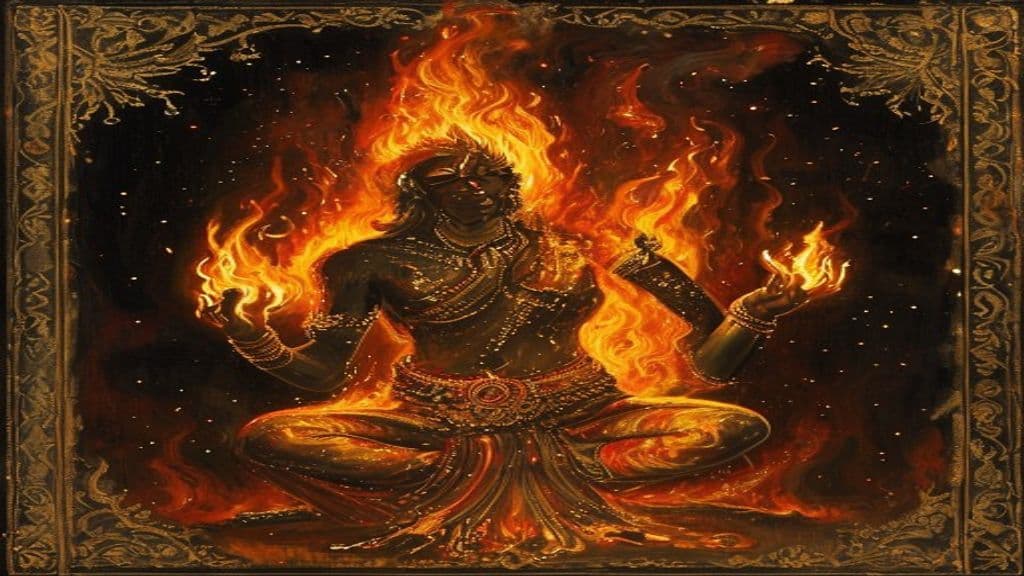
Agni is attested from the earliest Vedic layer (notably the Rigveda) as one of the principal invoked deities. Etymologically deriving from Proto‑Indo‑European *h₁n̥gʷnis (cognate with Latin ignis, Lithuanian ugnis, Old Slavic огнь, etc.), Agni is described in Vedic and Brahmanical texts as arising as the primal fire and as the first to appear in the universe (traditional etymologies in the Brahmanas derive his name from notions of 'first' and of movement). Over time his conceptual role evolves: in the Vedic period he is predominantly an external sacrificial god and mediator; in Upanishadic and post‑Vedic literature his identity is increasingly internalized and metaphysical, becoming a metaphor for inner transformative energy, knowledge, and an immortal principle in humans. The Vedic motif of Agni's triple presence (terrestrial hearth fire, atmospheric lightning, and celestial sun) underpins his role as messenger between humans and the gods.
Sources supplied do not record a single fixed anthropomorphic iconography but Vedic hymns and later descriptions portray Agni with luminous, flame‑related imagery: epithets such as Pāvaka (sanctifier), Havyavāhana (bearer of sacrificial butter), Saptajihvi (having seven tongues/flames), Chitrabhānu (variegated light), Jvalana (ever‑glowing) and Dhumaketu (crowned with smoke/fire) present a poetic picture of a radiant, tongued/crowned flame. Temple tradition places Agni as guardian of the southeast corner, further associating him with directional and architectural loci. Thus the textual appearance is best described as a radiant, multiform fire — tongued, crowned, and luminous — rather than a single standardized human figure (iconographic specifics are not given in the supplied extracts).
Textual sources describe Agni primarily in functional, ritual, and cosmological terms rather than as a catalogue of combative powers. He is the ritual consumer and transformer of offerings (Hutāśana), the mouth of the gods who conveys havis through the homa (votive/sacrificial) ritual (Havyavāhana), and therefore a mediator/messenger between humans and deities due to his triple presence (hearth, atmosphere/lightning, and sun). He sanctifies and witnesses rites of passage (for example the Saptapadi wedding rite and the Upanayana initiation), participates in household and sacrificial life (hearth fire, altar fire, cremation pyre), and functions metaphysically as the power that consumes ignorance and brings illumination, the fire of rebirth, and digestive/inner fire. Epithets and contexts imply rapid consumption (many‑tongued flame), purifying action, and a life‑transforming role, but sources in the provided material focus on ritual and symbolic operations rather than discrete 'magical' capacities.
*Péh₂usōn (reconstructed)
Péh₂usōn is a hypothetical Proto‑Indo‑European pastoral guardian reconstructed by comparative scholars from parallels in Greek and Vedic traditions. Proposed as a Graeco‑Aryan ancestor‑figure, the reconstruction describes a protector of flocks, roads, and travellers rather than an attested historical cultic personality.
Abhimanyu
Abhimanyu is a youthful Kuru/Pandava warrior-hero in the Sanskrit epic Mahābhārata. Son of Arjuna and Subhadra, he is famed for entering the Chakravyuha battle formation on the thirteenth day of the Kurukshetra War and dying at age sixteen; his posthumous son Parikshit continues the Kuru line.
Abhinandananātha
Abhinandananātha is the fourth Tīrthaṅkara (ford-maker) of the current Jain cosmic age (avasarpini). Traditional accounts place his birth in Ayodhyā to the Ikshvāku (Solar) dynasty, describe his renunciation and attainment of omniscience beneath a priyangu tree, and record his liberation on Mount Śikharjī.
Acala
Acala (Sanskrit: अचल, 'The Immovable') is a wrathful protective deity (dharmapala) in Vajrayāna and East Asian esoteric Buddhism, classed among the Wisdom Kings (Vidyārāja). He functions as a ritual focus for visualization and mantra practice intended to remove obstacles and bind or destroy hostile forces.
Acalanātha (Acala / Achala)
Acalanātha (also Acala or Achala) is a wrathful deity and dharmapāla — a protector of the Dharma — prominent in Vajrayana and East Asian Mahayana Buddhist contexts. Presented as a fierce, non‑human or semi‑divine protector-figure, Acalanātha functions to defend the teaching and practitioners by removing obstacles and confronting threats to the transmission and practice of Buddhism.
Achyuta
Achyuta (Sanskrit: अच्युत, acyuta) is primarily an epithet/theonym in Vaishnava Hindu tradition applied to Vishnu and Krishna, signifying the divine quality of being 'not fallen' — immutable, infallible, and imperishable. It functions as a devotional name in scripture, liturgy, and Pancharatra lists of divine emanations rather than as an autonomous folkloric spirit.
Acintya
Acintya is an Indonesian Hindu theological-symbolic representation of the ineffable supreme divine principle. In Balinese and Javanese practice it functions as a way to make ultimate reality present in ritual and art—often aniconically as an empty throne (padmasana) or anthropomorphically as a naked, flame-surrounded figure—rather than as a narrative, intervening deity.
Adi (asura)
Adi is attested in modern reference works as the name of an Asura who 'appears in the Matsya Purāṇa.' Beyond this single-line citation in secondary sources, no descriptive material about the figure is provided in the supplied research notes.
Adi Shakti
Adi Shakti (also Adi Parashakti, Mahadevi, Adya Shakti) is the primordial feminine power in Hindu/Shakta theology, regarded as the ultimate reality (Para Brahman) and the source from which all goddesses and gods manifest. She is both an impersonal cosmic principle (Mulaprakriti) and a focus of devotional invocation in temples, mantras, and pilgrimage sites such as Shakti Peethas.
Adi Vinayaka
Adi Vinayaka (Ādi Vināyaka; also called Nara Mukha Vinayaka) is a named iconographic and devotional form of the Hindu god Ganesha portraying the deity with a human head, described in sources as the form before the episode of decapitation by Shiva. It is rarely worshipped and appears in a small number of South Indian shrines and in devotional/musical repertoires.
Aditi
Aditi is a major Vedic goddess in Hindu tradition who personifies the boundless, infinite cosmic principle and functions as the maternal matrix from which many celestial deities (the Ādityas and other groups) are born. In the Vedic hymns she is invoked as a protective liberator who guards petitioners, provides wealth and safety, and frees devotees from hindrances such as sin and sickness.
Agastya
Agastya (also Agathiyar/Agasti) is a revered Vedic and later-period Indian rishi (sage) figure credited in textual traditions as an inspired seer, ascetic, teacher, culture-founder, and attributed author of Vedic, Puranic and Tamil works; in South Indian tradition he is associated with origins of Tamil grammar and Siddha medicine and is identified astronomically with the star Canopus.
Community Record
- [1]Agni — Wikipedia. Wikipedia contributors, 'Agni,' Wikipedia, The Free Encyclopedia, https://en.wikipedia.org/wiki/Agniwiki
- [2]Agni — Mythology & Folklore of the World (India entry). H. A. Guerber (ed.), 'Agni,' Encyclopedia of Indian Myth and Folklore (excerpt), http://mythfolklore.net/india/encyclopedia/agni.htmfolk