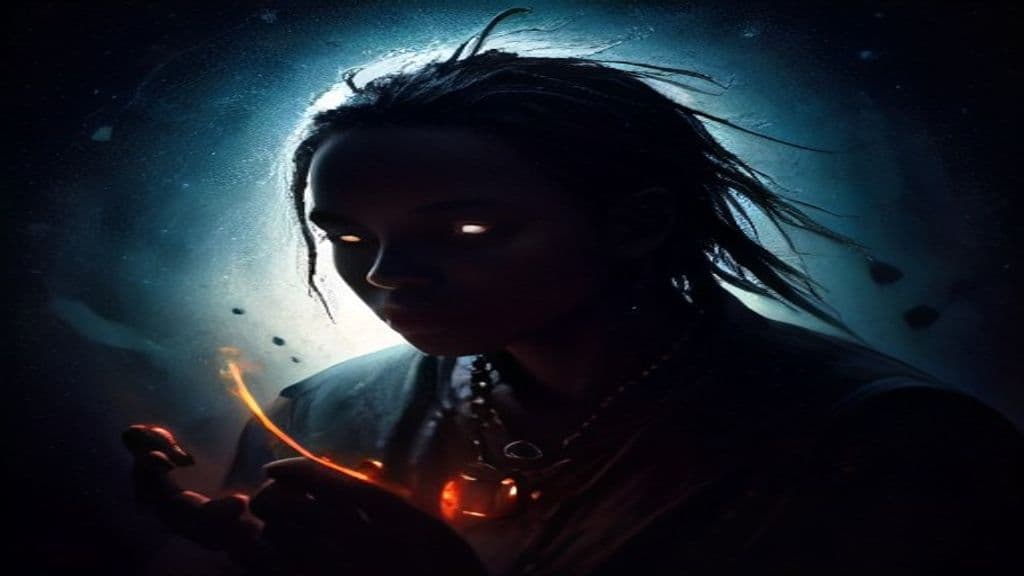
The Adze is associated with witchcraft among the Ewe. A witch may host an Adze willingly, sending it forth to harm enemies, but an uninvited Adze also wanders the night looking for victims on its own. When captured, the Adze takes a horrific humanoid form.
By night, a firefly that slips through the tiniest gaps — keyholes, cracks, woven walls — to reach sleeping victims. When captured or exposed to sufficient magical force, it reverts to a hunchbacked humanoid with hollow eyes and pitch-black skin.
Squeezes through impossibly small openings in firefly form. Drinks blood, coconut water, and palm oil — preferred prey is young children, especially the beautiful. Possesses humans, causing illness, madness, and misfortune in communities.
Weaknesses
- ritualExposure to strong daylight — it cannot hold firefly form
- ritualTrokosi priests' ritual purification
Wards
- ritualProtective charms (gris-gris) placed at children's bedsides
A ƭat Roog
A term attested in the vocabulary surrounding Roog within the Serer religious system; the provided sources do not supply a clear definitional account of an entity by this exact name. Material available situates the term in the wider context of Serer cosmology in which Roog is the universal supreme deity and ancestor cult (pangool) and priestly mediation (o yaal pangool) structure ritual life.
Abena Mansa
A name attested in a single contemporary Ghanaian blog anecdote as a 'mysterious being'; available sources do not establish Abena Mansa as a coherent, traditional supernatural figure or provide corroborating ethnographic detail.
Abonsam
Abonsam is a malevolent spirit name used in accounts from the Gold Coast (modern Ghana) to explain community-level misfortune such as accidents and disease. When local ritual specialists diagnose Abonsam as the cause, communities perform a prolonged communal expulsion ritual intended to drive the spirit into the sea.
Adze (Folklore)
Vampiric being in Ewe folklore, transforming into human shape upon capture. (Note: 1. Power tier should be Greater, as "deity-level" powers are implied by the ability to possess humans. 2. Add sensory cues (e.g., glowing lights) based on its firefly form. 3. Add weaknesses and wards)
Agbọghọ Mmụọ Masquerade
An Igbo masquerade category—literally 'Maiden Spirits'—in which masked (traditionally male) dancers embody the spirits of deceased unmarried girls, performing idealized adolescent feminine comportment and beauty in annual dry‑season civic ceremonies and at funerals and initiation rites in the Nri–Awka region.
Alusi
Alusi (also spelled arusi) are spirit-agents or divinities in the traditional religion of the Igbo people, each responsible for specific domains such as health, agriculture, rivers, justice, and the sky. They are worshipped and served through localized cults with priests and devotees and are distinct from clan ancestors (Ndichie).
Anansi
The spider trickster god of Akan folklore — cunning, mischievous, and wise. Keeper of stories and teacher of human beings, brought through the slave trade into Caribbean and African-American tradition.
Asanbosam
The Asanbosam (also Sasabonsam, Asasabonsam) is an Akan folkloric humanoid creature that dwells in trees and is described as vampire-like, feeding on people who enter its forest territory and enforcing localized rules of the woodland.
Asase Ya / Asase Afua
Asase Ya (Asase Yaa) or Asase Afua (Asaase Afua) is the Akan personified Earth-deity of fertility, land, truth, peace and the reception of the dead. She appears in a dual-aspect as an aged mother of the dead and as a youthful fertility-bringing woman and is central to agricultural, funerary and truth-rite practices among Akan peoples.
Asase Yaa
Asase Yaa (also Asase Afua, Asaase Yaa, Asaase Afua, Asase Efua, Asaase Aberewa) is the Akan personification of the earth in Ghana and Ivory Coast, regarded as an earth-mother figure associated with fertility, procreation, love, peace, truth, and the dry and lush earth. She is also described in sources as the 'Mother of the Dead' or Mother Earth, occupying a central moral and material place in Akan thought.
Asiman
A nocturnal, shape‑changing predatory luminous spirit known from West African accounts; presented in sources as the Dahomey counterpart to the Ashanti obayifo, capable of inhabiting humans by day and manifesting as phosphorescent lights or a flying ball of light by night.
Ayida Wedo
Ayida Wedo is a primordial rainbow-serpent loa of Haitian Vodou (with counterparts in Fon and Ewe vodun) associated with water, the rainbow, and the elemental forces; she often appears paired with Damballa as the dual cosmic serpent that assisted the creator in forming and upholding the world.
Community Record
- [1]West African Religion. Parrinder, Geoffrey. 1949. West African Religion. Epworth Press.academic
- [2]Vampires of the World. Bunson, Matthew. 1993. The Vampire Encyclopedia. Crown Publishers.folk