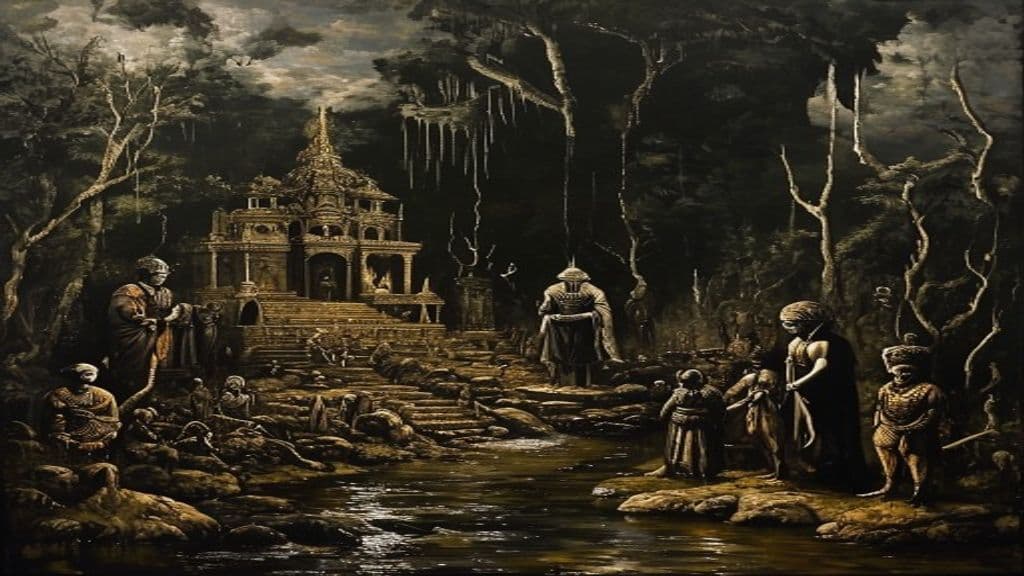
Sources do not record a single unified mythic origin for the class called alusi; rather, alusi are presented as a category of specialized spirit-forces that form part of Igbo cosmology alongside the living, the ancestors (Ndichie), and the unborn. Individual alusi have their own cults and local histories tied to towns, natural places (rivers, the ocean, the land), and social functions (justice, health, agriculture), but the surveyed source does not provide a pan-Igbo creation narrative for the alusi as a group.
The available sources do not provide specific or consistent physical descriptions for alusi as a class. Alusi are treated primarily as functional spirit-divinities with portfolios and cults rather than as described anthropomorphic or zoomorphic beings in the cited material.
Alusi exercise authority over discrete domains and are engaged by humans through worship, priesthood, offerings, and cult service. Examples recorded in the source include Agwu (associated with health, divination, and medicine), Osimmiri (a deity of the primordial ocean), Nne Mmiri / Nmụọ Mmiri (a sea goddess associated with wealth, protection, and healing), Idemmili (a river goddess), Njoku Ji / Ahiajioku (god of agriculture and production), and Ibini Ukpabi (Arochukwu oracle associated with justice and truth). Major alusi are served in towns by a priest assisted by acolytes and devotees, indicating ritual mediation of their influence over fertility, health, prosperity, and social order.
Weaknesses
None recorded.
Wards
- ritualregular cult observance and priestly service

Naga
Divine serpent beings of Hindu, Buddhist, and Jain cosmology — powerful guardians of water, earth, and underground treasures. Revered as deities in South and Southeast Asia.

Lwa (Loa)
Lwa, also spelled loa, are spirit beings venerated within the African diasporic religion of Haitian Vodou and incorporated into some revivalist forms of Louisiana Voodoo. Many lwa identities derive in part from deities of West African traditions, especially Fon and Yoruba.
Will-o'-the-wisp
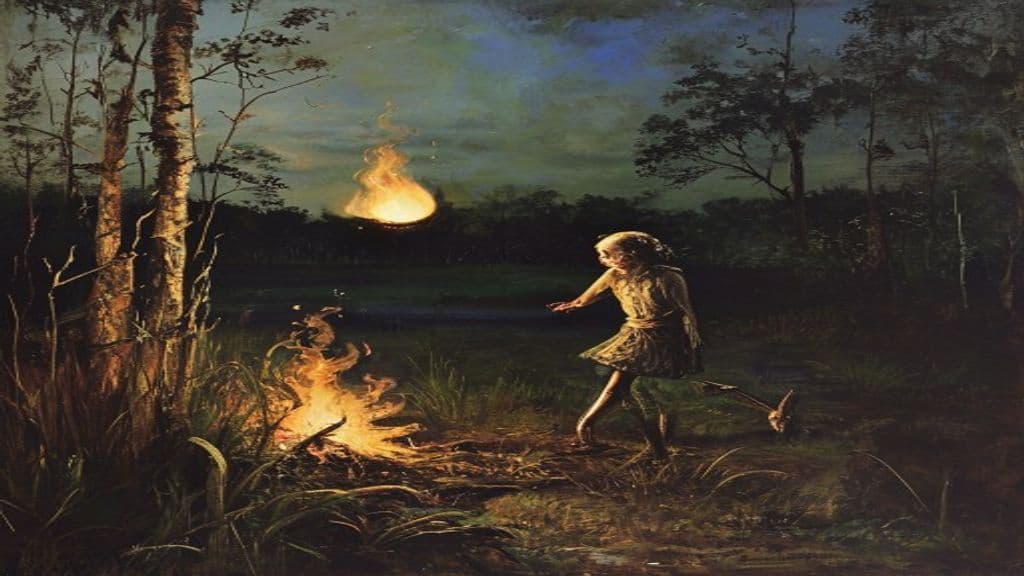
An atmospheric 'ghost light' — a small, mobile, lamp-like light seen at night over marshes, bogs, wet ground, or graveyards. In many cultures the phenomenon is interpreted as a supernatural being or manifestation (wandering nature-spirit, soul of the dead, transformed witch, or treasure-indicator); modern science offers chemiluminescent explanations for some occurrences.
A ƭat Roog
A term attested in the vocabulary surrounding Roog within the Serer religious system; the provided sources do not supply a clear definitional account of an entity by this exact name. Material available situates the term in the wider context of Serer cosmology in which Roog is the universal supreme deity and ancestor cult (pangool) and priestly mediation (o yaal pangool) structure ritual life.
Abena Mansa
A name attested in a single contemporary Ghanaian blog anecdote as a 'mysterious being'; available sources do not establish Abena Mansa as a coherent, traditional supernatural figure or provide corroborating ethnographic detail.
Abonsam
Abonsam is a malevolent spirit name used in accounts from the Gold Coast (modern Ghana) to explain community-level misfortune such as accidents and disease. When local ritual specialists diagnose Abonsam as the cause, communities perform a prolonged communal expulsion ritual intended to drive the spirit into the sea.
Adze
A vampiric firefly of the Ewe people of West Africa — a spirit that takes the form of a firefly by night and a malicious possessing being by day, drinking the blood of sleeping children and spreading disease.
Adze (Folklore)
Vampiric being in Ewe folklore, transforming into human shape upon capture. (Note: 1. Power tier should be Greater, as "deity-level" powers are implied by the ability to possess humans. 2. Add sensory cues (e.g., glowing lights) based on its firefly form. 3. Add weaknesses and wards)
Agbọghọ Mmụọ Masquerade
An Igbo masquerade category—literally 'Maiden Spirits'—in which masked (traditionally male) dancers embody the spirits of deceased unmarried girls, performing idealized adolescent feminine comportment and beauty in annual dry‑season civic ceremonies and at funerals and initiation rites in the Nri–Awka region.
Anansi
The spider trickster god of Akan folklore — cunning, mischievous, and wise. Keeper of stories and teacher of human beings, brought through the slave trade into Caribbean and African-American tradition.
Asanbosam
The Asanbosam (also Sasabonsam, Asasabonsam) is an Akan folkloric humanoid creature that dwells in trees and is described as vampire-like, feeding on people who enter its forest territory and enforcing localized rules of the woodland.
Asase Ya / Asase Afua
Asase Ya (Asase Yaa) or Asase Afua (Asaase Afua) is the Akan personified Earth-deity of fertility, land, truth, peace and the reception of the dead. She appears in a dual-aspect as an aged mother of the dead and as a youthful fertility-bringing woman and is central to agricultural, funerary and truth-rite practices among Akan peoples.
Asase Yaa
Asase Yaa (also Asase Afua, Asaase Yaa, Asaase Afua, Asase Efua, Asaase Aberewa) is the Akan personification of the earth in Ghana and Ivory Coast, regarded as an earth-mother figure associated with fertility, procreation, love, peace, truth, and the dry and lush earth. She is also described in sources as the 'Mother of the Dead' or Mother Earth, occupying a central moral and material place in Akan thought.
Asiman
A nocturnal, shape‑changing predatory luminous spirit known from West African accounts; presented in sources as the Dahomey counterpart to the Ashanti obayifo, capable of inhabiting humans by day and manifesting as phosphorescent lights or a flying ball of light by night.
Ayida Wedo
Ayida Wedo is a primordial rainbow-serpent loa of Haitian Vodou (with counterparts in Fon and Ewe vodun) associated with water, the rainbow, and the elemental forces; she often appears paired with Damballa as the dual cosmic serpent that assisted the creator in forming and upholding the world.
Community Record
- [1]Alusi. Wikipedia contributors. "Alusi." Wikipedia, The Free Encyclopedia. https://en.wikipedia.org/wiki/Alusiwiki