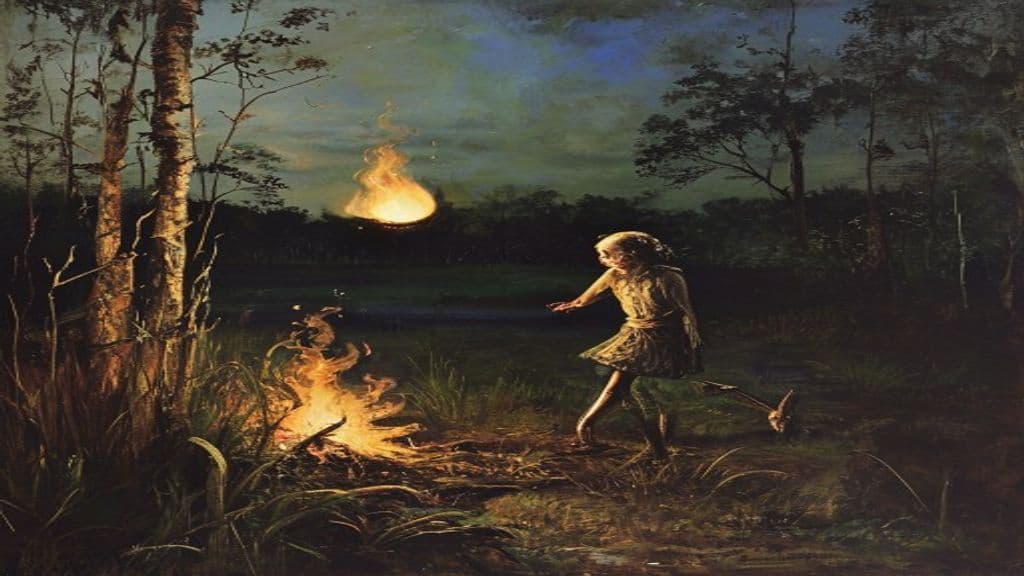
There is no single origin story; names and etiologies vary by region. Folkloric explanations include wandering lights of nature-spirits, souls of the dead (corpse/ghost candles), witches transformed into lights, returned souls performing penance (Louisiana fifollet), markers of buried treasure (Mexico, Paraguay), or serpent-like fiery beings (Brazilian Boi-tatá, from Old Tupi mboî tatá). The learned Latin term ignis fatuus ('foolish fire') appears in early modern literature (16th century) as a translation of German folk names such as Irrlicht rather than as an ancient Roman concept. Modern scientific interpretations (chemiluminescence from gases produced by organic decay) are separate, post-folklore explanations noted alongside traditional accounts.
High-level common features recorded across sources: a small, flickering, dancing or floating ball or lamp-like light seen at night, often hovering low over ground, especially marshes, bogs, or graveyards. Regional variants supply distinct imagery: the Brazilian Boi-tatá described with great fiery eyes and serpentine form (mboî tatá), the Argentine/Uruguayan luz mala as an extremely shiny ball of light floating a few inches above the ground, and graveyard variants referred to as ghost or corpse candles appearing among graves.
Folkloric behaviors include wandering or dancing motion and the tendency to resemble lamps or lanterns that may lead travellers astray or, alternately, guide them; when followed or closely observed the lights commonly seem to fade or disappear. Some local traditions attribute harmful actions to particular variants: the Louisiana fifollet is described as a returned soul that mostly mischiefs but sometimes attacks or sucks the blood of children; the Boi-tatá is said to eat the eyes of animals and corpses and to possess great fiery gaze at night. Other traditions treat the lights as indicators of buried treasure or as omens. Modern scientific accounts interpret some sightings as natural chemiluminescent phenomena caused by oxidation of gases (phosphine, diphosphane, methane) from organic decay.
Weaknesses
- conditionbeing observed closely (commonly causes the light to fade or disappear)
Wards
- othernone attested in provided sources
Abandinus
Abandinus is a locally attested Romano‑Celtic theonym known from a single inscribed bronze feather (votive object) dedicated at Godmanchester (the Roman fort Durovigutum) in Cambridgeshire. Scholars interpret him as a local god or male spirit tied to a specific place and possibly associated with a nearby spring or stream; this association is tentative and based on etymological readings of the name.
Abarta (Ábartach)
Abarta (also Ábartach) is a figure of Irish myth who, in surviving accounts, tricks Fionn mac Cumhaill's warriors by giving them a supernatural grey horse that bears them into the Otherworld. Sources variably identify him as a member of the Tuatha Dé Danann or as a Fomorian; after the incident he is compelled to release the captured warriors and is refused entry to the Fianna.
Abcán (Abhcán)
Abcán (modern spelling Abhcán) is a named dwarf poet and musician of the Tuatha Dé Danann in Irish myth. He appears in a small number of narratives as a musician whose art has soporific power and as the ferryman who brings the goddess Ruad from the Otherworld to the human world.
Abdiel
Abdiel (Hebrew עֲבְדִּיאֵל) is primarily a theophoric Hebrew personal name meaning "servant of El/servant of God," attested once in the Hebrew Bible (1 Chronicles 5:15). In later literature—most notably John Milton's Paradise Lost—Abdiel is reimagined as a faithful seraph who opposes Satan's revolt. The provided sources do not treat Abdiel as an autonomous folkloric spirit type or record rituals or wards associated with the name.
Abhean
Abhean is a named poet of the Tuatha Dé Danann in medieval Irish literature, described as a poet in particular of Lugh and recorded as having been killed by Óengus before Midir in a poem by Fland Mainistreach preserved in the Lebor Gabála Érenn.
Abiel
Abiel is attested in the supplied sources only as a male given name — borne by several historical American individuals and listed as two minor biblical figures. The provided materials contain no evidence presenting Abiel as a supernatural, mythological, or folkloric entity.
Abigail
Abigail is a female figure in the Hebrew Bible portrayed in 1 Samuel 25 as the intelligent and beautiful wife of Nabal who intervenes to prevent David from committing violence; later tradition regards her as one of the Tanakh's seven female prophets and as a model of beauty and wisdom.
Abnoba
Abnoba is a Gaulish theonym and toponym attested in Roman-era sources and inscriptions: a localized deity associated with woods, springs and the sources of rivers (notably the Danube) and simultaneously the name applied to a mountain or mountain range in the Black Forest/Baar/Odenwald region. Roman altars equate her with Diana, reflecting syncretic cult practice in frontier provinces.
Accolon
Accolon is a mortal knight of the Arthurian court, presented in the Post-Vulgate Merlin tradition and Malory's Le Morte d'Arthur as Morgan le Fay's paramour and instrument in a plot to supplant King Arthur; his tale centers on enchanted weapons (Excalibur and its scabbard), love-manipulation, and a tragic duel with Arthur.
Achall
Achall is an eponymous mortal woman in the Ulster Cycle of early Irish literature whose grief-induced death is given as the origin of the hill-name Achall (identified with the modern Hill of Skryne). She appears as a genealogical and etiological figure tied to Tara and later legendary events at the hill, rather than as a recurring supernatural agent.
Achtland
Achtland is a figure from Irish tradition who, according to the surviving account, was a mortal woman famed for rejecting mortal suitors who married a member of the Tuatha Dé Danann and crossed into the síde to become immortal as his wife.
Adar Llwch Gwin
Legendary large, intelligent birds from Welsh tradition said to understand human speech and obey their master's commands; best known for tearing their master Drudwas ap Tryffin to pieces when bound by a literal order in an Arthurian battle narrative. The term later came to be applied to raptors and metaphorically to brave men in medieval Welsh poetry.
Community Record
- [1]Will-o'-the-wisp. Wikipedia, 'Will-o'-the-wisp'.wiki
- [2]will o' the wisp (Wikidata). Wikidata entry Q160569.wiki
- [3]The Anatomy of Melancholy. Burton, Robert. 1621. The Anatomy of Melancholy. Clarendon Press.literary
- [4]Folklore of the British Isles. Briggs, Katharine. 1976. An Encyclopedia of Fairies. Pantheon Books.academic