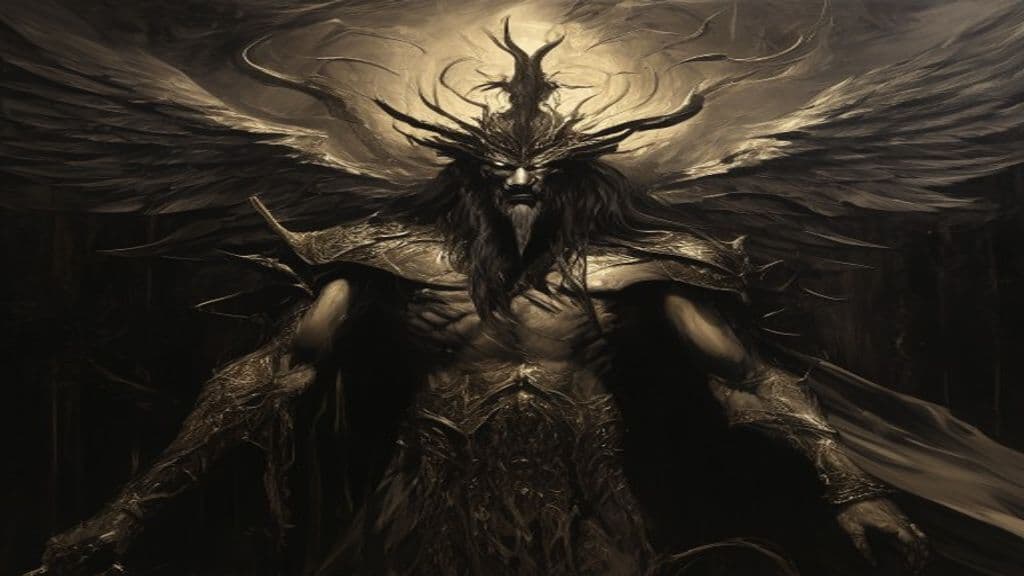
In the earliest Zoroastrian texts (the Gathas) the destructive tendency appears not as a fixed divine person but as an angra-qualified mainyu — a 'destructive' or 'malignant' mentality that, by an exercise of will, chooses deceit (Druj) over truth/order (Asha). Over subsequent doctrinal development (notably Pahlavi/Sasanian scholasticism) this tendency is increasingly personified and set as the cosmic antagonist to the constructive principle (Spenta Mainyu) and to Ahura Mazda, yet interpreters insist that Ahriman lacks genuine divine creatorship and is ontologically deficient, parasitic, and destined for annihilation at the final restoration (Frashokereti).
The provided sources do not supply a consistent corporeal or iconographic description. The Gathas treat the phenomenon as abstract — a mentality or spirit — while later Pahlavi writings personify the antagonist rhetorically and theologically; however, the emphasis in the material is on metaphysical and moral character rather than on physical form or standardized iconography.
Sources describe Angra Mainyu/Ahriman as lacking authentic generative power: he does not create substantive reality but functions by corrupting, misaligning, and introducing parasitic or destructive effects into the created world (e.g., death, disease, pestilence, moral decay). Early texts emphasize his capacity for moral choice (opting for Druj), while later exegesis stresses his ignorance, blindness, and ontological deficiency. His role is primarily adversarial — the source of deceit and disorder whose influence must be resisted by ritual and ethical action.
Weaknesses
- conditionOntological non-existence (described as ultimately non-being in Pahlavi sources)
Wards
- ritualLiturgical recitation (Yasna and related rites)
- symbolTextual execration (writing the name upside-down or striking it through in Pahlavi manuscripts)
Ab-Zohr
Ab-Zohr is the culminating rite of the Zoroastrian Yasna service: a formal offering to the waters (Aban/Apas) that creates the consecrated liquid parahaoma and functions to purify, strengthen, and atone for damage done to waters. It is a ritual action rather than an independent supernatural being.
Aban (Āb/Ābān)
Aban (Avestan apas; Middle Persian āb/ābān) is the collective, sacred principle of the waters in Zoroastrian cosmology — both the element water and its personified hypostases (the Apas/Ahuranis). Aban functions as a primordial, life-giving creation, a calendrical and liturgical focus (day-name, month-name, Abanagan feast), and a ritual object of veneration (ape zaothra, Aban Yasht) rather than a malign force to be expelled.
Aban Yasht
The Aban Yasht is a hymn from the Persian tradition that praises Anahita, a goddess associated with water, fertility, and wisdom. It consists of 132 stanzas and is part of the 21 Yashts collection. (Note: - Power tier should be "Primordial" or possibly "Cosmic", given that it's a hymn of great spiritual significance and associated with a goddess. - The article incorrectly states that Anahita is associa)
Abtin
Abtin (Persian: آبتین), attested also as Athwya, is a mythic ancestral figure in Iranian tradition described in Avestan and later epic literature as one of a small set of formative human-like figures involved in preparing the corporeal world and as the father of the epic hero-king Fereydun in the Shahnama.
Adur Burzen-Mihr
Adur Burzen-Mihr is a consecrated Atash Behram — one of the three Great Fires of late antique Sasanian Zoroastrianism — historically associated with the farmer social estate and with a cultic location in northeastern Iran. Medieval texts (e.g., the Bundahishn) and later summaries record it as a major pilgrimage fire with legendary associations of protection and miraculous efficacy; its documentary history after the early Islamic period is unclear.
Adur Farnbag
Adur Farnbag is one of the three Great or Royal fires in the Zoroastrian ritual/topographical system of pre‑Islamic Iran. Presented in the sources as a continuously tended sacred fire housed in a temple, it is attested in secondary accounts as a focus of cultic activity, miracle stories, and association with elite ritual geography in the Parthian–Sasanian eras.
Adur Gushnasp
Adur Gushnasp (Middle Persian: Ādur ī Gušnasp; New Persian: Āzargušnasp) is a pre-Islamic Zoroastrian Great Fire — one of the three highest grade sacred temple fires (Atash Behram) of Sasanian-era Iran. Housed at the temple-site historically called Shiz (modern Takht-e Soleymān, Adurbadagan), it functioned as a continuously tended cultic fire, a pilgrimage destination, and a focal point of royal patronage and warrior-class identity.
Aeshma
Aeshma is the Zoroastrian hypostasis of wrath — a fiendish being who personifies rage and functions as an ontological opponent to Ahuric principles and ritual discipline. In scripture and later tradition he distracts worship, foments violence and drunkenness, can be driven off by prayer or by divine agents such as Sraosha and Mithra, and will be overthrown or flee at the final renovation.
Afrasiab
Afrasiab is the legendary king and arch-enemy of Iran in Iranian epic and Zoroastrian-influenced tradition. Attested from the Avestan Fraŋrasyan through Middle Persian and the Shahnameh, he functions as a powerful Turanian ruler associated with sorcery, subterranean dwellings, and opposition to Iranian heroes and divine agencies.
Aghrirat
Aghrirat is a named Turanian noble and peacemaker in the Shahnameh and Iranian mythic tradition, presented as a son of Pashang and brother of Afrasiab and Garsivaz. He is notable for his kind and gentle character and for attempting, largely unsuccessfully, to end the hostilities between Iran and Turan.
Ahura
Ahura is an Avestan term that designates a class of divinities in the Indo‑Iranian and Zoroastrian tradition, marking the sacred ‘lords’ who are to be reverenced and opposed to the rejected class of daevas. In Zoroastrian scripture the label functions as both a technical category and an honorific applied to high divine figures such as Ahura Mazda, Mithra, and Apam Napat.
Ahura Mazda
Ahura Mazda is the principal deity of Zoroastrian tradition, invoked as the supreme source of goodness and wisdom who instructs Zoroaster and commands helper spirits (yazatas). Historically attested in Achaemenid royal inscriptions, Ahura Mazda occupies a central role in Zoroastrian liturgy (notably the Yasna) and in various Iranian religious formulations.
Community Record
- [1]Ahriman. Wikipedia entry 'Ahriman' (summary of Avestan and Pahlavi treatments)wiki
- [2]Angra Mainyu (Wikidata). Wikidata: Angra Mainyuother
- [3]Ahura and ahriman war. Archive.org item referencing modern textual uses of the name 'Ahriman'other
- [4]DON’ T EXPECT THE SAME LEVEL OF INTEGRITY IN RETURN. Archive.org item showing contemporary repurposing of the name 'Ahriman'other
- [5]Zombie Book Covers 2. Archive.org item containing cultural/ad hoc uses of the name 'Ahriman'other