
Son of Oileus (leader of the Locrians), Ajax the Lesser appears in the Trojan War cycle as commander of the Locrian contingent (forty ships in the Iliad). He fights among the Achaeans at Troy; in accounts of the sack of Troy he committed a sacrilegious assault on Cassandra while she sought refuge at Athena's temple. That transgression provoked the anger of Athena (and, through divine action, Poseidon and Zeus), which results in storms, shipwreck, and his death at sea. Variants report his corpse washed ashore and buried by Thetis, or his spirit dwelling afterwards on the island of Leuce; the Opuntian Locrians maintained cultic remembrance of him after his death.
Source descriptions vary. Dares (as cited in summaries) calls him "stocky, powerfully built, swarthy, a pleasant person, and brave." Malalas (as reported in later summaries) describes him as "tall, strong, tawny, squinting, good nose, curly black hair, thick beard, long face, daring warrior, magnanimous, a womanizer." In Homeric tradition he is described in martial terms: wearing a linen cuirass (linothorax), skilled at spear-throwing, and swift of foot (ranked next to Achilles in speed in some passages). The corpus preserves divergent physical portrayals rather than a single standardized iconography.
Ajax is depicted as a highly capable mortal combatant rather than a supernatural agent: leader of the Locrian contingent (forty ships), noted for spear-throwing, speed (often counted among the fleetest Achaeans after Achilles), and audacity in battle. He committed a sacrilegious act against a supplicant in Athena's precinct (removing Cassandra; some sources explicitly allege rape — accounts vary), and his impiety draws direct divine response: Athena's wrath leads to the wrecking of his ship (thunderbolt or divine storm), and in some variants Poseidon splits the rock on which Ajax clings, causing his drowning after Ajax boasts he can defy the gods. Thus his narrative role emphasizes martial excellence combined with hubristic impiety that earns lethal divine punishment.
Weaknesses
- conditionvulnerability to divine wrath (Athena, Poseidon, Zeus)
- conditionmoral/hubris exposure — impiety (violation of sanctuary) provokes punishment
Wards
- ritualsanctuary/asylum at an altar (supplication)
- ritualsacrificial appeasement
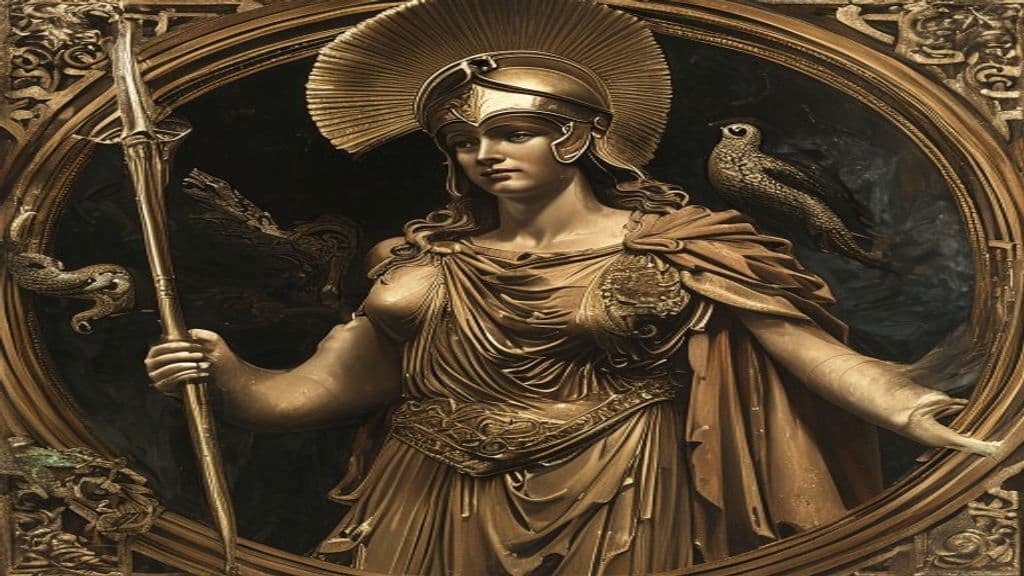
Athena
Athena is a major ancient Greek goddess associated with wisdom, handicraft (notably weaving), and warfare; she serves as a tutelary protector of cities—most prominently Athens—and is central to myth, cult, and civic identity in the Greek world.

Poseidon
Poseidon is a principal deity of the ancient Greek pantheon, counted among the Twelve Olympians; he presides over the sea, storms, earthquakes and horses and functions as protector of seafarers and guardian of cities and colonies.

Ajax the Great
Ajax the Great (Ancient Greek: Αἴας, Aíās) is a mortal heroic figure of the Trojan War cycle, famed as a towering, steadfast Greek champion and defender of the Achaean ships. Prominent in Homer’s Iliad, he is portrayed as second only to Achilles in martial standing and as a paragon of defensive strength and reliability.
*Péh₂usōn (reconstructed)
Péh₂usōn is a hypothetical Proto‑Indo‑European pastoral guardian reconstructed by comparative scholars from parallels in Greek and Vedic traditions. Proposed as a Graeco‑Aryan ancestor‑figure, the reconstruction describes a protector of flocks, roads, and travellers rather than an attested historical cultic personality.
Aba (disambiguation / name-form)
Aba is a polyvalent name-form attested across many unrelated contexts (place names, personal names, animal names, and brief mythological listings). The provided sources do not support a single, coherent supernatural entity called "Aba" and offer no descriptive or ritual material for such a being.
Abarbarea
Abarbarea is a name attested in classical Greek and Roman sources for freshwater nymphs (naiads). The name appears for at least two individual mythic figures — a naiad wife of Bucolion and a naiad counted among ancestors of the Tyrians — and Hesychius records plural forms that may indicate the name was also used as a class-name (Abarbareai / Abarbalaiai).
Abas
Abas (Ancient Greek: Ἄβας, gen.: Ἄβαντος) is not a single mythic being but a recurring personal name borne by multiple mortals and minor mythic figures in Greek epic and genealogical traditions — kings, founders, seers, warriors, attendants, a centaur, and a youth transformed by a goddess. The name is glossed in the sources as 'guileless' or 'good-hearted' and appears across Argive, Theban, Trojan, Euboean, and other local cycles.
Abderus
Abderus (Ancient Greek: Ἄβδηρος, romanized Ábdēros) is a mortal heroic figure in Greek myth closely associated with Heracles, remembered as the youth left in charge of the Mares of Diomedes who was killed by them. He functions as an eponymous local/divine-hero ancestor for the city of Abdera and received funerary commemoration and athletic agones at his tomb.
Abomination of Desolation
An apocalyptic prophetic phrase originating in the Book of Daniel designating a profaning thing or act that renders the Jerusalem Temple cult desolate; later reused in the Synoptic Gospels as an eschatological sign prompting urgent flight. The term denotes ritual/cultic impurity (Hebrew shiqquts) and is variously interpreted as pagan offerings or altar, a foreign cult statue, or (in some New Testament readings) an acting agent.
Absyrtus
Absyrtus (Ancient Greek: Ἄψυρτος) is a Colchian prince in the Greek Argonautic cycle, son of King Aeëtes and brother or half-brother of Medea. He appears in variant traditions either as a companion taken by Medea during her flight with Jason and murdered/dismembered to delay pursuit, or as a pursuer sent by Aeëtes who is overtaken and slain by Jason; his death functions as a key narrative device in the escape from Colchis.
Acacallis
Acacallis (Ancient Greek: Ἀκακαλλίς; also Acalle) is a mythological princess of Crete in Greek tradition, daughter of King Minos and Pasiphae. She functions primarily as a dynastic and etiological figure: in varying accounts she is mother, by gods such as Hermes (Mercury) or Apollo, of eponymous or founder-figures like Cydon (founder of Cydonia), Miletus, or Lydon/ Lydus.
Acacus
Acacus (Ancient Greek: Ἄκακος) is, in Arcadian Greek tradition, a mortal eponymous founder-king of Acacesium and is remembered as the foster-father who reared the infant Hermes (Mercury) in that local tradition. He is presented in genealogies as a son of Lycaon and functions as a local ancestral/onomastic figure rather than a supernatural spirit.
Academus
Academus (Greek: Akádemos / Hekádemos) is an Attic hero-eponym tied to a sacred grove (Akademeia) on the Cephissus near Athens. In myth he revealed where Helen was hidden to the Dioskouroi, an act said to have saved the city, and the place bearing his name became a long-lived sacred precinct, later the site of Plato's Academy.
Acamas
Acamas (Ancient Greek: Ἀκάμας) is a personal name recurrent in ancient Greek narrative traditions applied to multiple human characters (warriors, princes, suitors), once to a Cyclops, and once as a hound's name. Rather than a single supernatural entity, bearers of the name appear episodically across the Trojan War, Theseid, and Theban cycles as mortal actors whose deeds intersect with gods and fate.
Acantha
Acantha (Ancient Greek: Ἀκάνθα, 'thorn') is a late or secondary mythological figure known from modern retellings as a nymph transformed into the acanthus plant. The tale that she scratched Apollo and was changed into a spiny-leaved plant is not attested in surviving classical corpora and appears to be a modern compilation or invention rather than a firmly documented ancient myth.
Community Record
- [1]Ajax the Lesser - Wikipedia. Wikipedia contributors, 'Ajax the Lesser', Wikipedia, The Free Encyclopedia.wiki
- [2]Ajax the Lesser - Citizendium. Citizendium, 'Ajax the Lesser'.wiki
- [3]Ajax the Lesser - Greek Legends and Myths (summary). GreekLegendsAndMyths.com, summary article on Ajax the Lesser.other
- [4]Ajax the Lesser - Villains Wiki (summary). Villains Wiki / Fandom, 'Ajax the Lesser'.other
- [5]Whither Ajax? – The Imaginative Universal (blog commentary). Imaginative Universal blog, 'Whither Ajax?'.other
- [6]The Tragedy of Ajax - Classical Wisdom (essay). Classical Wisdom essay 'The Tragedy of Ajax' (Sean).other