No preserved pre-Islamic birth-myth for al-ʻUzzā survives in the supplied sources. Later exegetical commentary recorded in Islamic tradition (e.g., at-Tabarī citing ʿAbdullāh ibn ʿAbbās) links her name to the epithet al-ʿAzīz ('the Mighty') from Qurʾanic theonyms, but this is a medieval interpretive derivation rather than an attested pre-Islamic origin account.
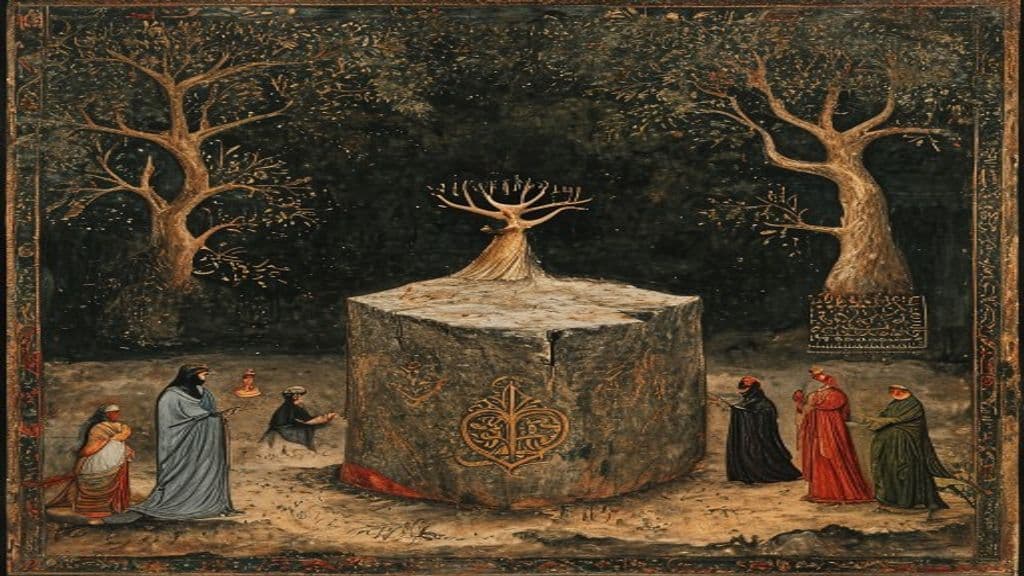
The supplied sources preserve no consistent, reliable pre-Islamic iconography. Tradition records a stone cube at Nakhlah and three sacred trees as cult foci. A late medieval narrative in Ibn al-Kalbī's Kitāb al-Aṣnām describes a dramatic apparition of 'a woman with wild hair' at Nakhlah during the reported destruction of the shrine, but that specific visual episode is attested only in Ibn al-Kalbī and is treated as uncertain by later commentators and modern scholarship.
Surviving accounts present al-ʻUzzā primarily in cultic terms: an object of invocation for intercession and protection, the recipient of offerings and sacrifices, and the focus of oracular consultation at a shrine-house (per Ibn al-Kalbī's summary). The dramatic episode in Ibn al-Kalbī in which a woman appears to defend the sacred trees frames a human-like manifestation in that narrative, but beyond protective intercession and oracular function no wider supernatural powers are preserved in the supplied material.
Weaknesses
- ritualDestruction of cult objects and shrine
- ritualCutting down sacred trees (Nakhlah)
- conditionAbolition of cult by replacement with Islamic monotheistic practices
Wards
- ritualOfferings and sacrifices to solicit favor
- otherOath-swearing and anthroponymic devotion (e.g., names like ʿAbdu l-ʻUzzá)
- ritualDestruction/eradication campaign (as recorded in Islamic narratives)
A'ra
No reliable sources in the supplied material establish A'ra as a distinct supernatural entity. The token "A'ra" appears in the dataset as (a) part of general references to pre-Islamic Arabian deities, (b) a modern Korean female given name (A-ra/아라), and (c) an Arabic toponym (A'ra, one village merged into Ar'ara).
Abgal
Abgal (Arabic: أبغال) is a pre‑Islamic local tutelary figure attested in the Palmyrene cultural sphere (c. 154–270 AD), primarily venerated by nomadic Arab groups in the Syrian desert. He appears in inscriptions and reliefs as one of a constellation of armed, mounted protective deities associated with caravan and nomadic protection, though no ritual texts survive in the cited sources.
Al-Abyad
Al-Abyad (Arabic: al‑Abyad, "the White") appears in modern compilations and anecdotal references as a named jinn or epithet within Arabic/Islamic discourse on jinn. The corpus consists mainly of contemporary lists, forum posts, popular articles, and a polemical anecdote; no coherent classical origin myth or primary ritual tradition for Al-Abyad is attested in the supplied materials.
Al-Jānn
Al-Jānn (jann) is a pre-Adamite, ancestral category invoked in Arabic-Islamic exegetical, hadithic, mystical, and folkloric materials to designate an earlier class of sentient beings—progenitors of later jinn—said to be created of fire, to have once inhabited and sometimes ruled the earth, and to stand in a liminal ontological position between angels and humans.
Al-Kuz
Al-Kuz is not attested in the supplied corpus as a supernatural being; the name appears as the designation of an impact crater on Saturn's moon Enceladus and as the name of a literary character (one of the barber’s six brothers) in "The Hunchback's Tale" from The Book of One Thousand and One Nights.
Al-Mi'raj
A mythical creature from medieval Arabic literature, described as a one-horned hare or rabbit. (Note: * Power tier: Given the lack of information on abilities and powers, it's too early to assign a power tier. However, considering its classification as a "mythical creature" in medieval Arabic literatu)
Aladdin
Aladdin is the human protagonist of a Middle Eastern folktale (ATU 561) who rises from poverty to wealth after acquiring a magical ring and a magical lamp that house spirit-agents. Although widely associated with The Thousand and One Nights, the tale entered that corpus via Antoine Galland from a story told by the Syrian storyteller Hanna Diyab rather than from the earliest Arabic Nights manuscripts.
Alexander the Great in Arabic tradition
Legendary figure with divine authority, expanded empire from Greece to northwestern India. (Note: - Power tier: Change Primordial to Ancient (Alexander is a legendary figure with divine authority, but his abilities are not on a cosmic level) - Abilities: Add that Alexander's ability to inspire loy)
Allah
Allah is the Arabic-language term for the singular monotheistic God of the Abrahamic tradition as used in Islamic theology and by Arabic-speaking Jews and Christians. Linguistically related to other West Semitic divine names, the term in Islamic usage functions as God's unique proper name (Lafẓ al-Jalālah) and denotes the transcendent creator and sovereign of the universe.
Allat (Al-Lat)
Allat (Al-Lat) is a pre-Islamic Arabian goddess attested across the Arabian Peninsula and in wider ancient Near Eastern onomastics. In the supplied sources she is recorded as one of the triad of goddesses worshipped in Arabia (with Al‑Uzza and Manat) and as a cult figure at sites such as al‑Ta'if where her cult-object was a cubic rock.
Amrak
Amrak is not attested in the provided sources as a supernatural being. The lexical string "Amrak" appears across unrelated secular contexts — as a historical regnal name (Amrak Khagan / Ashina Anluo), a Turkish place-name (Çamrak / amrak), titles in modern Arabic-language music, an institutional name/acronym (AMRAK Institute), and as a modern brand/typeface/project name. No folkloric, ritual, or mythological descriptions of an entity called "Amrak" are present in the cited material.
Anqa (ʿanqāʾ)
A singular, marvelous female bird of pre-Islamic and medieval Arab cosmography, the Anqa is described in medieval sources as a remote, extremely long‑lived composite bird associated with wisdom, liminal places (the setting sun, Mount Qaf), and ambivalent moral meanings that range from perfection to calamity.
Community Record
- [1]Al-Uzza - Wikipedia. Wikipedia: 'Al-ʻUzzá or al-ʻUzzā ... was one of the three chief goddesses of Arabian religion in pre-Islamic times...' (accessed source summary provided).wiki
- [2]Kitāb al-Aṣnām (summary in secondary sources, Ibn al-Kalbī). Summary of Ibn al-Kalbī's Book of Idols as presented in the supplied material: descriptions of shrine at Nakhlah, oracular house 'Buss', offerings, and the Nakhlah destruction episode.literary
- [3]Wikidata: Al-ʿUzzá. Wikidata entry cited in the dossier.other
- [4]Archived video listings (contextual modern treatments). Archive: modern critical/polemical video listed in the dossier; noted as not contributing primary cultic ritual detail.other
- [5]Archived video listings (contextual modern treatments). Archive: modern critical/polemical video listed in the dossier; noted as not contributing primary cultic ritual detail.other