
Supplied sources do not record a cosmogonic origin story for the Amarok. 19th-century collector Hinrich Johannes Rink reports that Greenlandic Inuit reserve the word Amarok for this legendary lone wolf, distinguishing it from ordinary wolves; beyond such classificatory remarks the available material does not present a detailed origin myth for the being.
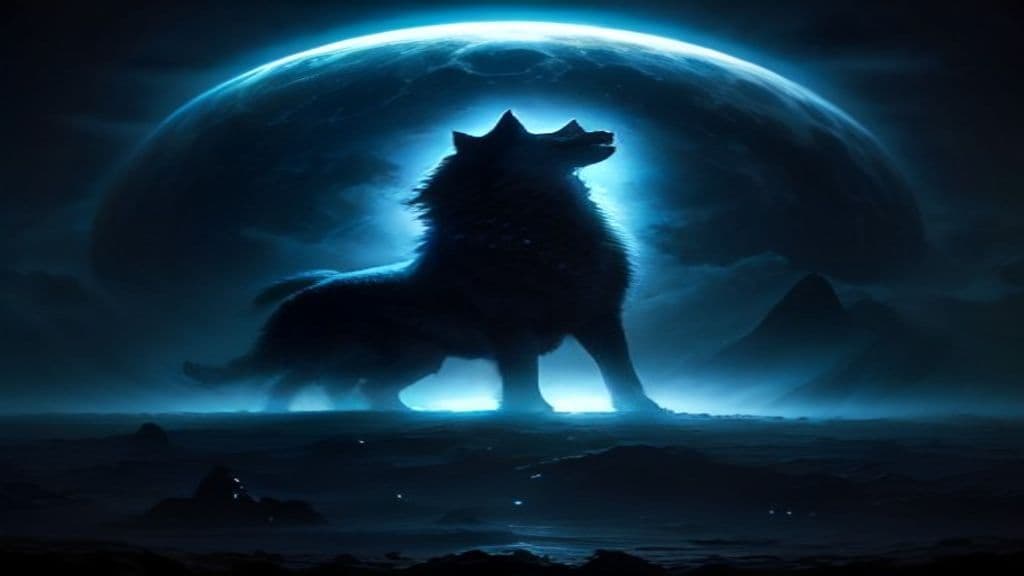
Described in the supplied sources as a gigantic wolf and a solitary hunter. Tales collected by Rink recount feats implying great size and strength (carrying a reindeer, dragging a humanoid from water, wrestling a boy), but do not provide consistent details of coloration, eyes, or fur in the excerpts provided.
Source tales attribute several potent roles to the Amarok. In Rink's collected tales an Amarok wrestles a stunted boy repeatedly, causing small bones to fall from the boy's body and eventually enabling the boy to grow strong enough to defeat bears (a strengthening/initiatory function). In another Rink tale an Amarok described as "from which nothing remains concealed" drags a humanoid form from a lake and the mourner collapses as the Amarok takes his soul, suggesting knowledge of hidden things and a soul-taking capacity. The Amarok is also said to stalk and devour anyone who hunts alone at night. Some versions imply a person can capture or kill an Amarok, indicating it is not absolutely invulnerable in all tales.
Weaknesses
- conditionmay be captured or killed in some tale versions
Wards
- conditionavoid hunting alone at night (behavioral prevention attested in sources)
A'akuluujjusi
A'akuluujjusi is an Inuit primordial creator mother who fashioned the non-human animals and adjusted their physical traits so they could be hunted by people.
Adlet
A category of non-human peoples in Inuit narrative tradition (also rendered Erqigdlet/Irqigdlit) that functions both as a mythic ancestor-race and as dog‑legged antagonists; the term can denote inland native American peoples or half‑canine humanoids depending on regional usage.
Agloolik
Agloolik (Inuktitut: ᐊᒡᓗᓕᒃ) is an Inuit spirit that dwells beneath Arctic sea ice and functions as a tutelary guardian of seals. Hunters and fishermen petition Agloolik for success; prayers before fishing are said to bring blessings of prey.
Ahkiyyini
Ahkiyyini is described in available sources as a skeleton spirit in Inuit folklore, called "the ghost of Alaska" in one account. Accounts report that his movements and the music made with his bones cause tidal waves, earthquakes, and could overturn boats.
Aipaloovik
Aipaloovik is an Inuit sea-associated supernatural being described in available sources as an evil or dangerous water deity linked to death and hazard for fishermen. The figure is described as the opposite of the being Anguta; beyond this brief characterization the cited sources provide no detailed myths, appearance, or ritual corpus.
Akhlut
An Inuit composite, shape‑changing animal‑spirit described in early ethnographic accounts as an orca that can become a wolf on land (and sometimes depicted in later popular media as a wolf‑orca hybrid). Associated with the seashore and ice edge along the Bering Sea, it is portrayed as powerful and dangerous in the cited sources.
Akna
Akna is a female figure named in modern secondary sources as associated with childbirth and motherhood. The provided materials conflate brief mentions linking the name to both Maya and Inuit maternal goddesses; primary Maya iconographic or epigraphic evidence for a distinct Maya Akna is not supplied in the sources.
Akycha
Akycha is identified in the supplied sources as a solar goddess in Inuit mythology. The available materials attest the name and classification but provide no further narrative, iconographic, or ritual detail.
Alignak
Alignak is named in modern reference works as an Inuit deity associated with the moon and with dynamic natural phenomena such as weather, water, tides, eclipses, and earthquakes. The available sources provide only terse domain associations and do not supply narrative, iconographic, or ritual detail.
Amaguq
Amaguq is an Iñupiaq term for 'wolf' that in modern summaries and secondary sources is presented as a wolf spirit or trickster capable of shapeshifting between wolf and humanlike modes. Available sources are brief popular or tertiary accounts; detailed traditional narratives and rituals are not documented in the provided material.
Amautalik
Amautalik is a child‑stealing ogress from Inuit folktale collections and modern retellings. Presented in story collections, illustrated books, graphic novels, and short films, she functions as a monstrous threat who carries away children and haunts communities, and whom protagonists overcome through luck, courage, and ancestral knowledge.
Amikuk
Amikuk is a Yup'ik / Alaskan Inuit spirit-creature associated with the ground and coastal waters; sources describe it as a shapeshifter that lives within the earth, can swim through earth and water, may take human form, and is dangerous to hunters and travelers.
Community Record
- [1]Amarok (wolf) — Wikipedia. Wikipedia contributors, 'Amarok (wolf)', Wikipedia, The Free Encyclopedia.wiki
- [2]Collected tales reported by Hinrich Johannes Rink (19th century). Hinrich Johannes Rink, as cited in summaries of Greenlandic Inuit tales (19th century collections) — recounted tales include the wrestling-strengthening episode and the soul-taking lake episode.folk
- [3]Archive item: Episode #1049: Amarok - Hope (listing). Archive listing referenced in research notes; contains no additional folkloric detail on Amarok beyond the Wikipedia summary.other
- [4]Archive item: Screensaver Dancing Baby (listing). Archive listing referenced in research notes; not a source of Amarok folkloric detail.other