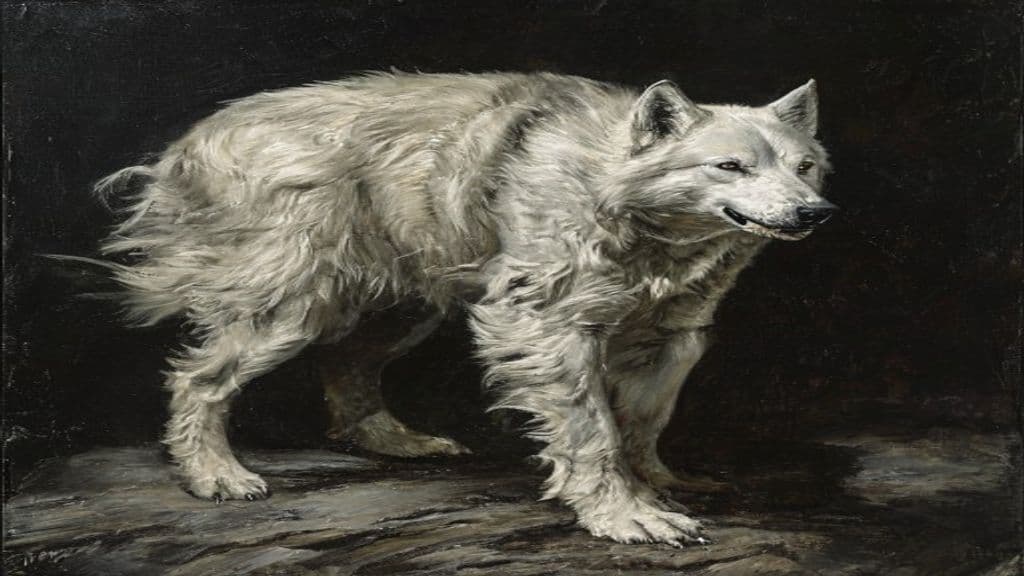
In the Dog Husband cycle recorded by Franz Boas (often titled “The Girl and the Dogs” or “The Origin of the Qavdlunait and Irqigdlit”), a woman (variously named in retellings) marries a dog. Of their ten children, five are ordinary dogs and the others are dog‑bodied humanoids (Adlet). The mother places the dog‑children in a skin boat and sends them across the sea where they become the Qavdlunait (interpreted in Boas’s account as Scandinavian/white ancestors); she sends the Adlet inland, from whom a numerous people springs and are associated with inland native groups. The tale includes motifs of revenge and transformation elsewhere in the cycle (for example, violent acts producing whales or seals in some tellings), and scholars have read the narrative both as an older Dog‑Husband tradition and as a version adapted to incorporate contact with Scandinavian whalers.
Canonical descriptions portray the canine Adlet as having the lower body of a dog (hindquarters and legs) and the upper body of a man (torso and arms). Some accounts depict them as taller than Inuit and white people; other variants stress ordinary dogs as part of the offspring mix, and regional usage varies — Labrador and Hudson Bay communities commonly use 'Adlet' to refer to inland human peoples, while other areas employ Erqigdlit/Irqigdlit for the half‑dog humanoids.
Folkloric attributes emphasize exceptional running speed and an aggressive disposition; encounters with humans are often hostile but are described as usually ending with human victory, implying vulnerability to human force. Some variants ascribe cannibalism to Adlet. Interpretively, the Adlet motif also functions socially: as an ancestral explanation for inland peoples or as a narrative device to account for contact with outsiders (e.g., Scandinavians), so the creature's role combines physical threat with etiological significance.
Weaknesses
- otherNone specified in supplied sources
Wards
- otherNo standardized wards attested in supplied sources
A'akuluujjusi
A'akuluujjusi is an Inuit primordial creator mother who fashioned the non-human animals and adjusted their physical traits so they could be hunted by people.
Agloolik
Agloolik (Inuktitut: ᐊᒡᓗᓕᒃ) is an Inuit spirit that dwells beneath Arctic sea ice and functions as a tutelary guardian of seals. Hunters and fishermen petition Agloolik for success; prayers before fishing are said to bring blessings of prey.
Ahkiyyini
Ahkiyyini is described in available sources as a skeleton spirit in Inuit folklore, called "the ghost of Alaska" in one account. Accounts report that his movements and the music made with his bones cause tidal waves, earthquakes, and could overturn boats.
Aipaloovik
Aipaloovik is an Inuit sea-associated supernatural being described in available sources as an evil or dangerous water deity linked to death and hazard for fishermen. The figure is described as the opposite of the being Anguta; beyond this brief characterization the cited sources provide no detailed myths, appearance, or ritual corpus.
Akhlut
An Inuit composite, shape‑changing animal‑spirit described in early ethnographic accounts as an orca that can become a wolf on land (and sometimes depicted in later popular media as a wolf‑orca hybrid). Associated with the seashore and ice edge along the Bering Sea, it is portrayed as powerful and dangerous in the cited sources.
Akna
Akna is a female figure named in modern secondary sources as associated with childbirth and motherhood. The provided materials conflate brief mentions linking the name to both Maya and Inuit maternal goddesses; primary Maya iconographic or epigraphic evidence for a distinct Maya Akna is not supplied in the sources.
Akycha
Akycha is identified in the supplied sources as a solar goddess in Inuit mythology. The available materials attest the name and classification but provide no further narrative, iconographic, or ritual detail.
Alignak
Alignak is named in modern reference works as an Inuit deity associated with the moon and with dynamic natural phenomena such as weather, water, tides, eclipses, and earthquakes. The available sources provide only terse domain associations and do not supply narrative, iconographic, or ritual detail.
Amaguq
Amaguq is an Iñupiaq term for 'wolf' that in modern summaries and secondary sources is presented as a wolf spirit or trickster capable of shapeshifting between wolf and humanlike modes. Available sources are brief popular or tertiary accounts; detailed traditional narratives and rituals are not documented in the provided material.
Amarok
In Greenlandic Inuit tradition the Amarok (also Amaroq) is a singular, gigantic wolf-like spirit said to hunt alone and to interact powerfully with humans: stalking and devouring lone nocturnal hunters, wresting with humans to bestow strength in Rink's tales, and — in another tale — dragging a humanoid from the water and taking a mourner's soul. The term in some dialects is reserved for this legendary wolf, while other Arctic peoples may use the word for ordinary wolves.
Amautalik
Amautalik is a child‑stealing ogress from Inuit folktale collections and modern retellings. Presented in story collections, illustrated books, graphic novels, and short films, she functions as a monstrous threat who carries away children and haunts communities, and whom protagonists overcome through luck, courage, and ancestral knowledge.
Amikuk
Amikuk is a Yup'ik / Alaskan Inuit spirit-creature associated with the ground and coastal waters; sources describe it as a shapeshifter that lives within the earth, can swim through earth and water, may take human form, and is dangerous to hunters and travelers.
Community Record
- [1]Adlet. Wikipedia contributors, 'Adlet,' Wikipedia, The Free Encyclopediawiki