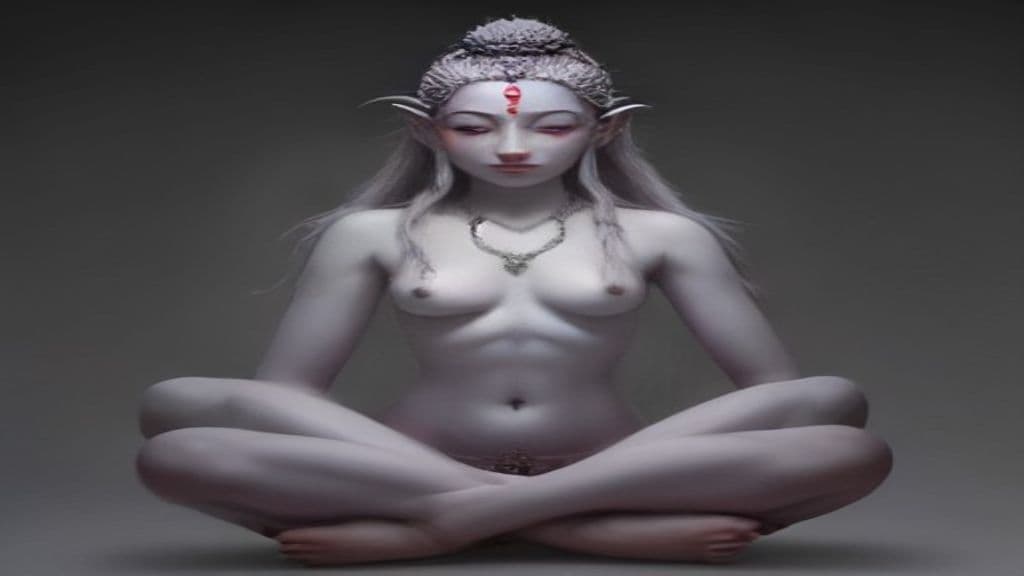
In the Devi Bhagavata Purana and the Kalika Purana, the Dakinis are described as beings created from or adopted into the retinue of the goddess Kali and Chamunda. They occupy the cremation ground shrines of the fierce goddess, tending the pyres and consuming what is left. The term 'Dakini' appears in the Atharva Veda, making these among the oldest documented supernatural entities in the subcontinent.
The 64 Yogini shrines scattered across North India — circular open-air temples at Khajuraho, Hirapur, Ranipur-Jharial — are dedicated to Dakinis and related beings in their role as fierce feminine powers surrounding the central Shiva or Devi figure. Tantric practitioners who sought siddhi (supernatural accomplishment) would visit these shrines at night, particularly on Ashtami and Chaturdashi tithi, to propitiate the Dakinis directly.
In classical iconography, the Dakini is depicted as nude or semi-nude, with wildly disheveled hair, carrying a skull-cup (kapala) filled with blood, a curved blade (khatanga), and wearing a garland of severed heads. Her skin is described as blue-black or deep crimson across different texts — the colours of sky at the moment before a storm.
When encountered at cremation grounds, witnesses across North India describe a gaunt woman running with unnatural speed at the edge of pyre-light, her hair flying, her laughter high and unrecognisable as human.
Dakinis can possess people who trespass on their cremation ground territory, causing violent fits and speaking in the voices of the recently dead through the afflicted person. They are said to steal the life-force (prana) of children and cause progressive wasting illness in those who disturb their domain.
For the tantric siddha who approaches correctly — with the right mantra, offering, and state of mind — the Dakini is a teacher rather than a predator. Classical texts record that a propitiated Dakini grants the ability to travel through space, access hidden knowledge, overcome enemies, and ultimately achieve liberation. The same being that destroys the unprepared illuminates the prepared.

Churel (Chudail)
A South Asian female revenant or vengeful ghost associated with women who die cruelly or unpurified; often said to target male relatives and sometimes described as latching onto trees, producing a tree‑attached tree‑spirit variant in local tales.

Baba Yaga
Baba Yaga is an ambivalent female figure of East Slavic folktale tradition, depicted variously as a fearsome, child-eating crone or as a helpful, maternal donor. She is associated with the deep forest, a hut described as standing on chicken legs, and the motific accoutrements of a mortar and pestle.
*Péh₂usōn (reconstructed)
Péh₂usōn is a hypothetical Proto‑Indo‑European pastoral guardian reconstructed by comparative scholars from parallels in Greek and Vedic traditions. Proposed as a Graeco‑Aryan ancestor‑figure, the reconstruction describes a protector of flocks, roads, and travellers rather than an attested historical cultic personality.
Abhimanyu
Abhimanyu is a youthful Kuru/Pandava warrior-hero in the Sanskrit epic Mahābhārata. Son of Arjuna and Subhadra, he is famed for entering the Chakravyuha battle formation on the thirteenth day of the Kurukshetra War and dying at age sixteen; his posthumous son Parikshit continues the Kuru line.
Acala
Acala (Sanskrit: अचल, 'The Immovable') is a wrathful protective deity (dharmapala) in Vajrayāna and East Asian esoteric Buddhism, classed among the Wisdom Kings (Vidyārāja). He functions as a ritual focus for visualization and mantra practice intended to remove obstacles and bind or destroy hostile forces.
Acalanātha (Acala / Achala)
Acalanātha (also Acala or Achala) is a wrathful deity and dharmapāla — a protector of the Dharma — prominent in Vajrayana and East Asian Mahayana Buddhist contexts. Presented as a fierce, non‑human or semi‑divine protector-figure, Acalanātha functions to defend the teaching and practitioners by removing obstacles and confronting threats to the transmission and practice of Buddhism.
Achyuta
Achyuta (Sanskrit: अच्युत, acyuta) is primarily an epithet/theonym in Vaishnava Hindu tradition applied to Vishnu and Krishna, signifying the divine quality of being 'not fallen' — immutable, infallible, and imperishable. It functions as a devotional name in scripture, liturgy, and Pancharatra lists of divine emanations rather than as an autonomous folkloric spirit.
Acintya
Acintya is an Indonesian Hindu theological-symbolic representation of the ineffable supreme divine principle. In Balinese and Javanese practice it functions as a way to make ultimate reality present in ritual and art—often aniconically as an empty throne (padmasana) or anthropomorphically as a naked, flame-surrounded figure—rather than as a narrative, intervening deity.
Adi (asura)
Adi is attested in modern reference works as the name of an Asura who 'appears in the Matsya Purāṇa.' Beyond this single-line citation in secondary sources, no descriptive material about the figure is provided in the supplied research notes.
Adi Shakti
Adi Shakti (also Adi Parashakti, Mahadevi, Adya Shakti) is the primordial feminine power in Hindu/Shakta theology, regarded as the ultimate reality (Para Brahman) and the source from which all goddesses and gods manifest. She is both an impersonal cosmic principle (Mulaprakriti) and a focus of devotional invocation in temples, mantras, and pilgrimage sites such as Shakti Peethas.
Adi Vinayaka
Adi Vinayaka (Ādi Vināyaka; also called Nara Mukha Vinayaka) is a named iconographic and devotional form of the Hindu god Ganesha portraying the deity with a human head, described in sources as the form before the episode of decapitation by Shiva. It is rarely worshipped and appears in a small number of South Indian shrines and in devotional/musical repertoires.
Aditi
Aditi is a major Vedic goddess in Hindu tradition who personifies the boundless, infinite cosmic principle and functions as the maternal matrix from which many celestial deities (the Ādityas and other groups) are born. In the Vedic hymns she is invoked as a protective liberator who guards petitioners, provides wealth and safety, and frees devotees from hindrances such as sin and sickness.
Agastya
Agastya (also Agathiyar/Agasti) is a revered Vedic and later-period Indian rishi (sage) figure credited in textual traditions as an inspired seer, ascetic, teacher, culture-founder, and attributed author of Vedic, Puranic and Tamil works; in South Indian tradition he is associated with origins of Tamil grammar and Siddha medicine and is identified astronomically with the star Canopus.
Aghasura
Aghasura is an asura from the Vaishnava/Hindu narrative tradition (notably the Srimad‑Bhāgavatam) who, at the command of Kamsa, assumed the form of a vast serpent to ambush Kṛṣṇa and the cowherd boys in Vṛndāvana. The episode demonstrates Kṛṣṇa’s protective, divine power as he enters and destroys the demon from within.
Community Record
- [1]Dakinī. Wikipedia, "Dakini"wiki
- [2]Dakini (Wikidata). Wikidata entry for Dakiniwiki
- [3]Orgyan Chokyi, Himalayan Hermitess. Hermitary, Orgyan Chokyi: Himalayan Hermitess (autobiographical context mentioning Himalayan hermit traditions)literary
- [4]Guru Padmasambhava: Buddha of the Vajrayana. Sahapedia, introduction to Padmasambhava and Vajrayāna contextsother
- [5]Whispers of the Dakini: From Odisha to Tibet, the Rise of Buddhist Tantra. Exotic India Art article on transmission and diffusion of dakini motifsother
- [6]Charnel ground. Wikipedia, "Charnel ground" (notes charnel-ground symbolism in tantric practice)wiki
- [7]Devi Bhagavata Purana — retinue of Kali. Vijnananda (trans.). (1921). Devi Bhagavatam. Sacred Books of the Hindus, Vol. 26. Panini Office, Allahabad.academic
- [8]The 64 Yogini Temples of India. Dehejia, V. (1986). Yogini Cult and Temples: A Tantric Tradition. National Museum, New Delhi.academic
- [9]Hagiographic reference: Naropa described as leader of 100,000 dakinis. Archive excerpt: 'Naropa was "the venerable leader of 100,000 dakinis."'literary
- [10]Visualization of the Refuge Assembly of the Longchen Nyingthik Dzogchen. Archive excerpt: 'They are surrounded by numerous yidam deities of the four tantras, dakinis, and dakas.'; instructions to 'First, visualize yourself in a pure realm, wonderful and pleasing.'literary
- [11]Guide to Dakini Land: The Highest Yoga Tantra Practice of Buddha Vajrayogini. Guide to Dakini Land (bibliographic excerpt; summary: provides detailed instructions on the eleven yogas of generation stage and completion stage meditations)other
- [12]Circling the Sacred Mountain: A Spiritual Adventure Through the Himalayas. Circling the Sacred Mountain (table of contents and chapters referencing 'The Dakini Secret Path,' 'The Cool Grove Charnel Ground,' etc.)literary
- [13]Spiritual Journey Home: Eastern Mysticism to the Western Wall. Spiritual Journey Home (table of contents and chapters including 'Meeting the Dakini: Kathmandu')literary