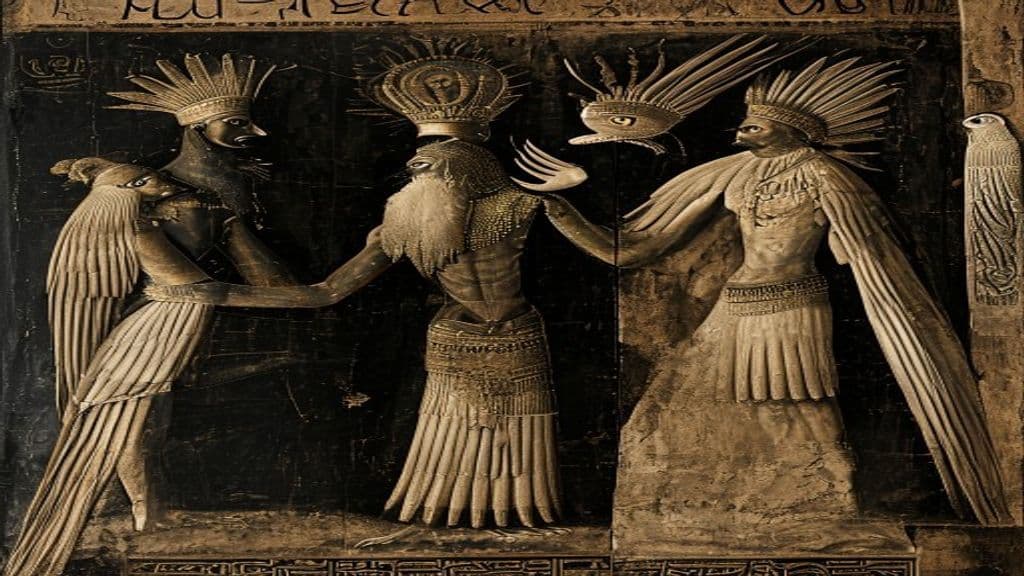
In Mesopotamian textual traditions the apkallu are presented primarily as primeval culture-bringers who transmit arts, rites, and specialized knowledge from the gods (especially Ea/Nudimmud) to humans; a canonical formulation preserves a group of seven antediluvian sages who serve this role. Textual lists (e.g., the Uruk List of Kings and Sages) pair these sages with kings and subsequently continue sequences into postdiluvian lists in which some figures are recast as human ummânu. Later Hellenistic reception (Berossus) retells the tradition with Oannes (Uanna) as a fish-man teacher; names such as Adapa appear in overlapping and disputed relations with Uanna in the sources.
Sources present no single canonical anatomy. In mythic and apotropaic contexts some apkallu are depicted as part-man/part-fish (fish-man hybrids) while other ritual images are bird-headed; postdiluvian sages in lists are sometimes fully human and titled ummânu. Ritual corpora (e.g., Bit meseri) and later summaries describe fish-man and bird-headed figurines used in protective installations, and literary accounts such as Berossus describe the founding fish-man teacher (Oannes/Uanna).
Textual attestations credit the apkallu with transmitting technical and ritual knowledge to humans (teaching crafts, rites, and lore), custodianship of sacred knowledge (texts refer to reading tablets of destiny), and apotropaic efficacy (their images are prescribed in household and cultic protection). They function as intermediaries between gods and humans—agents of Ea/Nudimmud—rather than as simple household spirits, and their status shifts in different textual contexts (demi-godlike in antediluvian accounts; human experts in later lists).
Weaknesses
None recorded.
Wards
- ritualApkallu statuette installation (Bit meseri)
'Ain Samiya Goblet
Silver cup from the Middle Bronze Age I, discovered in a tomb at Ain Samiya. (Note: 1. Power tier should be "None", but add a note explaining that historical artifacts don't fit into the typical power tier classification. 2. Add a description of its appearance based on it being a sil)
*Péh₂usōn (reconstructed)
Péh₂usōn is a hypothetical Proto‑Indo‑European pastoral guardian reconstructed by comparative scholars from parallels in Greek and Vedic traditions. Proposed as a Graeco‑Aryan ancestor‑figure, the reconstruction describes a protector of flocks, roads, and travellers rather than an attested historical cultic personality.
A'annepada
A'annepada (Sumerian cuneiform 𒀀𒀭𒉌𒅆𒊒𒁕; also romanized Aanépàdda) is attested as a historical ruler of the First Dynasty of Ur, flourishing c. 2350 BC. He is recorded in dedicatory and foundation inscriptions as king of Ur and as son of Mesannepada, credited with temple-building and dedication to deities such as Ninhursag and Inanna.
Aba (disambiguation / name-form)
Aba is a polyvalent name-form attested across many unrelated contexts (place names, personal names, animal names, and brief mythological listings). The provided sources do not support a single, coherent supernatural entity called "Aba" and offer no descriptive or ritual material for such a being.
Abarbarea
Abarbarea is a name attested in classical Greek and Roman sources for freshwater nymphs (naiads). The name appears for at least two individual mythic figures — a naiad wife of Bucolion and a naiad counted among ancestors of the Tyrians — and Hesychius records plural forms that may indicate the name was also used as a class-name (Abarbareai / Abarbalaiai).
Abas
Abas (Ancient Greek: Ἄβας, gen.: Ἄβαντος) is not a single mythic being but a recurring personal name borne by multiple mortals and minor mythic figures in Greek epic and genealogical traditions — kings, founders, seers, warriors, attendants, a centaur, and a youth transformed by a goddess. The name is glossed in the sources as 'guileless' or 'good-hearted' and appears across Argive, Theban, Trojan, Euboean, and other local cycles.
Abderus
Abderus (Ancient Greek: Ἄβδηρος, romanized Ábdēros) is a mortal heroic figure in Greek myth closely associated with Heracles, remembered as the youth left in charge of the Mares of Diomedes who was killed by them. He functions as an eponymous local/divine-hero ancestor for the city of Abdera and received funerary commemoration and athletic agones at his tomb.
Abomination of Desolation
An apocalyptic prophetic phrase originating in the Book of Daniel designating a profaning thing or act that renders the Jerusalem Temple cult desolate; later reused in the Synoptic Gospels as an eschatological sign prompting urgent flight. The term denotes ritual/cultic impurity (Hebrew shiqquts) and is variously interpreted as pagan offerings or altar, a foreign cult statue, or (in some New Testament readings) an acting agent.
Absyrtus
Absyrtus (Ancient Greek: Ἄψυρτος) is a Colchian prince in the Greek Argonautic cycle, son of King Aeëtes and brother or half-brother of Medea. He appears in variant traditions either as a companion taken by Medea during her flight with Jason and murdered/dismembered to delay pursuit, or as a pursuer sent by Aeëtes who is overtaken and slain by Jason; his death functions as a key narrative device in the escape from Colchis.
Abu
Abu is a poorly understood Mesopotamian god attested in modern reference summaries. Secondary literature tentatively links him with vegetation and snakes and records that he was often paired with a deity written gu2-la2, but primary details about his cult, iconography, and myths are lacking in the cited sources.
Abzû
Abzû (Sumerian abzû; Akkadian Apsû) is the primordial freshwater abyss in Sumerian–Akkadian cosmology: the deep fresh waters that underlie and surround the earth, source of springs, rivers and ritual holy waters, and a creative principle whose mingling with the salt sea (Tiamat) figures in Mesopotamian cosmogony.
Abī-simtī
Abī-simtī (also rendered Abi-simti, Abisimti) is a named woman attested in third-millennium BCE Mesopotamian documentary and literary texts. She appears in administrative account records as a provider of animals and donor to temple cults and in Sumerian love-song literature as the named beloved/consort addressed by a royal speaker.
Community Record
- [1]Apkallu. Wikipedia, 'Apkallu' article summarizing cuneiform attestations, Bit meseri, Berossus and iconographic types.wiki
- [2]Apkallū (Seven Sages). Livius, 'Apkallū (Seven Sages)' — synthesis of textual evidence on seven sages, lists, and reception.other
- [3]Uruk List of Kings and Sages; Bit meseri; Twenty-One Poultices (textual loci cited). Archive collection 'Apkallu' containing references to primary texts including Uruk Lists, Bit meseri, and the Twenty-One Poultices (LKA No.76) as cited in the research notes.other
- [4]Berossus (Hellenistic reception; Oannes). Summary of Berossus' account of Oannes (Uanna) as a fish-man teacher appearing in Hellenistic reception.wiki
- [5]Adapa. Wikipedia, 'Adapa' article referenced for the overlapping and debated relation between Adapa and apkallu/Uanna traditions.wiki